How Cybersecurity Vendors Build Credibility with CISO Buyers Through Content Marketing
Introduction
Only 5% of organizations fully trust their cybersecurity vendors. The other 95% operate with a constant, low-level anxiety that their security stack might fail them. For a startup trying to sell into the enterprise market, this statistic isn’t a hurdle; it’s a wall. Traditional marketing tactics – generic blogs, broad LinkedIn ads, and consumer-facing influencers – don’t break through this wall. They simply bounce off.
CISOs at mid-market and large enterprises don’t buy based on hype. They buy based on peer validation and verifiable proof. They trust industry peers (64%) far more than vendor claims or analyst reports. When a breach occurs, the board asks about the vendor. If that vendor cannot prove they are trustworthy before a sale or a renewal, the deal dies. This is why startups often stall despite having superior technology – they lack the social proof required to get invited to a meeting.
Paid thought leadership offers a path through this deadlock. It’s not about buying a celebrity endorsement – it’s about aligning with niche practitioners who already speak the language of the CISO. Experts like Christophe Foulon, Jean-Christophe Gaillard, Kayne McGladrey, and Alex Sharpe have earned trust through years of their operational work. Their audiences aren’t consumers; they are the exact decision-makers startups need to reach.
The strategy requires a shift from “broadcasting” to “borrowing.” A startup can’t build a reputation from scratch in six months, but it can inherit a portion of an expert’s credibility. By partnering with these voices, a vendor gains access to private CISO communities, roundtables, and Signal group chats where real buying decisions are discussed. The cost is manageable: a podcast appearance can start at $500, while an in-person keynote might run up to $2,500. The return is access to the 95% of skeptical buyers who live in these private spaces.
Who Are Enterprise CISO Buyers and What Do They Need?
The modern CISO works under a unique pressure: securing the organization while enabling business velocity, all while facing substantial personal liability for failures. This role has changed over time into a “Gen 4” mandate where leaders now govern AI-driven decisions, not just infrastructure, and validate that automated systems do not introduce unmanaged risk. This means that they evaluate vendors not just on feature lists, but on the ability to handle complex, non-deterministic environments. A startup promising a simple fix for a specific vulnerability often misses the mark because it ignores this broader governance reality.
Trust for this buyer is built on verifiable artifacts, not catchy marketing. Independent assessments, certifications like SOC 2 Type II, and documented operational maturity are the strongest drivers of confidence.
- CISOs prioritize transparency during incidents and consistent technical performance every day.
- Boards lean on third-party validations.
- The common thread is evidence-backed transparency.
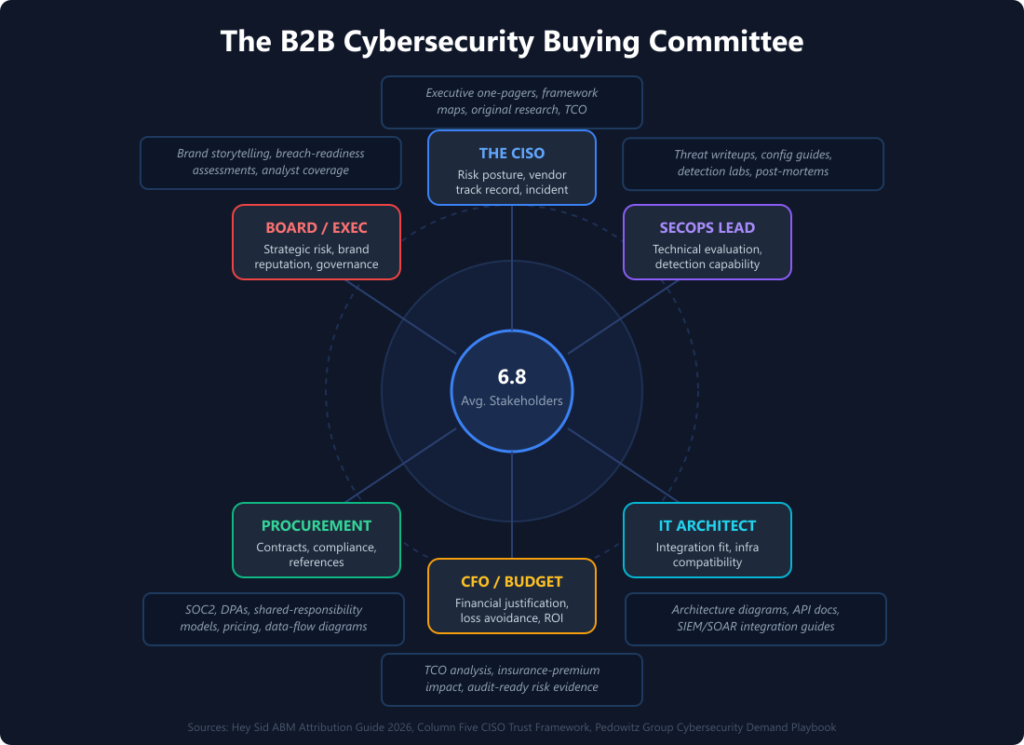
When a vendor cannot independently verify their security maturity, that uncertainty flows directly into the boardroom, stalling deals. And the modern buying committee is rarely small – it averages 6.8 decision-makers, each consuming different content:
- The CISO reads executive insights.
- The security engineer needs technical deep dives.
- Procurement requires compliance docs.
- The CFO wants financial framing and ROI.
A startup producing content only for the CISO leaves the rest of the committee unaddressed. Peer validation remains the primary information source, with 64% of CISOs relying on conversations with industry peers. Analyst reports have lost weight, relied on by only 9% of CISOs. The shift is clear: CISOs trust each other far more than vendors.
This dynamic creates a specific challenge for startups that don’t have a long track record. They can’t point to a decade of incident-free operation. The “invisible until it fails” nature of security makes new entrants risky. If a startup cannot prove their competence before a sale, the buyer cannot accept the risk. The vendor must provide the proof the buyer doesn’t have time to find on their own.
Why Consumer-Facing Influencer Marketing Fails in B2B Security
Consumer influencer marketing fails in cybersecurity because the audiences aren’t even vaguely similar. A creator with 100,000 followers on Instagram or TikTok reaches consumers, not CISOs.
Sixty percent of CISOs do not follow influencers at all.
When a startup hires a macro-creator for a sponsored post, they’re paying for reach that doesn’t convert into pipeline. The failure mode works like this: brands push their corporate marketing through an influencer’s network instead of letting the influencer lead the motion. But people follow the influencer for their voice, not the brand’s pitch. The moment a post reads like an advertisement, the audience disengages. In B2B security, where trust is already fragile, this damage is permanent for both the brand and the influencer.
B2B influencer marketing operates on different economics. Expertise and buyer trust matter more than raw reach. A creator with 500 followers who are all cybersecurity practitioners is more valuable than one with 50,000 general tech enthusiasts. The buying cycle is longer, often 12 to 18 months for enterprise deals. A 30-day campaign burst doesn’t move the needle. The sweet spot for B2B creator programs is three to six months.
Technical buyers also demand depth. A 60-second video may work for consumer products, but CISOs need 30-minute webinars or detailed written analyses they can reference during evaluation. Marketing language registers as noise for practitioners in ten seconds.
Eighty-one percent of engagement on cybersecurity topics happens on editorial and non-sponsored content, not vendor sites.
How to Identify and Vet Niche Security Thought Leaders
Finding the right partner requires ignoring follower counts and focusing on relevance. In B2B security, credibility is defined by technical expertise and industry recognition, not viral reach. The vetting process must assess whether a creator can explain complex concepts accurately and demonstrate hands-on experience. Tools like LinkedIn analytics can help determine if a thought leader’s audience matches buyer personas in job title and seniority.
Four distinct types of influencers serve different purposes:
- Practitioners: Engineers and security leads offering peer-to-peer credibility.
- Consultants and Advisors: Experts providing patterns across multiple companies.
- Niche Creators: Newsletter writers or podcasters explaining tools to targeted audiences.
- Founders and Operators: Individuals sharing real-world struggles, carrying immense weight in technical markets.
The goal is to find voices who would share their insights regardless of their employer, proving their independence.
Startups should look for creators who actively engage in private communities like the CISO Society, private CISO roundtables, or Signal groups. These are the spaces where real buying decisions are discussed, along with the marketing failures and unwanted interrupt-driven sales outreach. A creator with a small but highly engaged audience of CISOs is far more valuable than one with a massive, passive following of general tech enthusiasts. The vetting criteria should prioritize the types of connections and prior examples of in-depth technical discussion over vanity metrics like likes or shares.
How to Structure Paid Partnerships for Maximum Credibility
Compensation models must align with the long B2B sales cycle. Flat fees are standard for large assets like keynote speeches or white papers, while performance commissions can work for targeted audiences with high conversion potential. Hybrid structures often balance production costs with incentives. A three-to-six-month partnership allows the influencer to develop genuine expertise with the product, moving beyond scripted talking points to authentic insights.
Co-creation is the engine of credibility. Ninety-six percent of creators want deeper relationships than one-off social posts. They want opportunities to produce content for multiple channels, become long-term ambassadors, and to co-host events. The brand needs to provide product access and education, not just marketing briefs. When an influencer truly understands the technology, they can explain it accurately in their own voice. This authenticity is what buyers trust.
Governance is critical for technical accuracy. Agreements should include provisions for reviewing content to catch factual errors without micromanaging the creative voice. The goal is to maintain technical precision while preserving the influencer’s unique perspective. Exclusivity clauses prevent confusion that arises when the same voice promotes competing products. Long-term alignment ensures the brand is associated with the expert’s reputation over time, building sustained authority rather than fleeting awareness.
What Content Formats Resonate with Enterprise Buyers?
CISOs and their committees consume content differently based on their role. This means that the brand must plan to address their concerns with original research, executive insights, and documentary-style video. These assets help the CISO and CFO justify the purchase internally. The technical track serves practitioners with threat writeups, detection guides, and post-incident analyses. Accuracy and timeliness matter more than polish here, and marketing language fails instantly if it lacks technical depth.
Specific formats drive the highest engagement:
- Technical webinars with Q&A segments allow buyers to ask specific questions.
- Comparative analyses that honestly acknowledge trade-offs build more trust than claims of universal superiority.
- Implementation case studies co-created with customers provide real-world proof of value.
- Podcast series offer a conversational space to explore complex topics without the pressure of a sales pitch.
One well-designed annual research report can carry six to twelve months of pipeline, driving press and analyst attention.
Distribution channels must match the audience. LinkedIn remains the most effective platform for thought leadership, with 76% of marketers citing it as their top channel. Email newsletters and speaking events follow closely. However, the most important conversations happen in private spaces. CISOs turn to industry peers in roundtables and private Signal groups for vendor recommendations. Content that is optimized for these closed loops through direct sharing and peer endorsement outperforms broad public campaigns.
| Audience Role | Primary Motivation | Effective Content Formats | Content Characteristics |
|---|---|---|---|
| CISO | Risk posture, incident reduction, and internal credibility. Needs to justify spend to the board and ensure vendor stability during a breach. | • Original research reports • Executive thought leadership • Documentary-style video • Interactive explainers • Case studies on incident reduction | • Strategic and high-level • Focuses on track record and perceived competence • Helps the CISO make an internal case without staking credibility on marketing claims • Must hold up in worst-case scenarios (boardroom ready) |
| Security Engineer / SecOps Lead | Technical validation, configuration, and detection capabilities. Needs to verify the tool works in their specific environment. | • Threat writeups and emerging-threat analysis • Configuration guides and detection labs • Post-mortems and technical documentation • Product walkthroughs and teardowns • Implementation case studies | • High technical depth and accuracy • Minimal marketing language (regarded as noise) • Timeliness is critical • Must demonstrate hands-on expertise and real-world application • Often consumed via third-party editorial or non-sponsored content |
| CFO / Budget Owner | Financial framing, expected loss avoidance, and audit-ready evidence. Needs to translate cyber risk into financial terms. | • Financial impact analyses (loss avoidance) • Insurance-premium impact studies • Audit-ready compliance documentation • ROI and pipeline influence reports • Reference customer data | • Clean answers over editorial voice • Focuses on financial outcomes and risk mitigation • Requires evidence of improved cyber risk posture • Translates technical capabilities into business value |
How Standards and Frameworks Support Thought Leadership
Mapping capabilities to recognized frameworks like NIST, ISO, and CIS isn’t optional; it’s a prerequisite for procurement. CISOs use these standards to speed up security reviews and justify spending to the board. Content that explicitly ties a vendor’s solution to specific control requirements reduces friction in the buying process by making a sales pitch into a compliance artifact that buyers can file away.
Verifiable security artifacts remain the single greatest driver of trust. Independent assessments, certifications, and documented operational maturity signal that a vendor takes risk seriously. While analyst reports have lost weight, with only 9% of CISOs relying on them, third-party validation from auditors and peers still carries significant weight. Startups must package these artifacts – SOC 2 reports, data flow diagrams, and shared-responsibility models alongside their thought leadership. This combination proves that the vendor isn’t just talking about security, but living it.
The goal is to align the vendor’s story with the buyer’s risk language. When a thought leader discusses AI governance or cyber resilience, they should reference the specific frameworks their audience uses to measure success. This alignment signals that the vendor understands the buyer’s world. It moves the conversation from “what your product does” to “how you help me meet my business obligations.”
How to Measure ROI of Thought Leadership Campaigns
Measuring thought leadership requires looking beyond vanity metrics like likes and impressions. The true value lies in pipeline influence and lead quality. Seventy-three percent of decision-makers prefer thought leadership over marketing collateral when assessing a company’s capabilities. But only 26% of marketers can directly link this content to business outcomes. The gap exists because attribution models often fail to capture the long, non-linear B2B buying journey.
Effective measurement tracks account-level engagement rather than individual conversions. With an average of 6.8 decision-makers per deal, success means seeing multiple stakeholders within a target account engage with the content. Cohort analysis – comparing influenced accounts against non-influenced ones – reveals the true impact on win rates and sales cycle length. Deals that include influencer touchpoints often close faster and at higher values.
Key metrics include content consumption depth, qualified lead generation, and share of voice.
A 14x return on investment is achievable for high-quality programs, but only if the content is distributed where buyers actually look. This means prioritizing LinkedIn, private communities, and direct peer referrals over broad public channels. The goal isn’t just visibility; it is credibility that translates into revenue.
Conclusion
Building credibility with CISOs is no longer about shouting the loudest. It’s about borrowing trust from the voices they already respect. Startups that align with niche practitioners, respect the long sales cycle, and prioritize verifiable proof over hype will break through the 95% trust deficit. The path forward is clear: stop broadcasting to disinterested consumers, start engaging with peers, and let the experts lead the conversation.
Frequently Asked Questions
How can a cybersecurity startup find influencers who actually reach CISOs?
Startups should look for creators who actively engage in private communities like the CISO Society, private CISO roundtables, and Signal groups. The vetting process must assess whether a creator can explain complex concepts accurately and demonstrate hands-on experience, prioritizing quality of comments over vanity metrics.
Why do consumer-facing influencers fail to generate B2B security leads?
Consumer influencers fail because their audiences do not match the CISO profile; 60% of CISOs do not follow influencers at all. Additionally, failures happen when brands push corporate marketing through an influencer’s network instead of letting the influencer lead with authentic voice.
What criteria should startups use to vet potential thought leadership partners?
Vetting should focus on technical expertise, industry recognition, and audience composition rather than follower counts. Startups must ensure the partner can explain complex concepts accurately and has a history of sharing insights independent of their employer.
How much should a startup budget for paid thought leadership campaigns?
Costs are manageable, with podcast appearances starting around $500 and in-person keynotes running up to $2,500. The sweet spot for B2B creator programs is a three-to-six-month partnership to allow for genuine expertise development.
What content formats are most effective for building trust with enterprise CISOs?
Technical webinars with Q&A, comparative analyses acknowledging trade-offs, and implementation case studies drive the highest engagement. One well-designed annual research report can carry six to twelve months of pipeline, while long-form written analyses are preferred over short-form video.
How do cybersecurity vendors prove credibility before the first sale?
Vendors must provide verifiable security artifacts including independent assessments, certifications like SOC 2 Type II, and documented operational maturity. These artifacts should be packaged alongside thought leadership content, with explicit ties to recognized frameworks like NIST, ISO, and CIS. Third-party validation from auditors and peers carries significantly more weight than analyst reports.
What metrics matter most when measuring thought leadership ROI?
Effective measurement tracks account-level engagement rather than individual conversions, with success defined as multiple stakeholders within a target account engaging with content. Key metrics include content consumption depth, qualified lead generation, and share of voice. Cohort analysis comparing influenced accounts against non-influenced ones shows true impact on win rates and sales cycle length.