11% of CXOs say they’re ready for 1,661 AI agents, I’m sure that’s fine
Key quote:
“The most critical architectural capability is integration. We don’t know what’s coming next, so the foundation must support constant change.”
Why it matters:
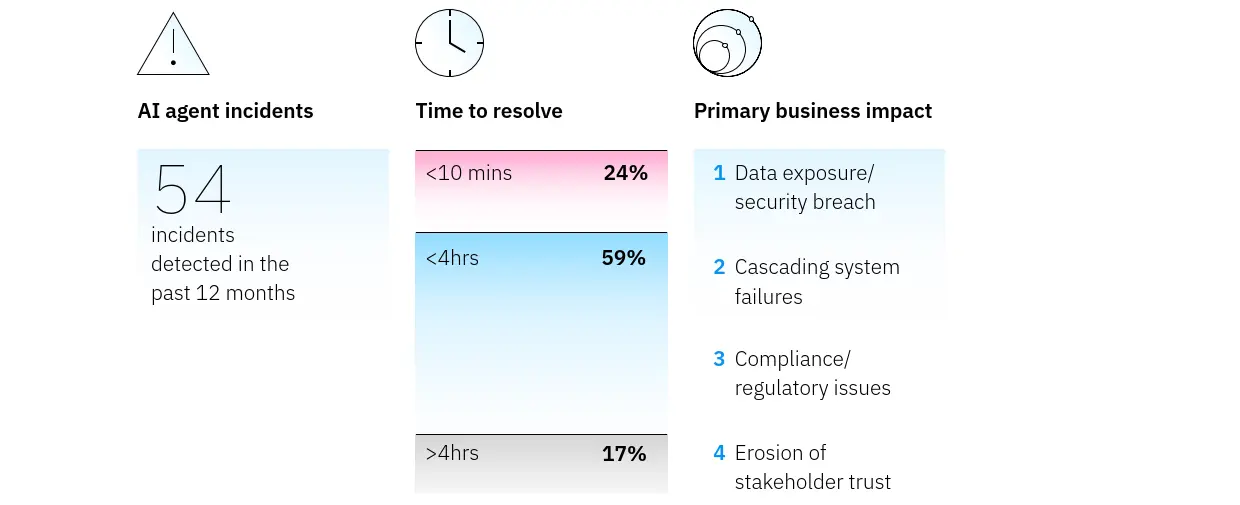
Eleven percent. That’s the share of 2,000 CXOs who told IBM and Oxford Economics they’re fully prepared for the scale of agentic AI deployment expected in the next 12 months, while the other 89% are accountable for systems they don’t fully control. About four out of five of them have CEO-mandated transformation orders, and are in charge of over an average of 54 AI agent incidents per year, with 17% qualifying as high severity. That’s currently.
And next year? The average enterprise expects to add another 1,661 AI agents, a 38% jump, where each one makes hundreds or thousands of autonomous decisions daily. Unfortunately, the math doesn’t math well. Two-thirds of CIOs say that business units are bypassing IT to adopt AI (AKA shadow AI), and 70% say teams deploy technology faster than IT can track. When you can’t see what’s running, you can’t attest to its controls (let alone define those controls), and when you can’t attest to controls, every audit, regulatory filing, and board attestation becomes fiction or, more charitably, an aspiration.
The boards aren’t positioned to catch this either; an older proxy statement analysis found only 1.6% of S&P 500 companies have explicit board or committee oversight of AI while 13% have at least one director with AI expertise. These same boards demanding AI velocity haven’t assigned anyone to supervise the blast radius, which means CIOs and CISOs face the impossible task of scaling governance without actual authority. The gap between what executives expect and what’s actually happening is a structural problem.
IBM’s data shows organizations engineering governance into system architecture deploy 16x more agents while spending 4x less of their AI budget on oversight, which isn’t a marginal improvement but the difference between scaling and drowning. Contracts are starting to call for “AI circuit breakers” that trigger automatic pauses when systems exceed risk thresholds, because insurers are already moving to exclude AI agent losses from coverage. Having nice looking policy PDFs sitting in SharePoint folders unfortunately no longer cut it during breach investigations.
Still feeling lost? Here are some very basic ideas to get started in translating abstract risks into controls (stats nerds may love these):
| Risk | Design-Time Controls | Run-Time Controls | Contractual Mitigations |
|---|---|---|---|
| Model Drift | Training with diverse data, stress testing for future variations, planned model update pipelines with performance thresholds | Continuous monitoring using drift detection metrics (Population Stability Index, KL divergence), alerts when data distribution shifts, automated retraining schedules, human escalation when confidence drops | Require vendors to provide model refresh guarantees, define who bears costs for retraining due to accuracy degradation, specify minimum performance SLAs with penalties, clarify ownership of improved model versions |
| Hallucinations | Fine-tuning on high-quality domain data, Retrieval-Augmented Generation (RAG) to ground outputs in verified sources, Reinforcement Learning from Human Feedback (RLHF) for truthfulness | Real-time fact-checking against trusted APIs/databases, output filters for false claims, confidence thresholds flagging uncertain answers, mandatory human review for high-stakes uses | Demand warranties on factual accuracy for critical claims, require indemnity for damages from incorrect outputs, negotiate service credits for hallucination-caused errors, define what constitutes “acceptable error rates” |
| Bias & Fairness | Diverse representative training data, bias mitigation algorithms during training, fairness-constrained optimization, pre-deployment bias audits with synthetic test data | Outcome monitoring by demographic group in production, regular fairness audits on live decisions, explanation and recourse mechanisms for affected users, spot checks by ethics committee | Require vendors to share bias testing results before deployment, mandate compliance with anti-discrimination laws, include termination rights for proven discriminatory outcomes, define audit rights for fairness verification |
| Adversarial Attacks | Adversarial training on known attack patterns, input preprocessing to sanitize/normalize inputs, red-team testing before launch, ensemble models with out-of-distribution detectors | Real-time adversarial input detection via statistical tests, rate limiting and throttling on APIs, logging unusual input spikes, safe mode switches during suspected attacks, rapid patching when new vulnerabilities discovered | Specify cybersecurity insurance requirements, demand prompt notice of vulnerabilities (within 72 hours), negotiate mutual indemnity for security breaches, require right-to-audit for security controls, include “AI circuit breaker” override clauses |
| Privacy Loss | Data minimization principles, differential privacy techniques, thorough dataset audits and provenance documentation, red-teaming for memorisation leakage | Named Entity Recognition (NER) filters blocking personal data in outputs, role-based access controls, ephemeral sessions without retention, internal investigations triggered by detected leaks | Require DPAs aligned with GDPR/CCPA, demand certification of no-training-on-customer-data clauses, include breach notification timelines (under 48 hours for sensitive data), define data deletion obligations post-contract termination |
These are executable controls, not compliance theater, and IBM’s report found organizations that are pulling ahead treat governance as code rather than documentation. Their incident rates so far are staying flat as deployment scales, while those with weak governance see problems rising along with agent count. The ones who survive the control attestation problem coming for everyone else are building automated guardrails today, because papering over a control gap with a PDF isn’t going to work when enterprises deploy nearly 1,700 autonomous agents next year.