What are the biggest cybersecurity risks facing companies in the Pacific Northwest right now?
Introduction
The Pacific Northwest faces a distinct cybersecurity threat profile that differs significantly from national averages. In 2025, the region saw:
- Combined cyber losses across Washington, Oregon, and Idaho exceed $800 million.
- Manufacturing and wholesale businesses face attack rates 21% higher than other sectors according to X-Force incident response data.
- Research shows 96% of ransomware victims fall into this category. They have enough revenue to make paying a ransom appealing, but often lack the security staff of larger enterprises.
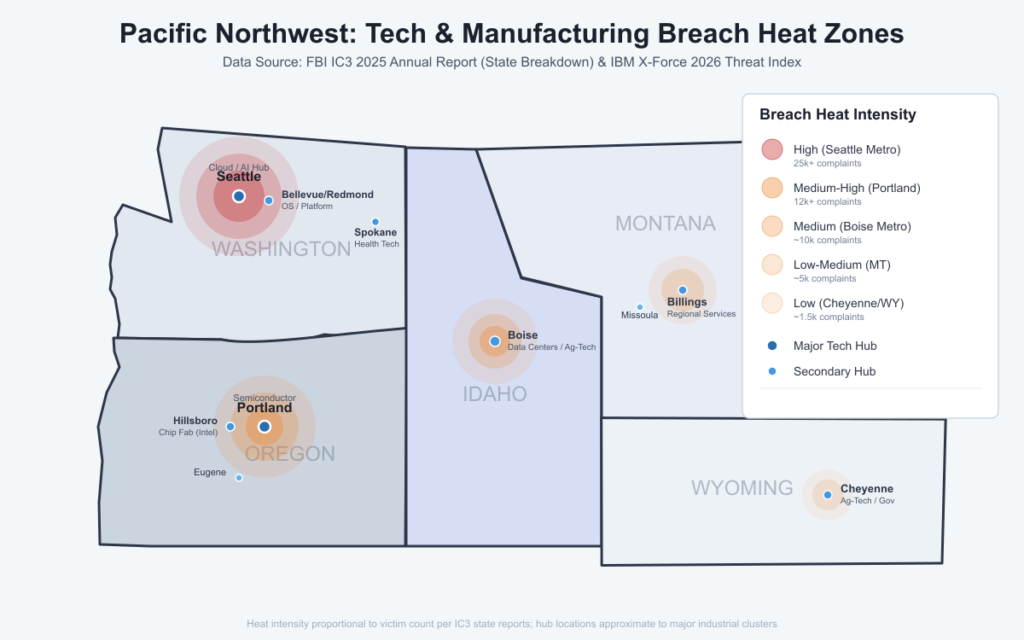
Map of Pacific Northwest highlighting major tech and manufacturing hubs with breach heat zones
Artificial intelligence has accelerated threat activity rather than simply being discussed as a future problem. Over 95% of North American organizations report increased AI-related vulnerabilities in the past year.
Attackers use these tools to automate credential theft and craft convincing phishing emails faster than traditional security teams can patch them. For a logistics firm in Tacoma or a manufacturer in Spokane, the question is not if they will face an attack, but how quickly their team will detect and respond when it happens. Understanding the specific threats and regulatory requirements creates the foundation for building a defense that actually works.
Why are mid-market companies targeted by ransomware attacks?
Ransomware attacks follow predictable patterns that favor mid-market targets over large enterprises. The 2026 Verizon Data Breach Investigations Report confirms that 96% of ransomware victims were small or medium-sized businesses. Attackers calculate their risks similarly to investors looking for the best return. Large corporations have dedicated incident response teams and legal departments ready to negotiate. Smaller companies often lack those resources, making them appear as easier targets willing to pay quickly to restore operations.
State-level data shows the size of the problem in the Pacific Northwest:
- Washington reported 67 ransomware complaints with $1 million in verified losses in 2025.
- Oregon logged 39 incidents with $94,740 in losses.
- Idaho recorded 22 cases with no reported financial loss.
These figures likely understate actual damage because many companies do not disclose loss amounts when filing reports.
Initial access methods reveal why prevention matters more than recovery planning. The FBI recommends creating off-site or offline backups that remain immutable even if main systems are compromised. System intrusion accounts for the majority of successful ransomware deployments, followed by these common vectors:
- Exploitation of public-facing applications
- Social engineering
Once attackers gain a foothold, they move through networks to identify high-value targets before deploying their malware. This means backup restoration alone may fail if credentials stored alongside production systems are already compromised. Building resilience requires stopping attackers before they reach the encryption stage.
What financial frauds are costing Pacific Northwest businesses the most?
While ransomware grabs headlines, business email compromise (BEC) is quietly stealing the most money from Pacific Northwest companies. In 2025:
- Washington businesses lost over $55 million to BEC schemes alone.
- Oregon followed with nearly $27 million in losses.
- Idaho saw more than $11 million vanish.
These aren’t minor accounting errors; they represent wire transfers sent to criminals posing as vendors, executives, or lawyers. The attacker does not need to break into a server or install complex malware. They only need to break into one email account or trick an employee into sending funds to a fake bank account.
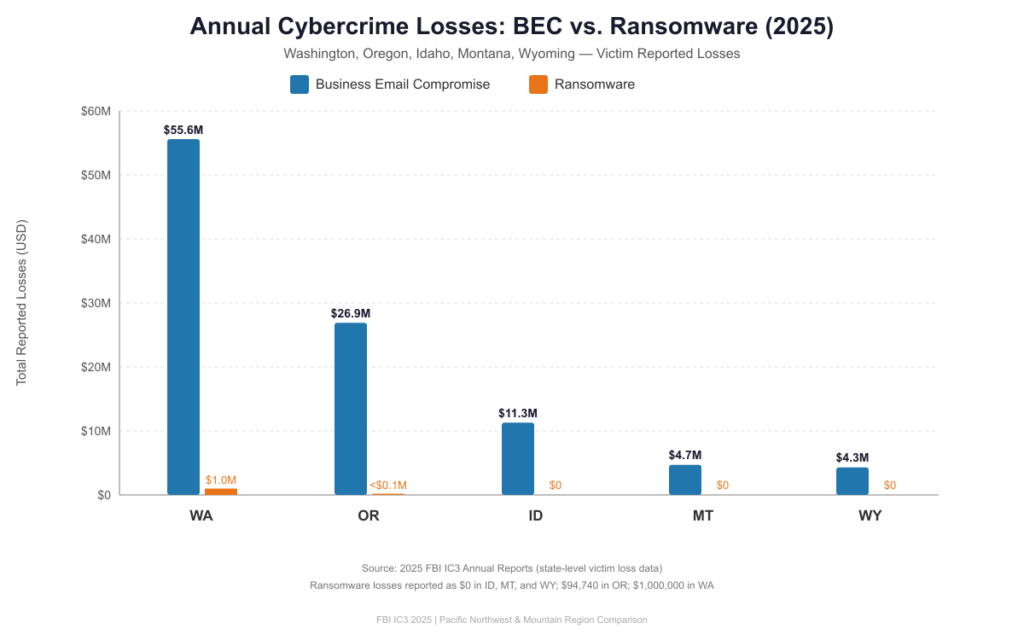
Comparison chart of total annual losses by fraud type (BEC vs. Ransomware)
The scale of the problem grows when artificial intelligence enters the picture. Criminals are now using these tools to enhance their attacks:
- Large language models draft emails that sound exactly like a CEO asking for an urgent payment.
- Voice cloning technology mimics a supervisor’s voice on the phone to authorize a transaction.
FBI data shows that businesses reported over $30 million in losses specifically tied to AI-enhanced BEC attacks last year. For a mid-sized manufacturing firm, a single successful impersonation can drain months of profit before anyone realizes the mistake.
Tech support scams also pose a massive financial threat to regional operations. Employees who believe they are getting help with a computer glitch often hand over control of their entire network to criminals. Washington lost over $46 million to these scams, while Oregon lost nearly $25 million. These incidents often start with a pop-up window or a cold call claiming the company’s systems are infected. Once trust is established, the scammer guides the victim through installing software that gives them remote access. This access allows thieves to steal data, move laterally across networks, or launch further attacks against customers and partners.
Why are public-facing applications a common attack vector?
The most effective way to steal money or data often doesn’t require sophisticated hacking tools. Instead of breaking down a digital door, attackers simply walk through an unlocked window left open on the company website. In 2025, IBM X-Force reported these key findings on exploitation trends:
- Exploitation of public-facing applications surged by 44%, surpassing the use of stolen credentials as the top method for gaining entry.
- This means attackers are not guessing passwords; they are finding mistakes in how web services are built and letting themselves inside.
- Over half of the vulnerabilities tracked last year could be exploited without any authentication, meaning a thief did not need a username or password to access sensitive systems.
This trend poses a specific threat to Pacific Northwest manufacturers and logistics firms that rely heavily on web applications for ordering, inventory, and customer tracking. Common entry points include:
- Missed software updates
- Open configuration settings left too permissive
- Unpatched dependencies in web frameworks
If a software update is missed or a configuration setting is left too open, criminals can slip in unnoticed. Once inside, they move laterally to find financial records, employee databases, or proprietary designs. The rise of AI tools has made this process faster; automated scanners can now test thousands of potential weaknesses across a network in minutes, identifying misconfigurations before human defenders even know they exist.
For businesses, this shows that keeping software updated isn’t just an IT task, it’s a direct financial safeguard. A single unpatched vulnerability in a public-facing system can lead to millions of dollars in losses through fraud or extortion. The speed at which these flaws are discovered and abused means that relying on “hopes and prayers” is no longer a strategy. Regular maintenance, immediate patching, and only having the minimum necessary services on the internet are the only reliable ways to close the door before attackers walk in.
What are the cybercrime losses by state in the Pacific Northwest?
The financial damage caused by cybercrime in the Pacific Northwest varies dramatically depending on where a company operates. Washington bears the heaviest burden, which tracks given its larger population and concentration of technology companies. But the per-capita exposure tells a different story. Idaho reported $88 million in total losses across roughly 4,500 complaints, translating to some of the highest loss-per-incident figures in the region. A smaller business base doesn’t mean a smaller target on your back.
The following table summarizes B2B-relevant cybercrime losses reported to the FBI’s Internet Crime Complaint Center in 2025 across six Pacific Northwest states.
| Crime Category | Washington | Oregon | Idaho | Montana | Alaska | Wyoming |
|---|---|---|---|---|---|---|
| BEC | $55.6M | $26.9M | $11.3M | $4.7M | $7.0M | $4.3M |
| Investment Fraud | $207.3M | $76.7M | $34.1M | $18.8M | $13.2M | $9.3M |
| Tech Support | $46.5M | $25.0M | $20.3M | $5.0M | $2.8M | $2.5M |
| Data Breach (Combined) | $24.6M | $9.5M | $2.6M | $3.0M | $1.9M | $4.2M |
| Ransomware | $1.0M | $94.7K | $0 | $0 | $0 | $0 |
| AI-Related | $24.7M | $11.1M | $2.1M | $840K | $640K | $744K |
Several patterns deserve attention regarding how criminals prioritize their targets:
- Investment fraud dominates absolute losses across every state, which in a B2B context often means corporate treasury funds diverted to fake opportunities.
- Cryptocurrency losses rank second in Washington and Oregon, reflecting the appeal of digital assets to tech-savvy firms and the ease with which stolen funds disappear into untraceable wallets.
- Ransomware losses appear suspiciously low across all states, hovering near zero in Idaho, Montana, and Wyoming. This does not mean ransomware is rare; it means companies frequently do not report the financial impact to law enforcement, either because they paid quietly or because the true cost of downtime never gets captured in a complaint form.
AI-related losses are worth watching closely. Washington recorded $24.7 million in AI-tagged complaints, Oregon saw $11.1 million, and even smaller markets like Idaho registered over $2 million. These numbers will grow as criminals refine their use of generated text, cloned voices, and automated reconnaissance tools. For mid-market companies evaluating where to allocate limited security budgets, the table above provides a straightforward prioritization: protect the wire transfer process first, then lock down web-facing systems, then prepare for the AI-powered attacks that are already arriving.
State Breach Notification Deadlines and Liability
Operating across state lines in the Pacific Northwest creates a compliance minefield that exists regardless of whether your security team is technically competent. Washington, Oregon, and Idaho all mandate breach notification, but they demand it at different speeds.
If a single incident compromises data for residents in all three states, your legal team faces conflicting deadlines:
- 30 days in Washington
- 45 days in Oregon
- An undefined “expeditious” window in Idaho
Trying to meet these simultaneously without a clear internal protocol invites error. A delay that satisfies Idaho law might already violate Washington’s statute, exposing the company to civil penalties up to $500 per unnotified resident.
Washington’s RCW 19.255 requires notification within 30 calendar days of discovery and mandates reporting to the Attorney General if more than 500 residents are affected. The definition of personal information is broad, covering not just Social Security numbers and driver’s licenses but also biometric data, health records, and even usernames combined with passwords. Oregon follows a similar structure but extends the deadline to 45 days under ORS 646A. Crucially, Oregon law imposes a specific 10-day requirement for third-party vendors to notify the companies they serve after discovering a breach. This creates a tight chain of liability where a vendor’s hesitation can immediately trigger penalties for the client.
Idaho operates under a less precise standard, requiring notice in the “most expedient time possible” without a fixed number of days. While this sounds flexible, it offers no protection against lawsuits if a court determines your timeline was unreasonable given the circumstances. The penalty for intentionally failing to notify remains capped at $25,000 per breach, but the ambiguity leaves companies guessing until a judge decides otherwise. For mid-sized firms managing customer or employee data across these borders, the safest approach is to treat the strictest deadline (30 days) as the universal rule. Relying on the vagueness of “expeditious” is a gamble that rarely pays off when regulatory or legal scrutiny kicks in.
Conclusion
The cybersecurity risks facing Pacific Northwest companies aren’t theoretical; they are quantifiable, costly, and accelerating. Ransomware targets mid-market businesses because the payoff is high and the resistance is low. Business email compromise drains corporate treasuries through simple social engineering. Public-facing applications remain the most common entry point for attackers, exploiting basic configuration errors rather than complex hacks.
The financial data confirms that the region is under continuous threat, with losses totaling hundreds of millions annually across Washington, Oregon, and Idaho alone. Ignoring these realities does not make them disappear. It simply leaves companies vulnerable to attacks that could have been prevented with basic hygiene:
- Timely patching of software and systems
- Multi-factor authentication for all accounts
- Employee training on phishing and social engineering
The regulatory landscape adds another layer of pressure, requiring swift action during a crisis while simultaneously demanding coordination across conflicting state laws. A breach response plan that works in Seattle might violate the timeline required in Boise. Companies that treat cybersecurity as an afterthought risk more than just their data; they risk their reputation, their liquidity, and their ability to continue operating.
Protecting a business in this environment requires a shift in mindset. Security is no longer just an IT issue but a core business function that directly impacts the bottom line. Understanding the specific threats in your region is the first step toward building a defense that actually works. The next phase involves implementing the right strategies and resources to close the gaps before attackers find them. Knowledge is power, but only if it leads to action.
Frequently Asked Questions
What cybersecurity regulations apply to private companies in Washington and Oregon?
Private companies handling resident data must comply with Washington’s RCW 19.255 and Oregon’s ORS 646A. Both laws require notification to affected individuals and the state Attorney General if a breach occurs. Washington mandates a 30-day deadline for notification, while Oregon allows 45 days. Idaho operates under a less specific “expeditious” standard, which can create legal ambiguity for multi-state operations.
How do cyber insurance requirements differ from regulatory compliance for mid-market companies?
Regulatory compliance focuses on meeting statutory deadlines and reporting breaches to authorities. Cyber insurance requirements often go further, demanding specific technical controls like multi-factor authentication, immutable backups, and regular penetration testing before a policy is issued. Failure to meet these insurer standards can result in denied claims, even if regulatory notifications were sent on time.
What is the biggest cybersecurity risk for mid-size manufacturers in the Pacific Northwest?
Business Email Compromise (BEC) currently represents the highest financial risk, with Washington alone reporting over $55 million in losses. However, ransomware remains the most disruptive threat, capable of halting production lines entirely. Manufacturing firms are also increasingly targeted for intellectual property theft due to their valuable proprietary designs and supply chain data.
Are small businesses less likely to be targeted than enterprises?
No. Data shows that 96% of ransomware victims are small or medium-sized businesses. Attackers prefer these targets because they typically lack dedicated security teams and are more likely to pay ransoms quickly to restore operations compared to large corporations with robust incident response plans.
Do breach notification deadlines vary significantly by state in the Pacific Northwest?
Yes. Washington requires notification within 30 calendar days. Oregon allows 45 days but imposes a strict 10-day window for third-party vendors to inform clients. Idaho uses an undefined “most expedient time possible” standard, which offers no clear protection against litigation if the response is deemed too slow. Multi-state companies must prepare to meet the strictest deadline to ensure compliance everywhere.
How is artificial intelligence changing the cyber threat landscape in 2025?
Artificial intelligence has accelerated threat activity by allowing criminals to automate credential theft and craft convincing phishing emails faster than traditional teams can patch them. Over 95% of North American organizations report increased AI-related vulnerabilities. Tools like chat generators and voice cloning are now being used to mimic executives and authorize fraudulent transactions with high realism.
How should mid-market companies handle conflicting state breach notification laws?
The safest approach is to treat the strictest deadline – 30 days – as the universal rule for all incidents affecting multiple states. Relying on the vagueness of “expeditious” or waiting for the longest deadline creates significant legal risk. Companies should implement an internal protocol that triggers immediate investigation and notification workflows as soon as a breach is confirmed, regardless of the specific state involved.