The Productivity Gap Is a Data Quality Gap
“Workflow integration was an underestimated challenge early in our AI adoption journey. While a lot of processes looked simple on paper, there are many exceptions in practice.”
The Survey Season Grind
Welp, it’s Monday and the vendor-sponsored research mill is still running at full capacity. The latest entry comes from Forrester Consulting, commissioned by FPT, surveying 397 enterprise decision-makers at companies with $500M-plus revenue. Because it’s Forrester, the methodology is solid – executives with real AI budgets, conducted March through April 2026 – but the sales wrapper is equally thick. Buried under the “buy our AI-first operating model” framing are some genuine facts, provided you can separate the findings from the vendor’s pitch.
The Vendor Narrative vs. Reality
Fifty-one percent of enterprises are spending at least 5% of their IT budgets on AI, per the Forrester/FPT study. But only 26% consider themselves advanced in operationalizing it. That gap between spending and sophistication is where the real story lives. When you drill into the numbers, contradictions appear:
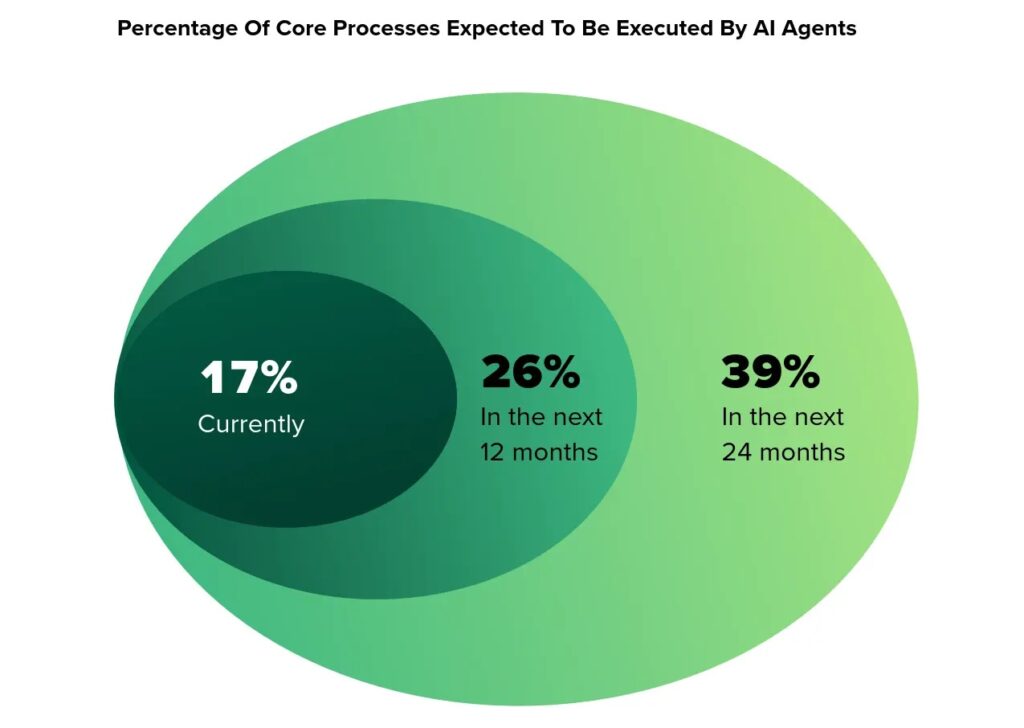
- Adoption vs. Trust: Respondents claim AI agents currently execute 17% of core processes, and that’s projected to hit 39% in 24 months (IBM mentioned something like this, see below). Simultaneously, 40% cite “limited organizational trust in agentic AI to make decisions” as a top challenge. They’re projecting massive growth in autonomous execution while admitting they don’t trust the outcome.
- Measurement Gaps: Thirty-five percent of organizations collect only qualitative data on AI outcomes. Ten percent aren’t measuring at all. Companies are spending real money on vibes.
The Academic Cold Water
Independent research paints a different, reality-based picture. NBER’s working paper (Yotzov, Barrero, Bloom, et al.) from February 2026 surveyed nearly 6,000 executives across the US, UK, Germany, and Australia through central bank partnerships. Their findings suggest that when leaders tell vendors they expect agents to handle 39% of processes, the word “expect” is a nicer way of saying “hope”.
| Metric | NBER Finding (Realized vs. Expected) |
|---|---|
| Productivity Impact | +0.29% (Past 3 Years) vs. +1.4% (Next 3 Years) |
| Employment Impact | 0% (Past 3 Years) vs. -0.7% (Expected by Execs) |
| Employee View | Employees expect +0.5% employment growth |
| Usage Intensity | 1.5 hours/week average executive usage |
Executives in the NBER sample use AI 1.5 hours per week on average. That’s not agentic deployment; that’s a fancy autocomplete. The expectations gap speaks to larger macroeconomic vibes, where executives expect AI to cut employment by 0.7%, while employees at the same firms expect it to raise employment by 0.5%. That 1.2% isn’t a rounding difference; it’s a fundamental disagreement about what AI does.
Structural Barriers and Costs
Earlier this year IBM’s 2026 Tech Leader Study, conducted with Oxford Economics across 2,000 C-suite leaders in 33 geographies, reframed the problem structurally. Enterprises were built for human-speed governance and multi-year investment cycles. AI operates at machine speed with 14-month model lifecycles. The mismatch is structural, not just technical.
Key constraints include:
- Cloud Cost Overruns: Cloud costs exceeded projections by 48% on average. Eighty percent report higher-than-expected data transfer costs. The infrastructure bill for AI flexibility is landing now (and just wait until the subsidies for tokens go away).
- Preparedness Gap: Only 11% feel prepared for agent deployment at scale, despite 80% receiving CEO mandates to transform.
AI spend is projected to grow from roughly 15% to nearly 25% of IT budgets by 2027. That’s hundreds of millions of dollars flowing into a category that has, so far, delivered marginal productivity gains according to rigorous academic measurement and vendor studies.
The Ground Truth: Botsitting
The Work AI Institute (not a real institute; just another vendor) provides the ground-level view executive surveys are missing. Workers save 11 hours per week through AI but burn 6.4 hours “botsitting”: checking outputs, debugging mistakes, rerunning prompts. Net savings: 4.6 hours. Only 13% report significantly improved outcomes. Two-thirds admit shipping unverified AI outputs downstream – you’ll have heard this called “workslop”. The trust deficit Forrester identifies isn’t theoretical. It’s happening daily, one re-run prompt at a time.
Data Hygiene Might Be a Thing
None of these studies dig deep enough into why AI outputs require so much verification. Part of the answer is model limitation, but a bigger part is data quality, and that’s a problem enterprises have been failing at for decades. Organizations have spent twenty years accumulating data lakes that are multiple sources of disagreement. Retention policies are frequently inconsistent or nonexistent – ask your general counsel how the data disposition schedule’s working out in reality. Classification schemes exist in theory but not in general practice.
When you point an AI agent at internal data, it surfaces every quality problem you’ve been ignoring. The agent doesn’t know that the 2019 pricing matrix was superseded. It doesn’t know that three departments maintain conflicting customer records. Workers spend 6.4 hours a week checking AI output not because the models are dumb, but because the underlying data are unreliable. Pilots work because they’re scoped to clean datasets. Production fails because production data is messy.
What Comes Next?
Expect the market to shift as patience wears thin. Companies will keep grafting AI agents onto existing workflows because it’s cheaper than redesigning processes. Only 34% are pursuing an “AI-first operating model,” per Forrester/FPT. The rest are bolting it on; I’ve seen firsthand how that works in cybersecurity, and can’t imagine it’s going to somehow magically be better.
We’ll see more consequences of this mismatch:
- Diminishing Returns: Bolt-on deployments aren’t going to deliver transformative results. The 0.29% productivity bump from the NBER data is already signaling this.
- Management Pressure: CFOs will start asking harder questions when ROI doesn’t show up despite 25% of IT budgets flowing to AI.
- Report Treadmill: Expect more sponsored studies diagnosing the same trust deficits, each concluding that the sponsor’s platform is the answer but lacking concrete, independent validation. The NBER paper, funded by central banks without a product to push, offers the only unbiased take I’ve seen so far this year.
The companies that succeed with agentic AI won’t be the ones with the best models or the fanciest governance platforms. They’ll be the ones that finally did the unglamorous work of cleaning up their data, the work they should have done fifteen years ago. Everyone keeps buying AI governance dashboards when what they actually need is to fix their data before implementing governance as code.