The £958 Million Workaround
Two consulting firms ran surveys about AI in the workplace this year and, read together, they describe organizations at war with themselves. FTI Consulting polled 1,600 senior decision-makers at large companies across seven markets and found that 60% had slowed, paused, or pulled back a planned AI deployment in the past twelve months. Deloitte, in a survey of 25,000 UK workers detailed in their press release, found employees spending an estimated £958 million of their own money on generative AI tools they use for work.
Same year. Opposite directions.
The budgets contracted and the workload didn’t. Anyone who has worked a deadline knows exactly what happens next. People solve the immediate problem with whatever’s within reach, and in 2026 that means a consumer chatbot subscription on a personal credit card. What nobody in the C-suite seems to have priced in is what happens when the employee doing that workaround is holding customer personally identifiable information (PII), protected health information (PHI), or a draft contract bound for a regulatory filing.
Why Companies Pumped the Brakes
FTI’s report lands on a blunt conclusion. AI adoption at large enterprises is stalling not because ambition ran out but because the bill came due. The survey, conducted in August 2026 among companies averaging £1.5 billion in annual turnover, found 29% of organizations still moving fast, 44% moving at pace in some areas while staying cautious in others, and 22% flat-out cautious. That leaves two-thirds of large enterprises moving with at least some caution (44% plus 22%), with the remaining 5% unaccounted for.
The concerns driving it aren’t mysterious. Cybersecurity leads the year-ahead risk list, named by 60% of respondents (coincidentally the same share that slowed their deployments), with 57% worried about incorrect or unreliable AI outputs leading to poor decisions and 54% citing employee use of unapproved AI tools as a major worry. Regulatory uncertainty looms even larger. Eighty-one percent of respondents told FTI that unclear AI rules have created material business issues, feeding risk aversion and pressure to slow adoption.
Then there’s the guardrails themselves. According to FTI, only 17% of surveyed companies have AI governance frameworks older than two years, and 41% built theirs less than a year ago. These are organizations managing billion-pound AI programs through policy scaffolding that barely survived its first winter. Small wonder only about a third feel very well prepared if a serious AI incident hit tomorrow.
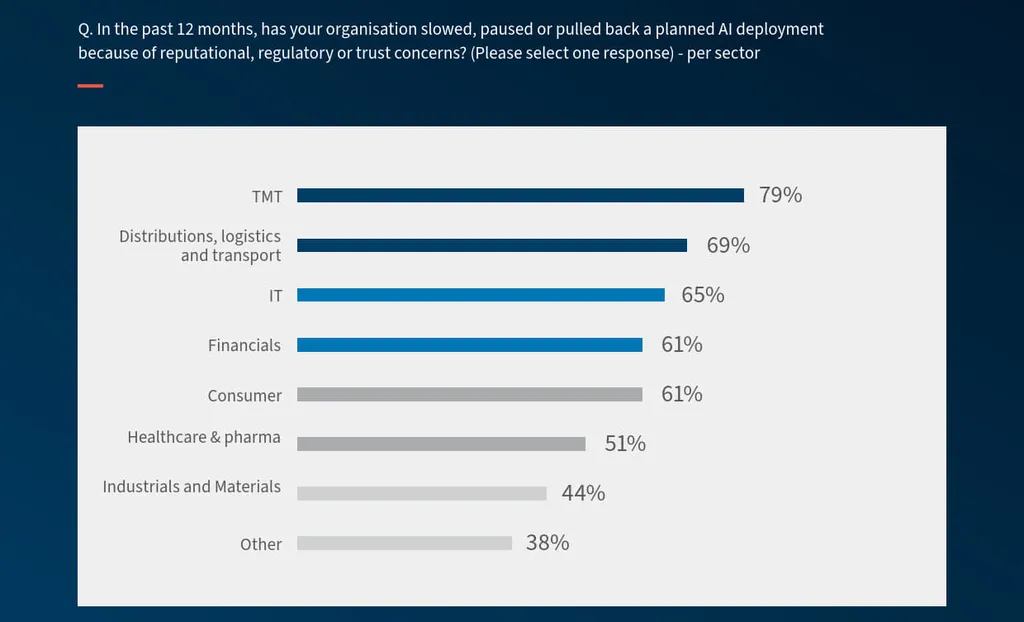
The sector breakdown should end the myth that caution is associated with the companies that struggled with cloud transformation. Technology, media, and telecom companies (the ones closest to the bleeding edge) pulled back hardest, at 79%. Healthcare and pharma sat at 51%, industrials at 44%. The people who understood the technology best were the first to tap the brakes.
Jon Priestley, a senior managing director in FTI’s Strategic Communications division, put it plainly in the company’s press announcement:
“AI has moved from hype to hard reality. Companies still see enormous opportunity, but enterprise AI adoption is now being shaped by cybersecurity risk, regulatory uncertainty and a growing trust gap inside organisations.”
The Workforce Never Got the Memo
Here’s the part of the story the board reports are missing. While the enterprise side was deliberating, workers made their own arrangements.
Deloitte’s inaugural GenAI Workforce Survey, with fieldwork conducted by Ipsos between May 7 and June 10, 2026, surveyed 25,000 UK workers and found 63% knowingly using GenAI for work. Nearly a third of those users, 31%, use it without their employer’s knowledge, AKA “shadow AI”. Composition matters more than size here. Twenty-two percent of Deloitte’s GenAI users say their employer would probably approve if asked, which sounds harmless until you consider that these are likely the people being casual about which tools they use and what goes into them. The 9% who know their employer wouldn’t approve are, at least, probably discreet.
One in six GenAI users pays for at least one tool out of pocket, and Deloitte’s aggregate estimate of that personal spend sits at £958 million annually, spent on tools whose primary beneficiary is the employer. About 6% of those paying out of pocket spend more than £50 a month, typically across multiple subscriptions.
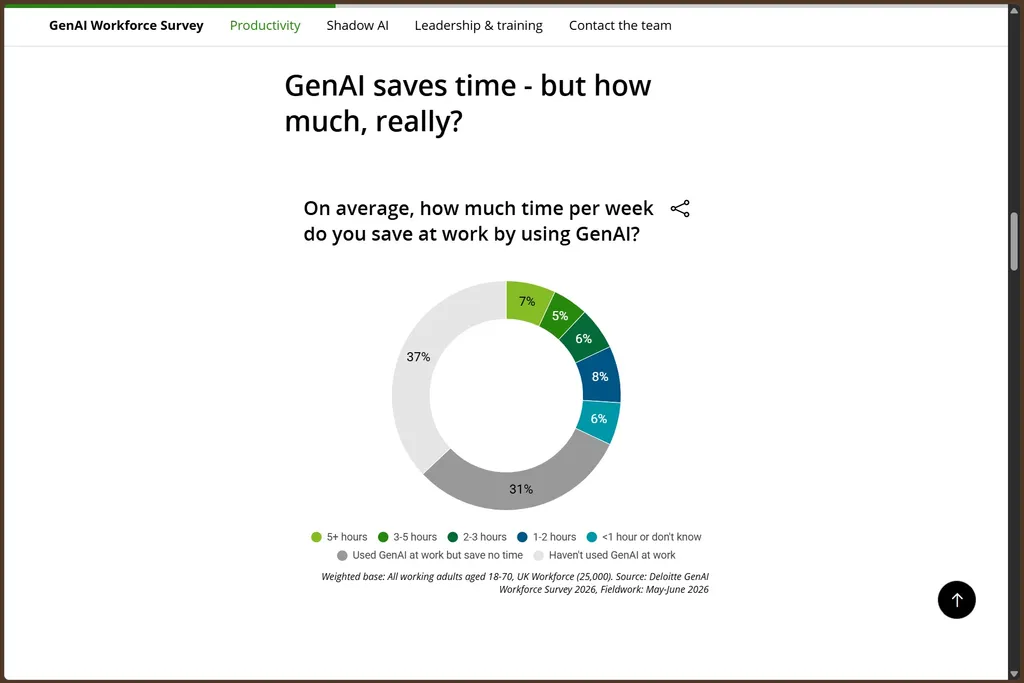
What do they get for the money? Deloitte’s answer is 70 minutes a week in claimed time savings, though the survey’s own distribution undermines the headline. Thirty-one percent of GenAI users save no time at all, and 37% of the workforce hasn’t touched the stuff. Deloitte also asked where the saved time goes (respondents could select multiple uses), and roughly 95% of it flows back to the same employer through more work, different work, or both. About 16% of savers redirect it to chores and childcare, and 9% to leisure.
Workers are personally financing productivity gains that accrue to their companies, and for a third of them, the gain isn’t even real. The financial services sector offers the clearest illustration in Deloitte’s survey, with in-house tool use at 28% there, well above the 17% UK-wide average, and company-paid external tools reaching 41% against 34% overall, so sanctioned supply is abundant. Self-paid subscriptions still run at 19%, above the all-industry average. Handing employees approved tools doesn’t extinguish the demand for better ones. Hayley McKelvey, chief AI officer at Deloitte UK, framed it as a demand problem rather than a discipline problem:
“UK workers are showing they don’t want to wait for permission to use GenAI.”
Ask these workers why they bring their own tools and Deloitte’s motivation data confirms the pattern. Forty percent cite time savings and efficiency, 31% say they already pay for personal use so the work overlap is trivial, and 21% believe the unapproved tools simply outperform what the company provides. Fourteen percent say the tools are essential to their jobs and their employers won’t fund them.
Where the Wires Cross
Neither survey proves the causal chain, so let’s be candid about what the evidence shows versus how I’m interpreting this.
Returns on AI investment have disappointed, so companies pulled back. Earlier this year, Thomson Reuters’ Future of Professionals Report 2026 found 78% of corporate clients expect AI-enabled quality improvements, while 6% report seeing those results, and a March Harris Poll found 71% of CIOs expecting budgets cut or frozen if targets were missed. We’re now into H2 and it looks like that’s come to pass. Simultaneously, workers faced unchanged workloads with shrinking sanctioned resources. Walmart discovered this the hard way, capping employee AI usage after demand exploded through an unlimited-token program. Accenture limited access after promotion-tied adoption drove employees to burn tokens converting PDFs into markdown, something a browser does for free. Every cap tightens the funnel that pushes people toward their own subscriptions.
The surveys supply the supporting conditions. FTI documents the retreat and its causes. Deloitte documents the vacuum beneath it, with 65% of GenAI users reporting no convincing leadership on how AI should be used at their organization and about half having received no formal training whatsoever. Combine a leadership vacuum with frozen budgets and constant deadlines, and self-funded shadow AI becomes the default.
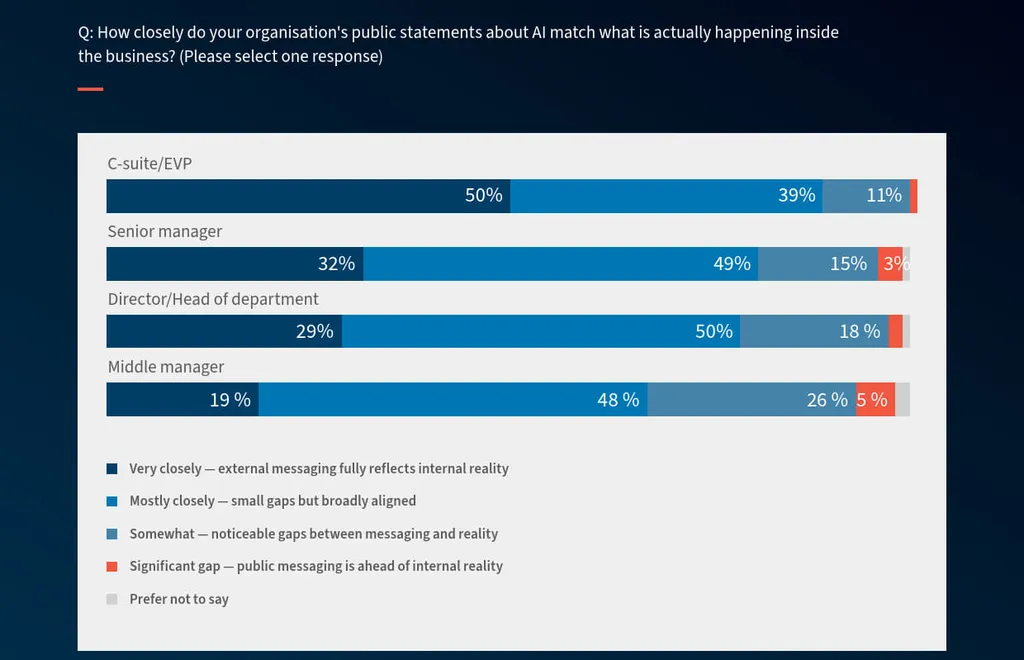
The credibility data explains why the two halves of the organization aren’t talking to each other. FTI found 50% of C-suite executives saying their public AI messaging fully reflects internal reality, a figure that drops to 19% among middle managers. Deloitte found the mirror image from below. Sixty-four percent of weekly GenAI users worry managers will conclude AI can do their jobs, and 23% perceive a stigma around using it; workers who do are more likely to conceal their use. Executives inflate the story upward while workers hide their usage, and the accurate picture of AI inside the organization lives in the middle, unrequested and unread.
The Exposure Nobody Can See
The data flows resulting from all this personal AI use are largely invisible to the organizations legally responsible for them. Netskope’s AI risk and readiness research found only 6% of organizations have complete visibility into AI usage, including prompts and uploads. Verizon’s 2026 Data Breach Investigations Report found 67% of employees using non-corporate accounts to access AI services on company devices, and shadow AI became the third most common non-malicious insider action in Data Loss Prevention (DLP) datasets per the same report, a fourfold increase over the prior year. When 54% of FTI’s respondents ranked unapproved employee tools among their top risks for the coming year, they were describing a threat they generally can’t detect.
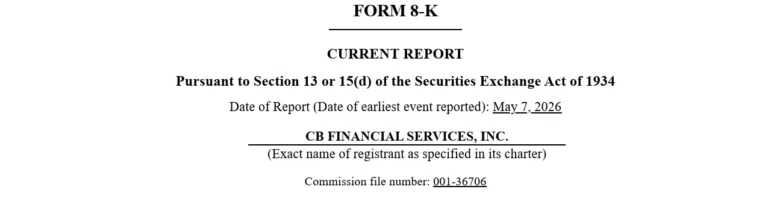
Community Bank (CB FINANCIAL SERVICES, INC.) learned this the hard way when an employee pasted customer names, birthdates, and Social Security numbers into an unauthorized external AI tool, an exposure serious enough to require a Form 8-K filing with the Securities and Exchange Commission (SEC). That’s the progression nobody budgets for. A worker under deadline pressure pastes into a chatbot bound by no enterprise terms, and a disclosure obligation follows.
Litigation risk compounds it. Under the Heppner ruling, AI prompts are now discoverable evidence, and shadow AI enjoys no special exclusion. Trade secrets that leak into a consumer-grade service can lose protected status, because legal privilege doesn’t extend to whatever someone typed into a browser window at 6 PM to meet a deadline.
These aren’t hypotheticals. According to IBM and Oxford Economics, enterprises are bracing for an average of 1,661 additional AI agents per organization next year, with only 11% of 2,000 surveyed CXOs saying they’re fully prepared for that scale of agentic deployment. Layering autonomous agents on top of an unmonitored sprawl of human shadow AI means gambling that the control environment holds. And that’s ignoring the things that unmonitored agents at the frontier labs are getting up to.
A Chief Information Security Officer (CISO) who claims their organization runs no unapproved AI isn’t describing employee behavior. They’re describing the limits of their monitoring coverage.
What Works
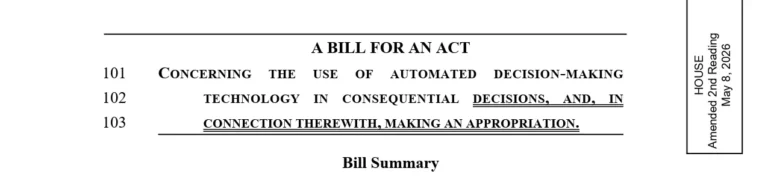
The Colorado courts recently taught this lesson for free. In Dunn v. LexisNexis Risk Solutions, decided August 31, 2026, Magistrate Judge Maritza Dominguez Braswell rejected a consent-and-amendment requirement for new AI tools in litigation precisely because the parties had already negotiated the protections that mattered, including no training on protected material and enforceable deletion obligations. Substance over ceremony. Her logic transfers cleanly to enterprise policy, and the elements that survive scrutiny look like this.
- Publish criteria employees can self-apply, covering training controls, data handling, and security posture like Service Organization Control 2 (SOC 2) Type II or International Organization for Standardization (ISO) 27001 for anything touching regulated data
- Provision a sanctioned tool good enough and fast enough that using it is the path of least resistance, because policy PDFs lose to convenience every time
- Tier the access so public information can ride consumer accounts while sensitive work requires enterprise agreements, letting people self-select without opening a ticket
- Build a reporting channel for “I pasted something into the wrong window” that doesn’t end careers, because you want that call before it becomes an 8-K, not after
FTI’s investment data points the same way. Planned AI investment is skewed toward risk control rather than more experimentation, with 47% increasing spend on cyber and information security, 35% on change management, 30% on employee training, and 27% on AI governance headcount. That’s the correct instinct, provided it buys usable guardrails rather than another committee that meets quarterly while the workforce keeps improvising.
Deloitte plans to repeat its survey every six months. That’s the scoreboard to watch. If leadership closes the gap between frozen budgets and constant workloads, shadow AI shrinks on its own, because most workers would happily stop paying out of pocket for tools their employer should provide. If not, the next reading will just be a bigger number, and the 8-K filings will keep explaining how it got there.