The Windchill Extortion Campaign and What Defense Contractors Stand to Lose
In August 2026, the Clop ransomware group publicly named more than 40 organizations as victims of a data theft campaign. Shell, Philips, GE, Fiserv, and dozens of others initially appeared on Clop’s leak site with claimed data volumes ranging from 1 GB to several terabytes (Reuters; SecurityWeek). If you’re picturing encrypted laptops and ransom notes, stop. Clop didn’t lock anything. They walked in through a vulnerability in PTC Windchill, helped themselves to whatever engineering data they could find, then sat quietly for nearly two months before sending extortion emails to hundreds of employees at each victim organization.
The data they took wasn’t credit card numbers or HR records. It was engineering drawings, product schematics, and manufacturing intellectual property, all the stuff your company spends decades and billions developing.
Why Windchill is Significant
PTC Windchill is enterprise Product Lifecycle Management (PLM) software used by more than 30,000 organizations worldwide, as DemystifyingPLM describes. It manages product data from initial design through manufacturing and long-term sustainment. The system holds bills of materials, engineering drawings, CAD models, supplier specifications and certifications, change histories, configuration management records, plus quality and test documentation. In aerospace and defense, Windchill tracks the as-designed, as-built, and as-maintained configurations of platforms that stay in service for 30 to 50 years.
Several years ago I served as the CISO at a Defense Industrial Base (DIB) company where Windchill was one of the systems I was responsible for securing. I can’t share specifics, obviously, but I’ve spent enough time around this software to understand exactly what sits in it and why compromising it is fundamentally different from breaching a marketing database.
The value inside Windchill splits into two categories, and security teams often focus on the wrong one:
| What’s Stored | Examples | Why Attackers Want It |
|---|---|---|
| Product Designs | Engineering drawings, schematics, CAD models | Reverse engineering, competitive advantage, export control violations |
| Production Processes | Assembly instructions, quality tolerances, supplier workflows, test procedures | Clone the manufacturing capability without R&D investment |
Everyone worries about someone stealing the design for the thing you build. The smarter concern is someone stealing the process for how you build it, a pattern we’ve seen repeatedly with some nation-state actors.
The Business Risks That Matter
Three risk categories extend well beyond a standard breach notification letter.
Intellectual property exposure hits statutory triggers. In defense manufacturing, engineering drawings and CAD models fall under ITAR and EAR export controls. If Clop exfiltrated that data and posts it on a public leak site, you may have a statutory reporting obligation that exists entirely outside your ransom negotiation timeline. The data enables reverse engineering of capabilities and exposes system architectures to adversaries who didn’t have to spend a dime on R&D. Obviously go talk to your General Counsel about reporting obligations.
Process replication is the quiet killer. Windchill doesn’t just store what you build. It stores how you build it, including supplier workflows, test procedures, and configuration management rules all sitting in the same system. Stealing this information lets a buyer clone your production capability without investing in your R&D pipeline. For defense contractors, this is national security exposure disguised as commercial competition.
The credential cascade turns one breach into an enterprise compromise. ReliaQuest’s threat research details how the web shell deployed in this campaign decrypts LDAP manager credentials and site administrator keys stored in Windchill’s keystore, returning every encrypted value in plaintext. LDAP credentials govern access to Active Directory, email, VPN, and basically every directory-authenticated service in your environment. What starts as a PLM breach on a single server can end as enterprise-wide credential compromise, giving attackers access to systems that have nothing to do with Windchill.
The Extortion Timeline
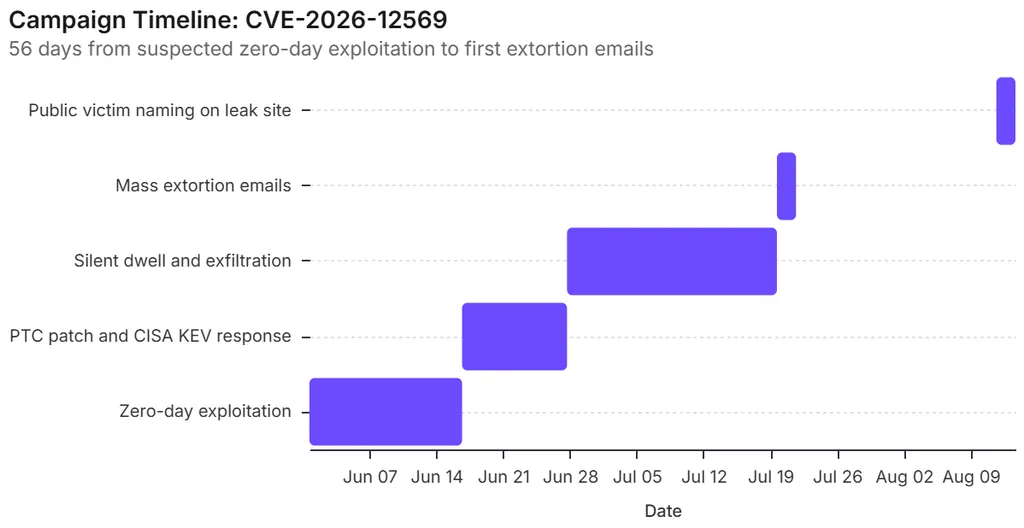
Clop exploited CVE-2026-12569, a critical unauthenticated remote code execution vulnerability in PTC Windchill and FlexPLM, likely beginning as a zero-day in early June 2026. PTC released patches on June 17-18. CISA added the vulnerability to its Known Exploited Vulnerabilities catalog on June 25, giving federal agencies three days to patch (NVD). German authorities at the BSI reportedly called PTC customers in the middle of the night urging immediate patching (DIESEC).
Then Clop waited.
About seven weeks passed from early June exploitation to July 20, when mass extortion emails went out to hundreds of employees per victim with the subject line “Windchill PDMLink module serious data leak” (Ransom-ISAC). By the time most organizations patched, attackers may have already emptied the vault.
Patching and confirming no data was taken are not the same statement.
On August 12-13, Clop publicly named victims on its leak site. Shell allegedly lost 89 GB of engineering drawings, site photographs, inspection reports, and project plans. Philips supposedly lost 13.5 GB of technical schematics. None of the named victims has confirmed a significant data breach. GE was removed from the list shortly after, which could mean payment, negotiations, or that Clop might have made a mistake in attribution.
Under the Hood
Clop deployed a custom JSP web shell built specifically for Windchill, not some off-the-shelf tool. It imports Windchill’s own internal classes (MethodContext, WTConnection, WTKeyStoreUtil) to run database queries under the application’s service identity, harvest credentials, enumerate file vaults, and load additional Java code in memory without touching disk. Commands arrive through a custom HTTP header. Responses are GZIP compressed. Traffic looks like normal Windchill application behavior at every layer, and signature-based detection won’t catch it.
What Security Teams Should Do Now
If your organization runs Windchill or FlexPLM:
- Confirm you’re on a patched build. PTC support article CS473270 lists the fixed versions: 13.1.1, 13.0.2, 12.1.2, 12.0.2, 11.2.1, 11.1 M020, and 11.0 M030. Being current doesn’t mean you’re clean.
- Hunt for JSP files in
/Windchill/login/matching 16-character or 6-character hexadecimal naming patterns, regardless of patch status. Web shells planted before you patched survive the patch. - Rotate LDAP manager passwords and everything in the Windchill keystore on any server you suspect was touched. The shell’s credential harvesting function returns all stored secrets in plaintext, so assume the full set is gone.
- Search internal email logs for mass messages referencing “Windchill PDMLink” and “data leak.” Clop sends extortion emails from compromised internal accounts, not external infrastructure. That’s a different alert than what your phishing rules catch.
- Conduct a post-patch compromise assessment. A patch closes the door. It doesn’t remove what already walked out.
The organizations on Clop’s list are still deciding whether to confirm anything. You don’t have that luxury. Assume the data walked, act like the credentials are burned, and treat the patch as the beginning of your response, not the end of it.