Why Mid-Sized Companies Need a Virtual CISO
Introduction
A mid-sized manufacturing firm in Idaho recently realized their IT director, already managing servers and the company’s help desk, was also supposed to be the company’s cybersecurity strategist. The board had asked for a risk assessment before renewing their cyber insurance policy. The IT director admitted he lacked the specific expertise to build one. The company faced a choice: hire a full-time executive for a salary exceeding $250,000 or find another way. They chose the latter.
This scenario plays out daily across the Pacific Northwest and beyond. Companies in logistics, tech, and light manufacturing hit a wall where operational risks outpaces their internal security maturity. They face ransomware threats that halt production lines, data breaches that trigger state notification laws, and insurance underwriters who demand proof of controls before issuing a policy. The budget for a dedicated Chief Information Security Officer simply isn’t there for these types of company. A virtual CISO provides the strategic leadership and board-level reporting these companies need without the six-figure salary.
What Is a Virtual CISO and What Do They Do?
A virtual CISO is an external executive who assumes the strategic responsibilities of a Chief Information Security Officer without becoming a full-time employee. The role differs from a managed security service provider, which handles technical operations like monitoring alerts and patching systems. A vCISO focuses on governance, risk strategy, and policy development while leaving day-to-day execution to internal IT teams or vendors.
Professional engagements frequently include defined deliverables:
- Risk assessments
- Security program documentation
- Policy development
- Compliance roadmaps
- Board reporting cadence
- Audit preparation
Some providers may optionally offer strategic guidance on a monthly call, as part of an advisory retainer, which can be a lightweight form of vCISO engagement. The distinction matters because many underwriters and auditors expect documented leadership.
Onboarding typically follows a structured timeline. Weeks one and two involve stakeholder interviews and review of existing policies. Weeks three through six cover a full risk and gap assessment. By day ninety, the vCISO presents a tailored roadmap to the board and launches one or two key initiatives like MFA rollout or endpoint upgrades.
Cross-industry experience provides value internal teams cannot replicate. A vCISO working across multiple clients sees what works and what fails, benchmarks a mid-sized firm against peers, and implements frameworks like NIST or ISO efficiently. Monthly retainers range from $3,000 to $15,000 depending on scope, with deliverables scaling accordingly.
When Does a Mid-Sized Company Need a Virtual CISO?
The decision rarely stems from a sudden fear of “hackers”. It usually arrives when a business hits a specific operational or financial wall. For many mid-sized firms, the first trigger is the cyber insurance renewal or first application. Underwriters now demand specific controls as baseline conditions for coverage. Businesses that cannot demonstrate MFA, endpoint detection, and offline backups face higher deductibles or outright denials.
In 2026, 21% of cyber insurance claims were denied or partially denied. The most common reason, accounting for 34% of denials, was the failure to maintain stated security controls. Insurers verify that protections listed on an application are active when an incident occurs.
Customer and investor demands provide another trigger. When a mid-sized tech firm pursues a Series C round or a logistics company bids on an enterprise contract, the prospect often demands SOC 2 reports or completed risk assessments. Internal IT staff cannot pivot to build these responses overnight. Board members are also asking harder questions about cybersecurity risk, wanting metrics and clear plans rather than assurances.
How Virtual CISOs Help Meet Cyber Insurance Requirements
Cyber insurance has become an active audit of a company’s security posture. Ninety-six percent of insurers require MFA on all remote access, email, and privileged accounts. Eighty-eight percent mandate endpoint detection and response tools across all devices. Eighty-two percent require offline or immutable backup systems. These are the price of entry for modern business.
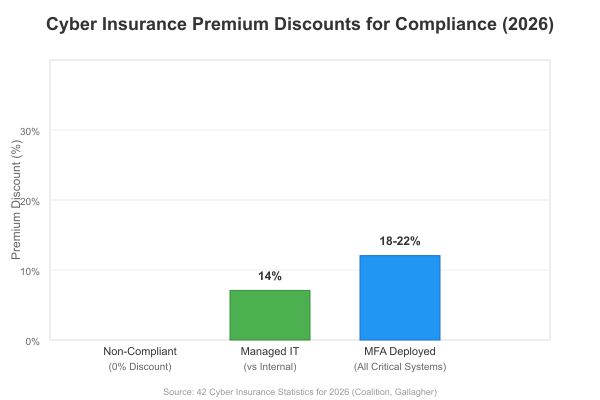
Meeting these standards impacts the bottom line directly. Companies deploying MFA across critical systems receive premium discounts averaging 18% to 22%. By comparison, the median deductible for ransomware events reached $100,000 for mid-market firms in 2025. A vCISO ensures controls are implemented and documented so claims survive scrutiny. For example, one mid-market firm had its renewal denied for lacking MFA and incomplete incident response documentation. After a vCISO oversaw the deployment of controls and validated them with the underwriter, the firm saw a 22% premium reduction and a reinstated $2 million coverage limit.
Forty-four percent of insured businesses are underinsured, holding coverage limits less than half their estimated maximum breach cost. A vCISO reviews policies annually to align limits with actual risk exposure.
Understanding State Breach Notification Laws
Operating across state lines introduces overlapping obligations with different timelines and penalties. Washington requires notification within 30 days; Oregon allows 45 days. Alaska and Idaho demand notice in the “most expedient time possible.” Penalties reach $50,000 per state, plus private lawsuits in jurisdictions like Washington. The definition of personal information also differs. Washington includes biometric data and health insurance numbers. Montana adds tribal identification and IRS identity protection PINs. Wyoming covers username-password combinations and birth certificates. A single incident can violate multiple statutes simultaneously.
Third-party data holders also face strict duties. In Oregon, a vendor must notify the primary data owner within 10 days. In Washington, the Attorney General must be notified if over 500 residents are affected. A vCISO works with your attorney to create and maintain a playbook mapping these requirements, ensuring the correct notices go out within statutory windows.
Note: This summary reflects state breach-notification statutes as currently codified and is for general informational purposes – not legal advice. Penalty caps in several states (e.g., Idaho, Oregon, Washington, Wyoming) flow through general consumer-protection or unfair trade practice statutes rather than the breach-notification law itself.
How Virtual CISOs Protect Against Operational Risk
Security failures translate directly to downtime. Ransomware accounted for 28% of cyber insurance claims in 2025 but 52% of total costs. First-party breach response costs averaged $410,000 for mid-market companies. A logistics firm losing access to shipping software for a week faces revenue loss that dwarfs the cost of preventive controls.
A vCISO ensures backup systems are tested quarterly, recovery time objectives are realistic, and networks are segmented so a single infected workstation can’t stop an entire production line. By building and testing business continuity plans, a vCISO reduces the financial impact of inevitable incidents and keeps operations running when systems fail.
Virtual CISO Cost vs. Full-Time CISO Salary
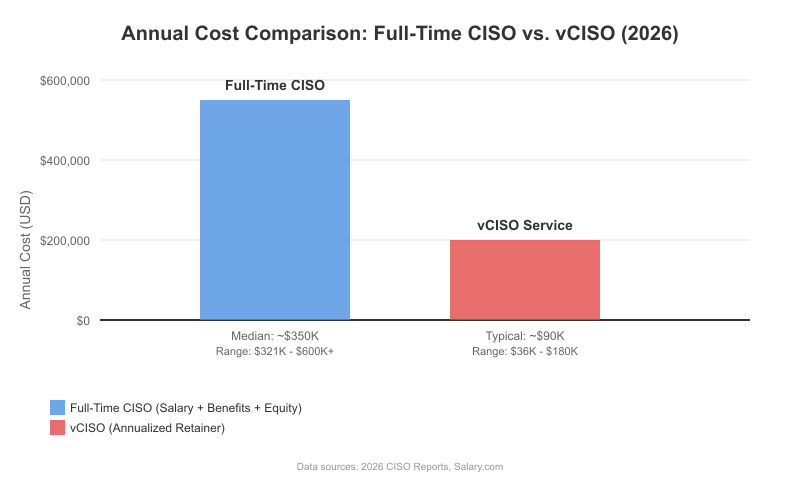
A full-time CISO in Washington typically commands $400,000 to $700,000 in total compensation. Even in Wyoming, the floor sits near $200,000, and neither of those figures includes benefits, recruiting fees, and equipment.
By comparison, a vCISO retainer ranges from $3,000 to $15,000 monthly, totaling $36,000 to $180,000 annually. This represents 20% to 40% of a full-time hire’s cost while delivering comparable strategic value. For companies under 1,000 employees, the math is straightforward, and the cost savings can fund the security tools the program requires.
How to Select the Right Virtual CISO Provider
Look beyond certifications. Ask for direct experience with your industry’s specific needs, because a vCISO who has only worked with healthcare startups may struggle with the operational technology risks facing a manufacturer. Verify their capacity to handle multiple clients without compromising incident response times.
Ensure the contract defines accountability boundaries clearly:
- Who owns the incident response plan
- What happens if a breach occurs at 2 a.m.
Avoid vendors who push proprietary tools or who claim exclusive relationships with cybersecurity vendors, as this signals a potential conflict of interest. Insist on a clear off-ramp where documentation and institutional knowledge transfer back to your team.
Frequently Asked Questions
What does a virtual CISO cost per month?
Monthly retainers typically range from $3,000 to $15,000 depending on company size, compliance requirements, and service scope. Startups and small businesses usually fall in the $3,000 to $5,000 range. Mid-market companies with complex compliance needs pay $8,000 to $12,000 monthly. Hourly advisory rates run $200 to $500 if you need ad-hoc support.
Can a virtual CISO handle a live incident?
Yes. Incident response coordination is a core competency of a professional vCISO engagement. A strong provider has a defined role in your incident response plan, relationships with forensic firms and breach counsel, and 24/7 escalation paths. If they are figuring out their role during a crisis, the engagement was underbuilt.
Do I need a vCISO if I already have a security team?
Internal teams typically focus on technical execution. A vCISO fills the strategic governance gap: policy development, board reporting, compliance management, and vendor risk oversight. The two roles complement each other rather than compete. Clear contracts should define where advisory guidance ends and internal ownership begins.
How quickly can a virtual CISO start?
Engagements typically begin within one to two weeks, compared to a four-to-six-month search for a full-time CISO. The first 90 days follow a structured onboarding plan covering discovery, gap assessment, and roadmap presentation to leadership.
Is a virtual CISO suitable for non-tech companies?
Manufacturing and logistics firms benefit significantly from this model. Physical assets and supply chains depend on digital systems, and manufacturing cyber insurance claims grew 56% year-over-year in 2025. These organizations often lack internal security leadership, making the fractional model a practical fit.
What industries benefit most from virtual CISO services?
Mid-sized companies in manufacturing, logistics, professional services, healthcare, and financial services see the greatest return. These industries face strict compliance requirements, high cyber insurance costs, and significant operational risk from downtime. Any company handling sensitive customer data or operating critical infrastructure benefits from strategic security leadership.
Conclusion
A mid-sized company needs a virtual CISO when insurance underwriters demand controls the internal team cannot implement alone, when prospects or investors require compliance documentation, or when a breach could halt operations. The financial case is clear: a vCISO delivers strategic security leadership at a fraction of a full-time executive’s cost. The operational case is equally strong: documented controls protect revenue, satisfy insurers, and keep production lines running. Assess your current insurance posture and legal exposure honestly. If the gaps are visible to you, they will be visible to an underwriter, an auditor, or an attacker.