PURPOSE: Helps organizations develop incentive structures that effectively encourage collaborative risk management behaviors while avoiding unintended consequences.
WHEN TO USE: When revising performance management systems, addressing security behavior challenges, or implementing shared risk ownership models.
BEHAVIORAL ANALYSIS
Target Behaviors to Encourage
Every client platform credential (ad platforms, CMS, analytics, CRM admin) is entered into the agency’s centralized password vault at onboarding and never stored in spreadsheets, chat threads, or browser password managers.
Participation in quarterly access reviews with completed documentation signed off by the pod lead.
Reporting suspected impersonation or credential-compromise attempts within 24 hours through the designated escalation channel.
Current Behaviors to Discourage
Storing or passing client credentials through Slack channels, shared spreadsheets, and browser-stored password managers.
Skipping or delaying access-review sign-off due to workload pressure.
Delaying incident reports to avoid investigation or blame.
Behavioral Drivers Analysis
Behavior
Current Drivers
Barriers to Change
Primary Motivators for Target Audience
Credential vaulting at onboarding
Speed in fast-launch cycles; existing habit of Slack exchanges during campaign setup
The vault adds friction when launching campaigns under tight deadlines; legacy accounts lack centralized visibility so staff must hunt down credentials before they can vault them
Client trust after prior session-hijack reputational crisis; career credibility as a trustworthy steward of client access
Approximately one-third of legacy client accounts still lack centralized credential management; staff turnover means institutional knowledge is lost during handoffs; review feels like administrative overhead
Avoidance of repeat incidents that trigger client escalation; professional development recognition for pod stewards
Reporting suspected impersonation attempts
Culture already trained post-incident to distrust inbound requests
Fear of being blamed if the report turns out false; unclear escalation path for credential-reset requests
Psychological safety to report without punishment; visible leadership acknowledgment of good catch
Table: Behavioral Drivers Analysis
INCENTIVE MECHANISM SELECTION
Incentive Types Evaluation:
Incentive Type
Appropriateness (1-5)
Key Considerations
Implementation Complexity
Financial Compensation
3
Budget-constrained at $15-20M revenue band; tying pay to raw counts creates perverse incentives
3
Recognition Programs
5
Fits close-knit creative culture; strong engagement value; risk of becoming tokenistic if not rotated
2
Career Advancement
4
Long-term value; limited promotion slots in ~75-person flat structure
3
Professional Development
4
Industry norm for craft training; extendable to security certifications
2
Autonomy/Authority
2
Best for experienced staff; credential hygiene depends on consistent application across the whole team
2
Team-Based Rewards
4
Credential hygiene is inherently a pod-level property for client accounts
3
Other:
N/A
No additional mechanisms under consideration for this cycle
N/A
Table: Incentive Types Evaluation
Selected Incentive Mechanisms
Primary: Security steward recognition program at the client-pod level with visible leadership acknowledgment
Secondary: Professional development funding for designated pod stewards (certification or training stipend)
Tertiary: Modest team-based reward tied to the pod’s quarterly access-review completion rate
Rationale for Selection: The working assumption, tested by the pilot before wider rollout, is that recognition and professional development fit this agency’s culture and budget better than cash compensation. Leadership expects these mechanisms to sustain engagement at lower cost, since the agency has already committed spend to password-manager tooling. The Q2 pilot evaluation, including the staff fairness survey, validates or adjusts that assumption. Base compensation stays untouched for factors partly outside individual control, which protects psychological safety for incident reporting.
METRIC DESIGN
Individual-Level Metrics
Metric
Definition
Measurement Method
Target
Weight
New credential vaulting timeliness
% of newly onboarded client credentials entered into central vault within 48 hours of receipt
Automated vault audit logs matched to onboarding ticket timestamps
90% in Quarter 1, 100% by end of Quarter 2
40% of Secure Client Stewardship Scorecard (single unified instrument)
Access-review completion
% of assigned client accounts with signed review documentation submitted within the quarterly window
Review workflow system timestamp vs. quarterly deadline
100% each quarter
30% of Secure Client Stewardship Scorecard
Incident reporting timeliness
Time from suspicion to formal report submission for suspected impersonation attempts
Security ticket creation timestamp
Under 24 hours for all reports
30% of Secure Client Stewardship Scorecard
Table: Individual-Level Metrics
Team/Department-Level Metrics
Metric
Definition
Measurement Method
Target
Weight
Pod credential inventory completeness
% of the pod’s assigned client accounts with zero credentials found outside the vault during quarterly access review
Quarterly manual sampling cross-checked against vault directory
95% by each pod’s second full quarter after go-live; 100% by fourth; quarters counted from the pod’s go-live quarter, which counts as the first full quarter
40% of Pod Performance Scorecard
Access-review completion rate
% of assigned client accounts with signed review documentation submitted on time
Review workflow system completion flags vs. quarterly deadlines
100% each quarter
35% of Pod Performance Scorecard
Legacy credential remediation rate
Reduction in unmanaged legacy credentials per pod relative to confirmed baseline
Baseline count from first quarterly review; subsequent reconciliation deltas
Per-pod 50% reduction by the pod’s second full quarter; 75% by fourth; full retirement of the backlog by the pod’s fifth full quarter (quarters counted from go-live)
25% of Pod Performance Scorecard
Table: Team/Department-Level Metrics
Note on measurement overlap: the access-review metric appears at both the individual and pod levels by design. The individual scorecard credits each person’s on-time submissions, while the pod scorecard credits collective completeness. The two instruments feed separate decisions (individual stewardship reviews and pod performance reviews), and aggregate program reporting draws only on the organization-level scorecard, so no single evaluation double-weights the activity.
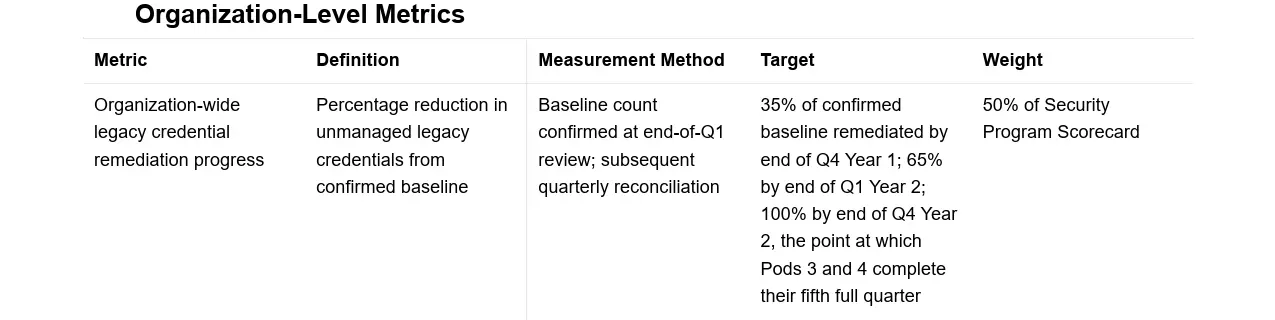
Percentage reduction in unmanaged legacy credentials from confirmed baseline
Baseline count confirmed at end-of-Q1 review; subsequent quarterly reconciliation
35% of confirmed baseline remediated by end of Q4 Year 1; 65% by end of Q1 Year 2; 100% by end of Q4 Year 2, the point at which Pods 3 and 4 complete their fifth full quarter
50% of Security Program Scorecard
Incident reporting volume
Count of suspected impersonation attempts reported monthly compared to baseline
Security ticket creation count, normalized for business activity
Increase of at least 20% from the pre-implementation baseline during Year 1
30% of Security Program Scorecard
Repeat-incident reduction
Repeat credential-hijack and phishing-success events per quarter against historical baseline
Post-implementation incident tracking vs. historical baseline
At least 75% reduction against historical baseline by end of Year 1; any residual event triggers a root-cause review within 30 days
20% of Security Program Scorecard
Table: Organization-Level Metrics
UNINTENDED CONSEQUENCES ANALYSIS
Proposed Incentive
Potential Unintended Consequence
Likelihood (1-5)
Impact (1-5)
Computed Severity (Likelihood × Impact)
Mitigation Strategy
“Zero credentials outside the vault” metric
Pods hide or quietly delete shadow credential copies rather than report them, corrupting the inventory audits depend on
4
5
20
Run a no-blame amnesty window covering each pod’s first live quarter; score teams on the credentials they discover and remediate, with missed items logged without penalty
Individual 90%/100% vaulting timeliness target
Staff enter false timestamps or delay recording credentials until after the 48-hour window closes to meet the target artificially
4
4
16
Random timestamp-integrity audits each quarter; a sample of vault entries is checked against onboarding tickets, and mismatched entries are corrected without penalty
Access-review completion rate incentive
Teams submit perfunctory reviews without actual credential verification to meet the completion threshold
3
4
12
Random audit of 20% of submitted reviews; audit failures void the completion credit and trigger retraining
Security steward recognition
Role becomes tokenistic or isolates one person as scapegoat when others slip
3
3
9
Rotate stewardship annually; anchor recognition to pod-level outcomes; leadership treats slips as learning moments
Team-based pod reward
Free-rider problem emerges: senior staff benefit while junior staff carry migration workload
3
3
9
Retain the individual reporting component (30% of the stewardship scorecard); cap the team reward’s value so workload inequities stay tolerable
Key message points: Credential vaulting protects client relationships after the prior six-figure session-hijack incident; this change removes future reputational risk for account teams; the agency absorbs tooling costs so staff do not carry personal devices for credential management
Communication channels: Kickoff during monthly all-hands; reinforced in client-pod standup meetings; FAQ posted in agency internal wiki
Timing considerations: Announce during weeks 1-2 of the launch month, ahead of the pilot pod kickoff later in Month 1; align messaging with quarterly access-review cycle so cadence is clear from day one
Pilot Approach
Scope of initial implementation: One client pod covering roughly 8-10 client accounts, spanning both newer onboardings where MFA and vault habits exist and at least one legacy account where the gap concentrates. The agency operates approximately four client pods with roughly 15-20 staff per pod, including one designated security steward per pod.
Duration: One full quarter of live operation (Q1), including one complete quarterly access-review cycle, followed by one quarter (Q2) reserved for evaluation, recognition, and the agency-wide rollout decision. Non-pilot pods begin their own implementations in Q3 and Q4 with staggered go-lives.
Success criteria: 90% of new credentials vaulted within 48 hours (staged target, stepping to 100% in Q2); 50% of the pilot pod’s legacy credentials migrated by end of Q2, matching the team-level pace; at least 95% access-review completion in the pilot quarter, a staged threshold below the steady-state 100% requirement; no measurable decline in client responsiveness; pilot staff survey shows the incentive is perceived as fair. Q1 migration trend data informs but does not gate the go/no-go.
Engagement approach: Weekly pulse checks during pilot; biweekly steering updates to leadership; open office hours for staff questions
Required approvals: Client Services Director signs off on pod selection; Operations lead approves amnesty window mechanics; agency principal approves budget envelope
Resource Requirements
Budget implications: Dominant cost already committed in password-manager licensing; incremental incentive-program budget of approximately $40K annually in Year 1, derived as $20K across four pods ($2K steward development stipend plus $3K pod recognition fund per pod) and roughly $20K of administrative backfill (about 440 hours at a blended internal rate of $45 per hour)
System changes: Vault integration with quarterly review workflow; automated alerting for credentials outside the vault detected during audit; review workflow system for tracking submission deadlines
Administrative support: Operations lead commits approximately 10 hours per week during the pilot quarter (Q1) and the pod-launch quarters (Q3 and Q4), and approximately 4 hours per week in the intervening quarter (Q2), totaling roughly 440 hours in Year 1; the commitment steps down to approximately 4 hours per week (about 210 hours) in Year 2 as pods reach steady state; no new headcount required
Timeline
Milestone
Activities
Owner
Timeline
Vault deployment and amnesty announcement
Configure vault workflows; publish amnesty terms; announce to all staff
Operations lead
Weeks 1-2 of launch month
Pilot pod kickoff with steward designation
Select pod; train stewards; distribute communication materials
Client Services Director
Late Month 1 of Q1
First quarterly access review (baseline count confirmed)
Sample credentials across pod; reconcile against vault; document legacy-gap count
Operations lead with pod stewards
End of Q1
Pilot evaluation and agency-wide rollout decision
Analyze pilot metrics; run recognition event; finalize go/no-go for full deployment
Agency principal + Operations lead
End of Q2
Pod 2 implementation kickoff
Begin second pod rollout with staggered go-live
Client Services Director
Month 1 of Q3
Pod 3 and 4 implementation kickoffs
Begin third and fourth pod rollouts with staggered go-lives
Client Services Director
Month 1 of Q4
Year 1 program evaluation and Year 2 planning
Comprehensive metrics review; set Year 2 targets
Agency principal + Operations lead
End of Q4
Final legacy-remediation verification and program close-out
Confirm 100% of baseline remediated across all pods; final report and Year 3 planning
Agency principal + Operations lead
End of Q4, Year 2
Table: Timeline
EVALUATION AND REFINEMENT
Effectiveness Measures
Track individual vault-timeliness metrics monthly to confirm behavioral adoption; monitor quarterly access-review completeness rates to measure lagging outcomes. Compare incident reporting rates before and after implementation to confirm reporting did not decline due to fear of punishment. The mid-pilot and end-of-pilot staff survey captures perceived fairness and burden. Organization-level legacy-credential reduction is reported as a percentage of the confirmed baseline.
Feedback Mechanisms
Anonymous suggestion channel opened through internal wiki for confidential submissions
Monthly pulse survey sent to all staff in participating pods asking whether the incentive fits their work reality
Office hours held weekly during pilot where staff can raise concerns directly to the Operations lead
Post-quarter retrospective sessions for each pod to surface systemic friction points before the next review cycle
Refinement Process
Adjustments reviewed at the end of each quarterly access-review cycle; minor tweaks (timing, wording, reward amounts) may be implemented immediately with stakeholder approval
Decision criteria for major changes triggered if any metric misses its target by more than 20 percentage points for two consecutive quarters, requiring leadership steering-group intervention
Any changes to the incentive structure communicated at least 30 days before take effect
Review Schedule
Quarterly formal reviews at months 3, 6, 9, and 12 of Year 1, continuing quarterly through Year 2 (months 15, 18, 21, and 24) so the cadence spans the full remediation timeline
Annual reassessment after Year 1 and again after Year 2 to determine whether incentives continue to drive desired behaviors or require redesign
Key stakeholders in review process: Agency principal, Client Services Director, Operations lead, designated pod stewards rotating each cycle
Opportunity Cost Analysis: The Security Tool Your CFO Actually Wants to See So many words, wouldn’t you rather just watch this? Every security leader knows the feeling. You build a thoughtful proposal for controls you genuinely need, walk into the budget meeting, and watch the CFO’s eyes glaze over the moment you say “ransomware.” The…
Security Governance Maturity Assessment Without the Guesswork So many words! Wouldn’t you rather just watch this on YouTube? Most organizations can’t answer a simple question: how mature is your security governance? Not with a guess, not with a feeling, but with a number. The Security Governance Maturity Assessment from Chapter 7 of Cyber Risk is…
Would you rather watch this on YouTube? Most security teams can’t prove they’re improving. They track vulnerabilities, incidents, and compliance checkboxes, but none of that shows whether cyber risk is actually integrated into business decisions. This resource changes that. The Design Your Progress Measurement System exercise guides you through building a plan that tracks integration…
The Risk Acceptance Decision Framework: Stop Guessing and Start Owning Your Exposure Rather just watch this on YouTube? Most organizations treat risk acceptance like a handshake deal in a hallway. Someone says, “We can’t fix this right now,” another person nods, and the problem gets tucked into a corner of a spreadsheet that no one…
Rather watch this on YouTube instead? Security teams live in a world of numbers where a scanner runs, finds a hole, and gives you a score. That score is usually a CVSS rating, and it tells you how bad the vulnerability is from a technical perspective. Then you send a report to leadership calling it…
Cookie Consent
This website uses cookies.
Cookie Preferences
Manage your cookie preferences below:
Essential cookies enable basic functions and are necessary for the proper function of the website.
Name
Description
Duration
wp_consent_functional
Wordpress
4 weeks
popup_form_dismissed_2
Used by MailPoet to indicate if the user has closed the pop-up newsletter reminder banner.
7 days
Cookie Preferences
This cookie is used to store the user's cookie consent preferences.
30 days
Statistics cookies collect information anonymously. This information helps us understand how visitors use our website.
Google Analytics is a powerful tool that tracks and analyzes website traffic for informed marketing decisions.
Used to monitor number of Google Analytics server requests
10 minutes
__utmb
Used to distinguish new sessions and visits. This cookie is set when the GA.js javascript library is loaded and there is no existing __utmb cookie. The cookie is updated every time data is sent to the Google Analytics server.
30 minutes after last activity
__utmc
Used only with old Urchin versions of Google Analytics and not with GA.js. Was used to distinguish between new sessions and visits at the end of a session.
End of session (browser)
__utmz
Contains information about the traffic source or campaign that directed user to the website. The cookie is set when the GA.js javascript is loaded and updated when data is sent to the Google Anaytics server
6 months after last activity
__utmv
Contains custom information set by the web developer via the _setCustomVar method in Google Analytics. This cookie is updated every time new data is sent to the Google Analytics server.
2 years after last activity
__utmx
Used to determine whether a user is included in an A / B or Multivariate test.
18 months
_ga
ID used to identify users
2 years
_gali
Used by Google Analytics to determine which links on a page are being clicked
30 seconds
_ga_
ID used to identify users
2 years
_gid
ID used to identify users for 24 hours after last activity
24 hours
_gat
Used to monitor number of Google Analytics server requests when using Google Tag Manager
1 minute
_gac_
Contains information related to marketing campaigns of the user. These are shared with Google AdWords / Google Ads when the Google Ads and Google Analytics accounts are linked together.
90 days
__utma
ID used to identify users and sessions
2 years after last activity
Marketing cookies are used to follow visitors to websites. The intention is to show ads that are relevant and engaging to the individual user.
Name
Description
Duration
wp_consent_statistics-anonymous
WordPress Consent Statistics Anonymous
4 weeks
wp_consent_statistics
WordPress Consent Statistics
4 weeks
wp_consent_preferences
WordPress Consent
4 weeks
wp_consent_marketing
Wordpress Marketing Consent
4 weeks
popup_form_dismissed_2
Used by MailPoet to indicate the user has closed the pop-up form.
7 days
A video-sharing platform for users to upload, view, and share videos across various genres and topics.
Registers a unique ID on mobile devices to enable tracking based on geographical GPS location.
1 day
VISITOR_INFO1_LIVE
Tries to estimate the users' bandwidth on pages with integrated YouTube videos. Also used for marketing
179 days
PREF
This cookie stores your preferences and other information, in particular preferred language, how many search results you wish to be shown on your page, and whether or not you wish to have Google’s SafeSearch filter turned on.
10 years from set/ update
YSC
Registers a unique ID to keep statistics of what videos from YouTube the user has seen.
Session
DEVICE_INFO
Used to detect if the visitor has accepted the marketing category in the cookie banner. This cookie is necessary for GDPR-compliance of the website.
179 days
LOGIN_INFO
This cookie is used to play YouTube videos embedded on the website.