The Role-Based Risk Awareness Program Template
Why read when you can watch this instead?
Most security training fails because it treats everyone the same. You send the same phishing video to your chief financial officer and your machine shop floor manager, and they both click the training link, and ignore the content. One month later, they both fail the phishing test. It doesn’t matter how good your platform looks if nobody retains the information. The Role-Based Risk Awareness Program Template fixes this problem by forcing you to map training to actual job functions, so it stops the guesswork and demands you identify real risks for specific teams before you build anything else.
This document isn’t just another checklist; it’s a strategic tool designed to replace generic awareness programs with targeted interventions. If your goal is to meet compliance requirements with zero effort, keep doing what you do. But if you actually want to reduce your risks, you need a plan that respects the daily reality of each department.
Template
Get the template as Markdown or Microsoft Word or Proton Docs. Yes, it’s free! Feel some need to give me your email address? Subscribe to my newsletter.
When Should You Use This Resource?
You should pull out this template when your current training program feels stale or disconnected from business goals. Many leaders realize their program isn’t working only after a breach occurs or during an awkward audit finding, so don’t wait for that moment. There are specific triggers where this tool becomes important. Consider deploying it whenever your organization undergoes structural changes like mergers or acquisitions, because these events bring together different cultures and risk profiles. A manufacturing firm absorbing a software startup will face entirely different threats than the original entity, and applying one-size-fits-all training here creates blind spots.
Use this resource when you identify high-consequence departments that handle critical assets. Finance teams handle money transfers, while HR holds employee records, and engineering keeps trade secrets. Each group needs protection tailored to their specific assets. If you try to protect them all with a generic training message, you leave gaps that attackers will exploit. The template forces you to define these gaps explicitly, ensuring nothing slips through the cracks. It works well for mid-sized companies that lack dedicated security staff, because without specialized teams, it’s easy to let risk slide or just to accept generic training. This worksheet provides the structure needed to manage organizational nuance without needing a large headcount.
Use the template when you need to justify budget or resources to leadership, since executives care about outcomes, not completion percentages. You can show them a filled-out document linking security training to specific revenue streams or operational continuity. Showing how protecting engineering data supports product launches makes security a business asset, rather than a cost center. Finally, use this approach when you plan to roll out new technology, because introducing cloud storage or mobile devices changes the threat model. Old policies might not cover these new vectors, so this template helps you update awareness programs to match the new tools employees will actually use every day.
- Mergers and Acquisitions: Different cultures and risk profiles require tailored training immediately.
- High-Consequence Departments: Finance, HR, and Engineering need specific protection strategies.
- Budget Justification: Link training to revenue and continuity to gain executive buy-in.
- New Technology Rollouts: Update programs to cover vectors introduced by new tools.
Why Does Generic Training Fail While This Approach Works?
Generic training creates a false sense of security that crumbles when real attacks happen. Managers see a 95% completion rate and assume the company’s safe, but that percentage only measures button-clicking, not actual behavior change. Real safety comes from understanding; when a finance worker recognizes a fake invoice request, it’s because they understand the tactic and know how to verify the source. Generic modules rarely teach this depth because they skim the surface just to finish the course quickly, leaving employees unprepared for nuanced threats.
This template pushes for depth by requiring you to write scenarios that mirror real attacks, so you can’t fake familiarity when you practice with realistic situations. It forces alignment between security goals and operational needs by asking you to list key business processes for every department, meaning you can’t skip the step where you connect risk to revenue. Leaders stop ignoring security requests when they see the connection to their KPIs; if you explain that better data handling prevents downtime during peak production, plant managers listen, whereas framing it as a compliance checkbox makes them tune out.
The value also lies in accountability, which most programs lack because IT builds the training and employees take it, then nothing else happens. This template assigns responsibility for measurement and feedback, ensuring you track whether behavior actually shifts like reporting rates going up or incidents dropping. You prove business value through data, not hope, turning a vague initiative into a measurable process that sustains momentum. Programs die when they feel like temporary projects, but frameworks survive because they become part of the workflow, embedding risk checks into standard operations to ensure longevity without constant reinvention.
- Depth vs. Surface: Scenarios mirror real attacks to build genuine familiarity rather than superficial knowledge.
- Business Alignment: Connecting risk to operational KPIs stops leaders from ignoring security requests.
- Measurable Accountability: Tracking behavioral shifts like report rates proves value through data, not just completion stats.
- Sustainable Workflow: Embedding checks into daily operations ensures the program survives as a long-term habit.
What Does a Completed Template Example Look Like?
It’d be a lot easier if you were looking at the template right now. Markdown | Word | Proton Docs
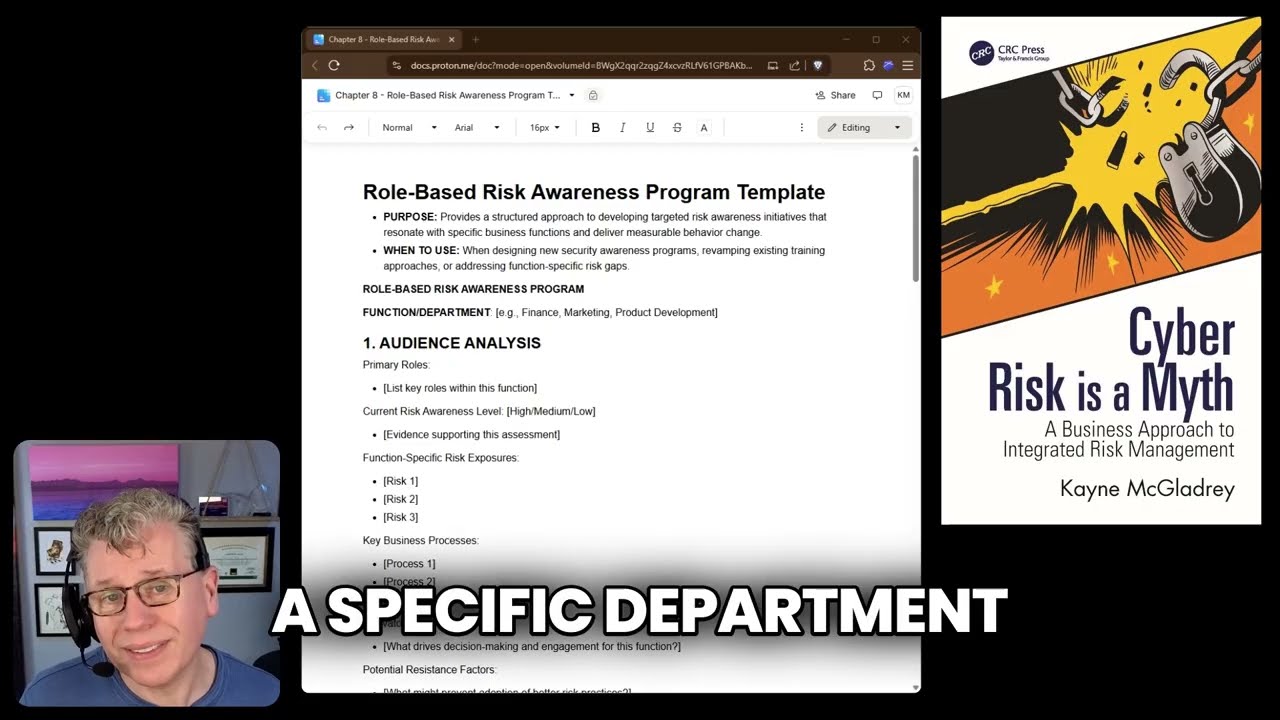
To show how this works, we built a sample entry using a fictional manufacturing company called Precision Components. Imagine a firm like this operating in Texas, making parts for automotive and aerospace clients. Their Finance team handles payments for suppliers, which means the risk here involves criminals trying to redirect funds through social engineering. Below is the exact data populated into the template; note how specific the exposures and objectives are.
Function/Department: Finance & Accounting
Current Risk Awareness Level: Medium
Function-Specific Risk Exposures:
- Business Email Compromise (BEC) targeting vendor payment changes.
- Invoice Fraud mimicking regional automotive suppliers.
- Credential harvesting via fake procurement portals.
The next section defines what success looks like in practical terms. It moves beyond “understand phishing” to actionable steps that employees can do during their normal work. The behavioral objective drives the training design; if the goal is verification, the training teaches verification methods that match real vendor interactions.
Learning Objective (Behavioral):
Participants will independently verify any request to change vendor banking details through a pre-established out-of-band channel before processing payment.
Scenarios make the content stick because abstract warnings fade fast while stories stay with people longer. Here is the specific scenario used to train the Finance team, and it mirrors a common attack vector against manufacturing firms that process wire transfers daily.
Role-Specific Scenario:
"A vendor representative sends an urgent email claiming their bank account changed due to 'system migration,' attaching a new W9 form. The email address domain is slightly off (e.g., precision-parts-supply.com instead of precision-parts.com)."
Finally, you need proof that the effort paid off since traditional metrics count training logins, but these metrics count actions. The success indicators focus on real-world results like report rates and incident avoidance, showing whether behavior actually shifted after training concluded.
Success Indicators:
- 20% increase in reported suspicious vendor emails.
- Zero confirmed incidents of fraudulent wire transfers within 6 months.
This completed view demonstrates the shift from abstract policy to concrete practice, proving every line serves a purpose. Nothing exists just to fill space, so managers can see clear connections between training inputs and security outcomes.
What Are the Common Questions About This Template?
How much time does it take to fill out this template for one department?
Expect two hours for the first pass because you need time to interview staff and gather real process data. The second round takes less time since you reuse the format, so don’t rush this step. Rushing leads to generic answers that miss the point of targeting specific risks.
Can I use this for small teams with fewer than ten people?
Yes, size doesn’t matter since small teams face big risks too. A solo contractor handling client funds needs the same protections as a finance director in a large firm. Focus on the role, not the headcount, and adapt the scale to fit the actual workload.
What if my company lacks the budget for custom training materials?
You don’t need expensive vendors when you can use internal knowledge effectively. Ask senior staff to review your scenarios, because they know the real tricks attackers use in your industry. Build the content yourself using existing examples from past incidents or near-misses.
Does this replace mandatory compliance training required by regulators?
No, it complements regulatory requirements rather than replacing them entirely. Mandatory training covers legal minimums, while this template ensures your team actually understands how to apply those rules daily. Both are necessary for full coverage against audits and breaches.
Who should own the template once it’s created?
Assign someone who interacts with the department regularly, like an HR partner or a team lead. Security specialists can advise, but the owner should understand the business context to keep things relevant. This ensures the content stays fresh as roles change or new tools arrive.
How often should I update the scenarios in the document?
Review them quarterly because threats change frequently, and old tactics might not be relevant in the future. A new social engineering trick could come out next month, so regular updates keep the material fresh and effective. Don’t let your scenarios become outdated relics of last year’s threats.
What if leadership rejects the behavioral metrics?
Show them the cost of incidents by calculating potential losses from fraud or downtime. Compare that to the minimal cost of updating the program, since money speaks louder than theory. Frame it as insurance for their revenue stream to win their support immediately.
Attribution
This resource and the accompanying training are derived from the work of Kayne McGladrey, author of Cyber Risk is a Myth (published 2026). The fictional company scenarios used in the examples are for illustrative purposes only and do not represent real organizations.