Stop Speaking Gibberish to Your Board When Discussing Cyber Risks
But I don’t wanna read this, I just want to watch it on YouTube!
Most security leaders don’t fail because they can’t find the bugs, but because they can’t talk about them to people with MBAs. You walk into a boardroom with a slide deck full of CVSS scores, zero-day exploits, and APT vectors, and the room goes silent. The CFO doomscrolls on their phone, while the CEO asks if this will stop production on Monday. You’ve just handed them a technical problem wrapped in jargon that means nothing to their bottom line. That silence isn’t indifference; it’s a language barrier, and it costs companies millions every year in wasted budgets and missed threats.
The “Decoding Security-Speak” exercise is a practical tool designed to break this barrier. It forces you to translate technical alerts into business impact before you ever send an email or walk into a meeting. The exercise doesn’t ask you to dumb down your knowledge – it asks you to add the context that makes your knowledge matter. If you can’t explain why a vulnerability matters in terms of revenue, reputation, or regulatory penalty, then you haven’t done your job yet. This worksheet gives you the structure to fix that, using real-world scenarios to build the muscle memory needed to speak the language of business.
Looking for the worksheet?
Word | Markdown | Proton Docs
Want more like this, even if you don’t have the book? Neat. Join the newsletter where these come out weekly. Also, support your library – they probably have a copy of the book, too. If not, try asking a nice librarian.
When Should You Deploy This Tool?
This resource isn’t for your daily stand-up with the engineering team because they already speak jargon fluently. This tool is for moments where the language gap creates actual risk. Use it right before you draft a budget request, since asking for $50,000 to patch a server demands more than a CVE number. If you don’t explain what happens when you don’t spend that money, your request might die in committee. Does it mean the company loses a key client? Does it mean a fines notice from a regulator? That’s the language the person holding the checkbook actually understands.
You should also use this when preparing for executive briefings. Many security teams make the mistake of dumping raw data on leadership without context. They send a weekly report listing 237 critical vulnerabilities, but executives glaze over because they can’t prioritize based on severity scores alone. Run your top five risks through this translation process first, then turn those twenty-seven characters of technical gibberish into a story about operational disruption or customer trust.
Consider a scenario like Precision Components, LLC, a fictional mid-size manufacturer serving automotive and aerospace clients. Their entire revenue stream depends on just-in-time delivery and maintaining ISO certifications. If their IT team reports “RCE vulnerabilities,” the COO hears noise. But if the same team uses this exercise to report, “We have vulnerabilities that could halt our CNC machines and delay shipments worth $1M annually,” suddenly the COO cares. Use the tool whenever a risk crosses the threshold from an IT issue to a business threat.
It fits perfectly during incident response planning too. When you write up the playbook for a ransomware attack, don’t just list the technical steps to isolate the network. Map out the business consequences in advance so leadership knows exactly what they’re buying time for. How much does an hour of downtime cost? What contracts get breached? This prepares leadership to make quick decisions without needing a crash course in networking protocols, and the tool works best when the stakes are high while the time to decide is short.
Finally, use it when hiring or training new staff. Many young analysts know how to run scanners but struggle to write an executive summary. Give them this exercise as part of their onboarding process, and make them practice translating raw scan results into business narratives. It accelerates their development from a technician to a trusted advisor, while teaching them that security isn’t just about code; it’s about protecting the organization’s ability to function.
What Makes This Translation Method Worthwhile?
The core argument in Cyber Risk is a Myth by Kayne McGladrey is that cyber risk doesn’t exist as a separate magical category. There’s only business risk, some of which happens to be enabled by technology. When you label something cyber, you accidentally tell the business, “This is someone else’s problem.” You create a silo where accountability goes to die. The “Decoding Security-Speak” exercise breaks that silo by helping you to frame every risk in terms of business outcomes.
Why is this better than guessing or winging it? Most security professionals default to technical descriptions because they feel safer. It’s easy to say “the firewall needs updating.” It’s hard to say “the firewall update prevents a breach that would cost us our ISO certification.” The exercise gives you a repeatable method to bridge that gap, and it removes the guesswork of figuring out how to phrase things. You follow the steps: identify the jargon, find the business context, attach a consequence.
Generic templates fail because they don’t account for the specific reality of your industry. A generic template might tell you to translate phishing into email attacks, which is useless. But if you apply the logic to a specific situation, you learn that for a bank, phishing means financial theft. For a hospital, it means patient safety risks. For a manufacturer like our fictional example, it means production stops and supply chain breaches. This tool pushes you to dig that deep instead of staying surface level.
The value extends beyond communication since it changes how you think about your own work. When you practice translating your risks, you start noticing the ones that don’t matter to the business. You realize that patching a low-value internal server might not be worth a boardroom presentation, while leaving a customer portal exposed is a catastrophe waiting to happen. It helps you prioritize your actual workload based on business impact rather than just scanner output.
This approach builds trust with leadership. Executives respect clarity while they hate ambiguity. When you come to them with a clear statement about money, time, or reputation, they see you as a partner in running the company. When you come with tech-speak, they see you as a cost center. This exercise flips the script by turning your security team from a group of gatekeepers into a group of strategic enablers who help the business move faster and safer.
What Does a Completed Example Actually Look Like?
It’d be way easier if you were looking at the worksheet: Word | Markdown | Proton Docs
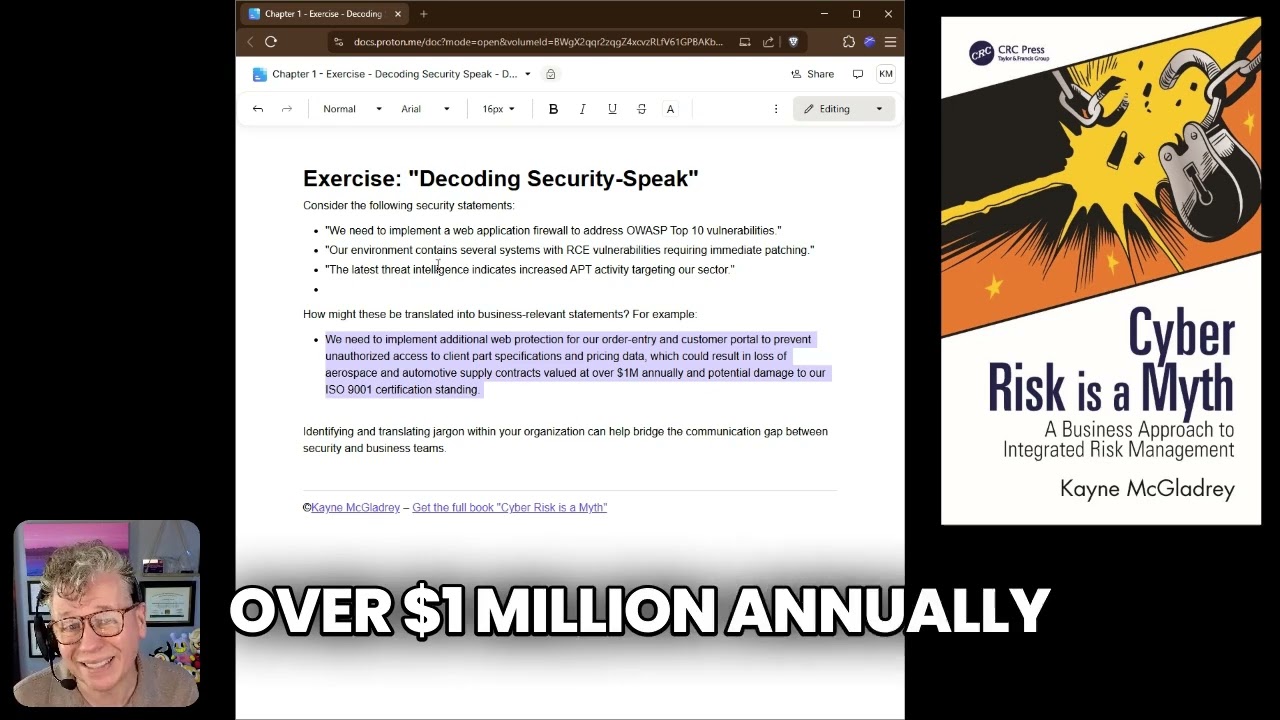
Let’s walk through what a finished exercise looks like when you apply it to real scenarios. We’ll use the fictional manufacturing company, Precision Components, LLC, to show how the translation works in practice. Imagine the security team has identified three specific technical issues that need executive attention, and consider how they look before translation versus the final output after using the worksheet.
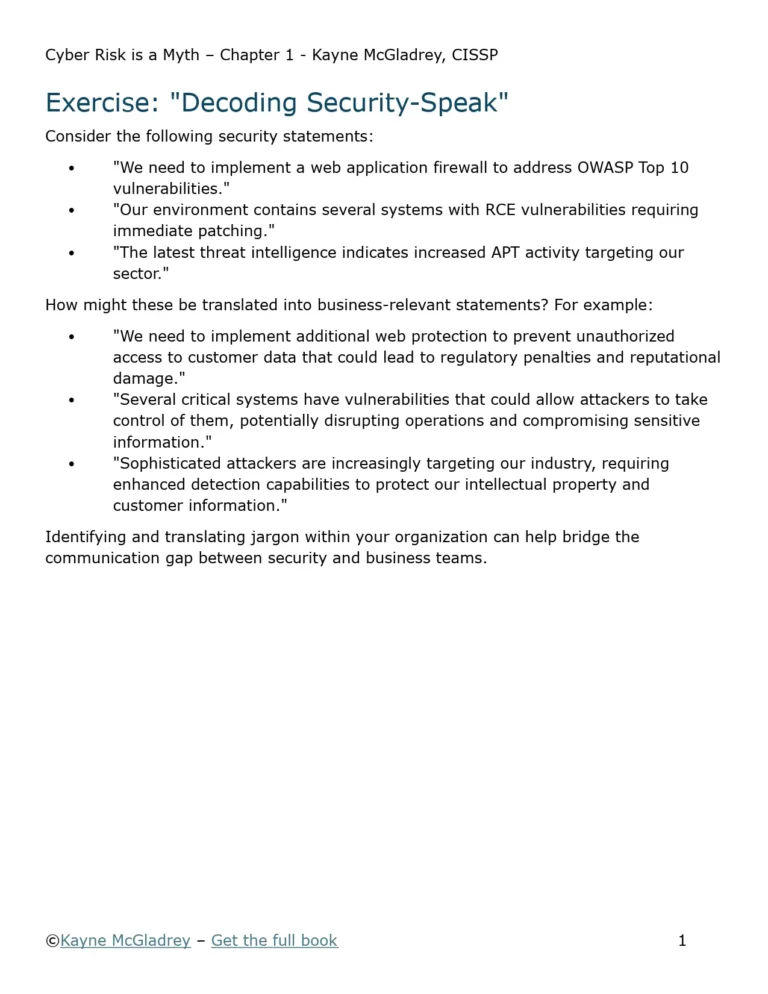
First, consider the web application firewall request where the technical team sees OWASP Top 10 vulnerabilities.
"We need to implement a web application firewall to address OWASP Top 10 vulnerabilities."
Without context, that’s just a buzzword salad that gets ignored. Using the exercise, we identify the business asset at risk as the customer portal used by aerospace clients, and we identify the consequence as loss of contracts and certification.
We need to implement additional web protection for our order-entry and customer portal to prevent unauthorized access to client part specifications and pricing data, which could result in loss of aerospace and automotive supply contracts valued at over $1M annually and potential damage to our ISO 9001 certification standing.
Notice how the word “vulnerability” disappeared from the narrative. It was replaced by the actual business outcome, while the dollar amount anchors the request in reality so nobody can argue with the stakes.
Next, look at the remote code execution (RCE) issue since technically this is a high-severity bug.
"Our environment contains several systems with RCE vulnerabilities requiring immediate patching."
In the workshop, we mapped it to the production scheduling systems because if attackers take control of these, the CNC machines stop working.
Several production-scheduling and inventory systems have vulnerabilities that could allow attackers to take control of them, potentially halting CNC machine operations and delaying shipments to customers who depend on our fast turnaround, risking contract penalties and loss of repeat business that represents the bulk of our $8.5M annual revenue.
Here, the focus shifts from “patching” to “revenue protection,” which means the CEO doesn’t care about RCE but they do care deeply about losing their primary revenue source.
Third, we tackle advanced persistent threats (APTs) because technical teams love to track these, but executives often tune them out as abstract dangers.
"The latest threat intelligence indicates increased APT activity targeting our sector."
The exercise forces us to narrow the scope so we know who is attacking, where they are striking, and what they are after.
Sophisticated, state-affiliated attackers are increasingly targeting mid-size manufacturers in the Dallas Fort Worth region and the automotive and aerospace supply chains specifically, requiring enhanced detection capabilities to protect our proprietary machining programs, client designs, and the intellectual property that differentiates us from competitors as we pursue export opportunities.
This version connects the threat to the company’s specific geography and industry vertical, highlighting the competitive advantage at stake so it’s no longer a generic threat but a direct challenge to their market position.
Finally, there was a bonus round in the video that shows an issue where the team found that their CNC controllers are running on unsupported operating systems.
"Our CNC machine controllers are running on an unsupported operating system version."
This is a classic technical observation, yet the translation adds the specific cost of downtime to make it urgent.
The software controlling five of our CNC machines can no longer receive security updates from the vendor, creating a risk that a single malware infection could disable our entire 10,000 sq ft production floor, idling 42 employees and costing roughly $23,000 per day in lost revenue until systems are restored.
This entry transforms a maintenance backlog item into a financial emergency, and the specific cost per day makes the urgency undeniable for anyone signing the checks. These examples prove that the same facts, presented differently, generate completely different reactions from leadership.
Common Questions About the Decoding Security-Speak Exercise
Do I need to fill out this worksheet for every single security alert?
No, because that would burn out your team fast. Use this for high-impact risks, budget requests, and strategic discussions where the audience isn’t technical. Routine alerts can stay in their native jargon. Reserve the heavy lifting for issues that could actually change the direction of the business.
What if my executive team doesn’t understand the business numbers either?
Then you’ve got a bigger cultural problem to solve, but starting with concrete numbers still helps. Even a rough estimate of revenue loss is better than a vague warning about risk, since numbers force people to engage because they imply accountability.
Can I use this for compliance reporting?
Yes. Compliance is often treated as a checklist, but framing it as business risk gets better attention from the people who sign off on it. Instead of saying “we meet HIPAA standards,” explain how avoiding non-compliance saves the company from massive fines and reputational ruin.
Does this replace the need for technical expertise?
Absolutely not. You still need the skills to find the vulnerabilities in the first place. This tool just ensures that your findings actually get heard by bridging the gap between finding the problem and solving it with real resources.
Is this only for cybersecurity teams?
No. Internal auditors, IT managers, and even risk officers can benefit from this approach. Anyone who needs to communicate technical risks to non-technical leaders will find value in this structured translation method.
What if I can’t find a dollar figure for the risk?
Start with a qualitative description first, since a phrase like “risk of major service outage” beats “server down” every time. If you can’t get exact numbers, ask for estimates or pull industry benchmarks. The act of trying to quantify the risk usually reveals its true importance anyway.
How long does it take to get good at this?
A: It takes practice, but most people get the hang of the basic pattern within three or four tries. The key is consistency. Make it a habit to review every major report through this lens before sending it out, and the translation starts to feel automatic.
Where Does This Training Come From?
This resource and the accompanying training are derived from the work of Kayne McGladrey, author of Cyber Risk is a Myth (published 2026). The book argues that separating cyber risk from business risk creates dangerous blind spots while offering practical methods for integration across departments. It’s in bookstores and libraries.
The fictional company scenarios used in the examples exist only for illustration purposes. They do not represent real organizations or actual security incidents. Use these patterns with your own context, because what works for one manufacturer won’t necessarily translate to every healthcare provider or financial services firm.