Turning Vulnerability Scans Into Budget Approvals
Rather watch this on YouTube instead?
Security teams live in a world of numbers where a scanner runs, finds a hole, and gives you a score. That score is usually a CVSS rating, and it tells you how bad the vulnerability is from a technical perspective. Then you send a report to leadership calling it “a risk”, but they see a 9.1 and shrug. Nothing happens for months until someone exploits that hole. Now you’re explaining why you didn’t fix something sooner, since the problem wasn’t the vulnerability, but the translation.
You can’t speak vanity cybersecurity metrics to someone who thinks in profit margins, so you need to tell them what it costs. This resource helps you make that switch, turning a technical finding into a business decision. It bridges the gap between the server room and the boardroom. Without it, security remains a cost center instead of a strategic partner.
Looking for the templates?
They’re available as Word | Markdown | Proton Docs. And you don’t have to register, though if you like, I do write a weekly newsletter about topics like this.
What Triggers the Need for This Framework?
You should reach for this framework when you need to justify spending money on security; it isn’t for your weekly status report, but for the moments that matter. Think about budget season where you have a list of patches to apply, and Finance wants to know why you need five thousand dollars for a consultant to fix a database server. Your standard answer won’t work because telling them about buffer overflows doesn’t make sense to them. Explaining that a failure stops production for four days does.
This tool also fits when you prepare for board meetings where executives don’t ask about CVE IDs. They ask about risk exposure and want to know if their reputation is safe. They want to know if regulators will fine them. If you walk into that room with a list of critical vulnerabilities, you’re set to fail. If you walk in with a one-page sheet showing a potential six-figure loss, your chances are substantially better. The framework guides you through the impact categories, forcing you to look at financial loss, operational disruption, and regulatory fallout. You use this when you need to move a risk from “low priority” to “immediate action.”
New system deployments are another trigger where you need to know what happens if a system goes dark before you flip the switch. Imagine a manufacturing company finding a vulnerability in an old quality-control reporting component. Is it a minor annoyance? Or does it stop shipments to an aerospace client? The framework helps you answer that before there’s a prolem. You map the dependencies. You assess the impacts. You decide if the risk is acceptable. You don’t guess. You document the decision, which saves arguments later.
Can Incident Planning Benefit From This Tool?
Incident response planning also benefits from this tool, since having a pre-written impact assessment speeds up the investigation process. You don’t waste time figuring out which business function’s affected. You already know, because you already estimated the cost. This reduces panic, and lets you focus on fixing the problem instead of scrambling to understand it. The goal is to build a library of these assessments, where each one covers a critical asset. Together, they form a defense plan based on reality, not bad vibes.
How Does the Gap Between Alerts and Action Cost Money?
Look at the Target breach in 2013, where their systems worked and leadership didn’t act. FireEye detected the malware. Symantec flagged the risky behavior. The alerts went out. Nobody stopped the attack because nobody had translated those alerts into business terms; instead, they sent technical warnings, and leadership only heard static. By the time the Department of Justice called, forty million credit card numbers were gone. The total cost was millions and millions of dollars. The technology existed. The translation process didn’t.
Most organizations face this same disconnect daily, where a scanner finds a flaw and the security team raises a brand-new high-priority ticket. The operations team ignores it because everyone assumes the risk is low, and their bonuses are based on shipping products or selling them, not fixing security holes. No one understands the impact. This happens because technical severity scores don’t account for context. A 9.8 vulnerability on a test server matters less than a 6.5 vulnerability on a payment gateway. The CVSS score treats them differently, but not always in the right way. It misses the business reality.
This framework fixes that reality, because it forces you to ask “So what?” after every technical finding.
- If this system goes down, how much revenue do we lose?
- If data leaks, what does the regulator fine us?
- If customers find out, do they leave?
These are the questions that drive funding. When you answer them, you stop sounding like an IT tech, and start sounding like a business leader. You align security with business strategy. You show that protection isn’t a cost center – it’s insurance against insolvency.
Why Do Small Companies Need This Tool?
Small companies still feel pain, since a forty-person shop can’t afford a week of downtime. Their margins are thin. One bad quarter ends their ability to expand into new markets or to develop new products. The stakes are high regardless of size. This tool scales. It works for a startup with ten employees. It works for a corporation with ten thousand. The math changes, maybe adding a couple zeros at the ends of financial numbers, but the logic stays the same. You measure impact in dollars. You measure urgency in time. You measure success in decisions made.
Ignoring this step leaves you vulnerable, because it invites complacency. It tells leadership that security’s just a checklist item. You want security to be a strategic partner, and to trust your judgment. The only way to earn that trust is to speak their language. Talk about profit. Talk about compliance. Bring up survival only if you need to.
A Look at the Completed Example
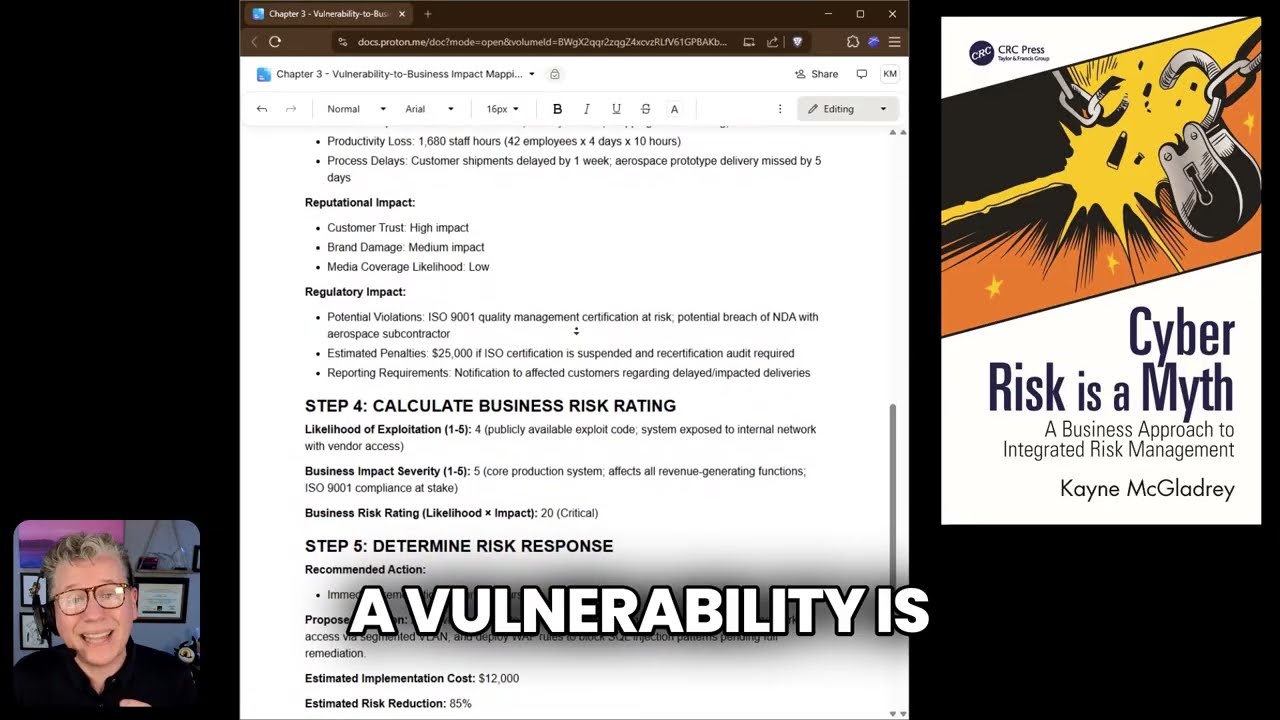
This will make more sense if you have the templates: Word | Markdown | Proton Docs
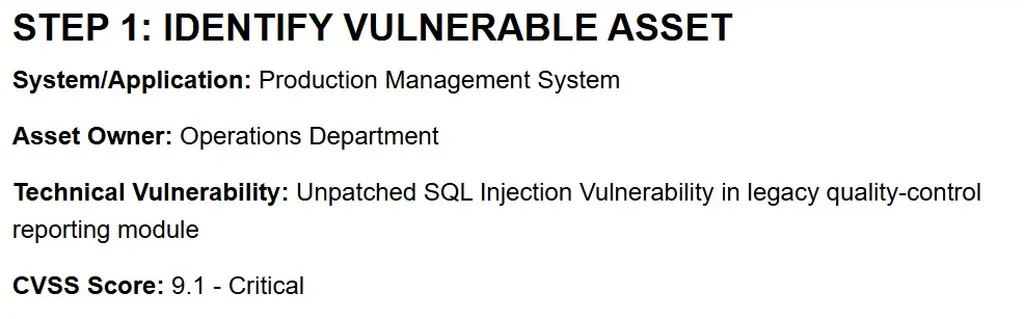
To see how this works in practice, consider the fictional company Precision Components. They run a CNC machining shop. Their production management system holds critical data. A scanner flagged a SQL injection flaw. The CVSS score was 9.1. That sounds scary. But what does it mean for the business? The team filled out the framework to find out.
They started by identifying the asset. The system is the Production Management System. The owner is the Operations Department. The technical issue is an unpatched SQL injection in a legacy quality-control reporting module.
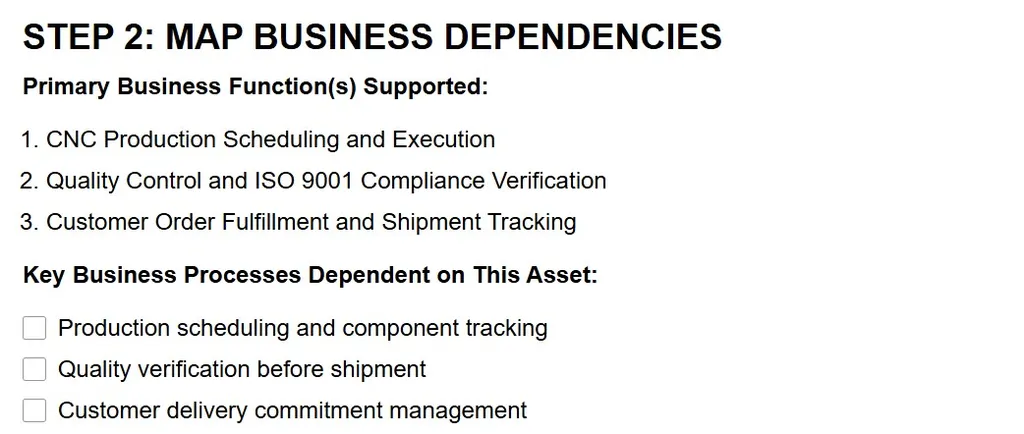
Next, they mapped the dependencies. This system isn’t just a database. It runs the schedule, checks the quality, and tracks the shipments. If it breaks, nothing moves.
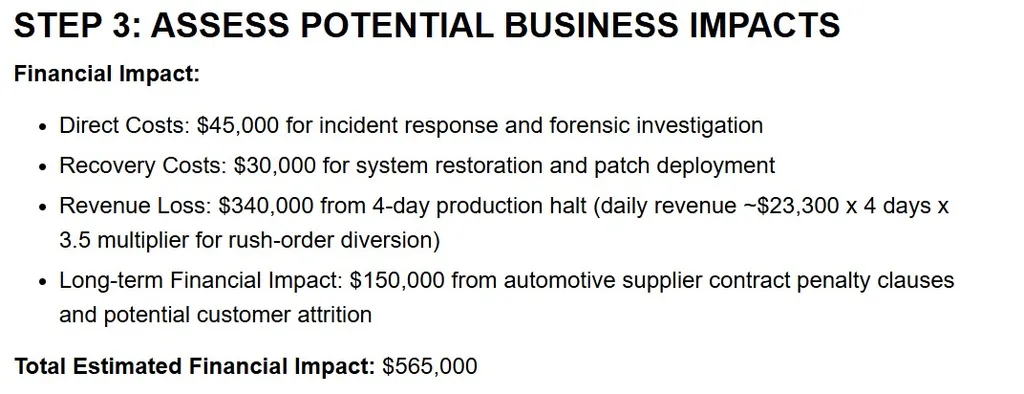
Then came the hard part. They put numbers on this. They calculated direct costs for incident response. They estimated revenue loss from halted production. They factored in reputational damage.
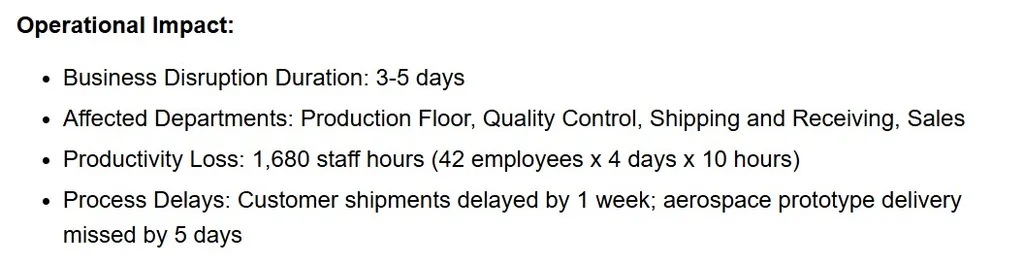
Operational impacts showed a three to five day disruption. Forty-two employees faced idle time. Shipping missed deadlines.
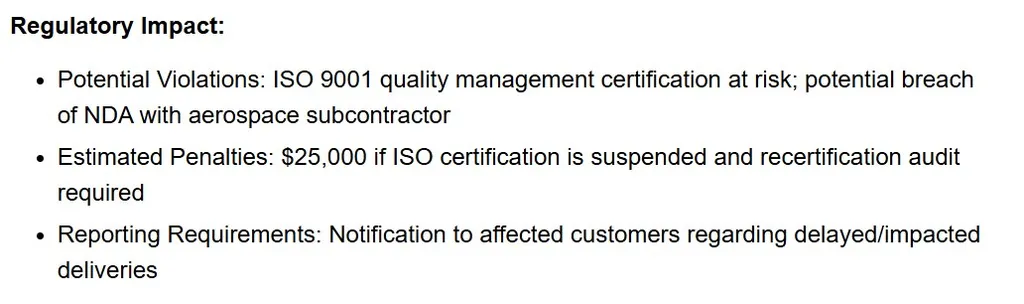
Reputational damage rated high for customer trust. Regulatory risks included ISO 9001 certification issues.

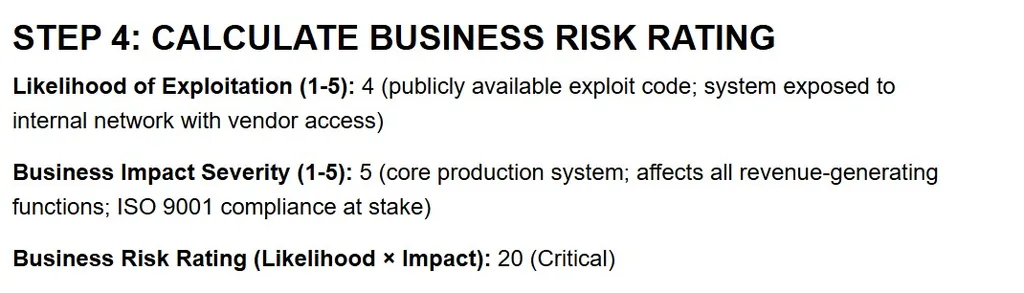
Finally, they calculated the risk rating. Likelihood was four. Impact was five. The total score was twenty out of twenty-five. That required action, because it was above the organization’s risk tolerance.
The recommendation was immediate remediation. The cost to fix was twelve thousand dollars. The risk reduction was eighty-five percent.
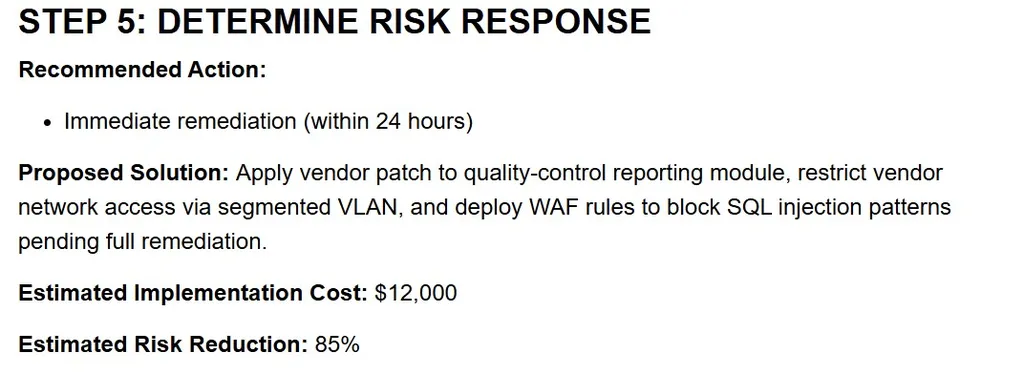
This single sheet tells a complete story. It replaces ambiguity with facts, and can help you prepare for those key conversations with leadership.
Frequently Asked Questions
How often should I update this framework?
You should review it whenever a major system changes or a new vulnerability appears, because treating it as a one-time project defeats the purpose. Business functions shift while revenue streams keep moving. Threat landscapes change too. A quarterly review keeps the data fresh, and if you wait too long, the numbers become stale.
What if I don’t have exact cost data?
Estimates work better than guesses since you can use industry benchmarks or consult with department heads. If you say “roughly fifty thousand,” that is stronger than saying “unknown.” Leaders prefer ranges because they need enough detail to make a choice. Just be honest about the uncertainty.
Can this work for cloud-only environments?
Yes, because the principle remains the same across all infrastructure types. Identify the service, map the business function, then assess the impact. Cloud providers give you some tools, but you still need to define the business value. The framework adapts to infrastructure changes naturally.
Who fills out this document?
Security leads should draft the technical details while business owners validate the impact figures. You need both groups for accuracy since a solo effort misses key dependencies. Collaboration ensures buy-in across departments. This prevents pushback later when budgets get tight.
Does this replace the risk register?
No, because this feeds into it instead of replacing the whole system. The risk register holds the summary while this framework provides the depth. You use this to populate the risk register with additional data that makes it actionable. Both tools work together for best results.
How do I handle confidential data in the report?
Sanitize specific identifiers before sharing the document with anyone outside security. Focus on the business function, not the secret behind it. For example, you can discuss revenue loss without naming a contract. Protect the source while sharing the impact so stakeholders still understand the stakes.
What if leadership rejects the recommended action?
Document their decision and record the reason for rejecting it. If they accept the risk, you have proof of due diligence on file. This protects you later if things go wrong. You did the analysis correctly. They made the call.
Attribution
This resource and the accompanying training are derived from the work of Kayne McGladrey, author of Cyber Risk is a Myth (published 2026). The book’s available from Routledge, and also your library. The fictional company scenarios used in the examples are for illustrative purposes only and do not represent real organizations.