The Risk Acceptance Decision Framework: Stop Guessing and Start Owning Your Exposure
Rather just watch this on YouTube?
Most organizations treat risk acceptance like a handshake deal in a hallway. Someone says, “We can’t fix this right now,” another person nods, and the problem gets tucked into a corner of a spreadsheet that no one looks at for years. This informal approach is how liabilities accumulate until they become lawsuits. The Risk Acceptance Decision Framework exists to stop that madness by forcing teams to evaluate, document, and approve security risks they cannot fully mitigate immediately. It ensures accountability, sets an expiration date for the decision, and defines the compensating controls required to manage exposure while waiting for a permanent fix.
Get the template
Microsoft Word | Markdown | Proton Docs
It’s free! Want more? I write a weekly newsletter where I release things like this.
When Should You Use This Resource?
You need this tool whenever a security vulnerability or control gap can’t be fixed within your standard remediation window. This often happens during major system deployments, like an ERP rollout, where business deadlines clash with incomplete security configurations. If you’re considering delaying a product launch by six months just to perfect access controls, you’re facing a business trade-off that requires formal documentation. The framework is your guide when the cost of delay outweighs the estimated risk exposure, but only if you follow the process. Pro tip: it sure helps if the other members of the executive suite have agreed to this process, so don’t YOLO this without introducing it first!
Consider a scenario where a mid-size manufacturer is launching a new customer portal. They find a moderate vulnerability in the authentication module two weeks before go-live. The engineering team guesses it’ll take four weeks to patch properly without disrupting other features, while the sales team insists on the original date. Without a framework, the CISO might cave under pressure, or the project manager might ship anyway and hope for the best. Both options are dangerous. Using this resource, the organization can formally accept the risk for a specific period, provided they implement temporary monitoring and get sign-off from the appropriate leadership levels. This provides defensibility if something does go wrong during the exposure period, and shows the organization was following a process they’d agreed to, which tends to play better in court or insurance investigations.
This tool is also helpful during mergers and acquisitions, or when inheriting legacy systems that pose known risks. You can’t always buy time to fix old code, but you must know exactly what you’re inheriting. If a due diligence audit reveals high-risk exposures in an acquired company’s infrastructure, you can’t simply ignore them. You need to decide whether to isolate the systems, accept the risk with strict limits, or reject the acquisition entirely. The framework provides the structure to make that call visible and defensible.
And you can use this when regulatory requirements or industry standards demand proof of due diligence. Auditors don’t care about verbal promises; they want a record that shows you understood the threat, calculated the impact, and made a conscious choice to proceed. If you skip this step, you are walking into an audit partially blind. The moment a breach occurs, investigators will ask who approved the unmitigated risk. If the answer is “nobody” or “it was just an email,” it’s going to be a bad month at the office. The framework ensures that every accepted risk has a paper trail, a named owner, and a clear path for escalation if conditions change.
Why Does Formal Risk Acceptance Matter?
The core argument of Cyber Risk is a Myth is that security risks aren’t technical puzzles; they’re business decisions. Treating them as anything else leads to failure. When security teams speak only in technical terms, executives tune out, and when business leaders ignore the technical reality, they gamble with the business processes they own. The framework bridges this gap by translating vulnerabilities into business impacts and facilitating a conversation about resources, timelines, and consequences. It turns abstract threats into concrete choices that leaders can actually understand and own.
Without a formal process, risk acceptance becomes a game of musical chairs where everyone assumes someone else is watching the door. The IT director thinks the CTO approved it, while the CTO thinks the board signed off. By the time a breach reveals the lack of oversight, the damage is done. This framework breaks the cycle of ambiguity by demanding three specific things:
- A specific name for the risk owner
- A quantified estimate of financial loss
- A defined timeline for resolution
It removes the ability to hide behind vague statements like “we’re managing it.” You either managed it on paper with evidence, or you didn’t.
The value extends beyond simple compliance because it protects the people making the hard calls. When a leader signs off on a time-bound risk acceptance with full knowledge of the potential downside, they’re making a strategic decision, not cutting corners. If the worst happens, there’s a record showing that the decision was informed, rational, and necessary for business continuity. This distinction is vital for legal defense and professional credibility, because it shifts the narrative from negligence to calculated risk management.
The framework also prevents risks from becoming permanent. Informal acceptances tend to linger indefinitely; a team accepts a vulnerability today because they’re busy, and then forgets to revisit it next year. The built-in expiration dates and reassessment triggers force the issue back onto the agenda. Conditions change, threats evolve, and what was acceptable six months ago might be reckless today. This mechanism ensures the organization continuously re-evaluates its posture rather than drifting into complacency, creating a rhythm of accountability that keeps risk management alive and relevant.
Using a standardized template also ensures consistency across the enterprise, because different teams have different habits. Some write detailed memos; others send quick chats. The framework provides a single source of truth that everyone understands by standardizing the language of risk. That makes it easier for executives to compare disparate issues and prioritize resources effectively. Whether it’s a supply chain disruption or a software bug, the format stays the same, allowing for apples-to-apples comparisons. This clarity is essential for allocating budget and attention where they matter most.
A Look at the Completed Example
Wouldn’t it be neat if you had the template and could follow along? Microsoft Word | Markdown | Proton Docs
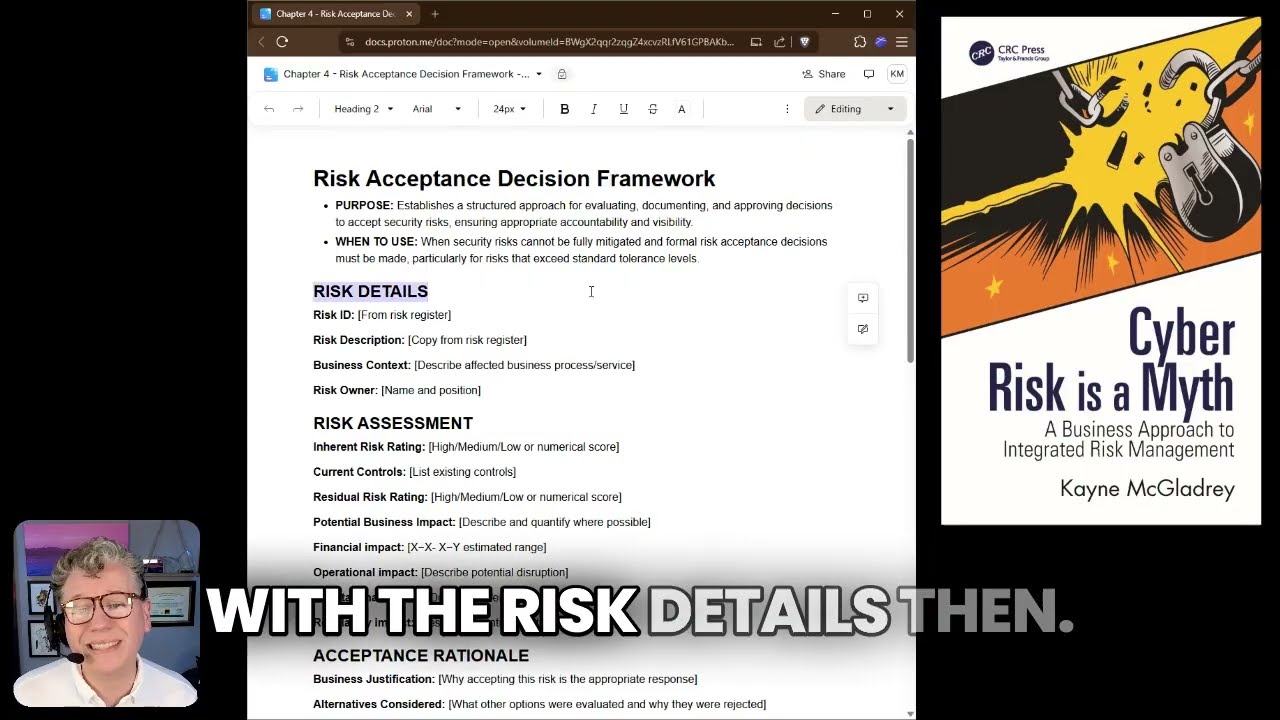
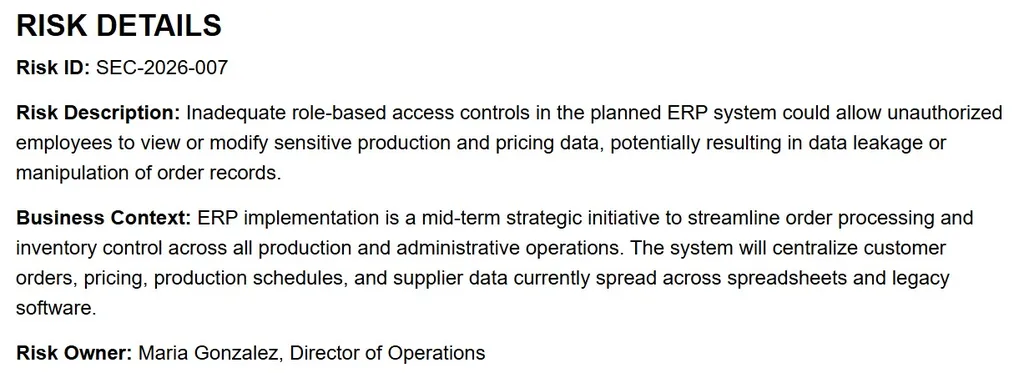
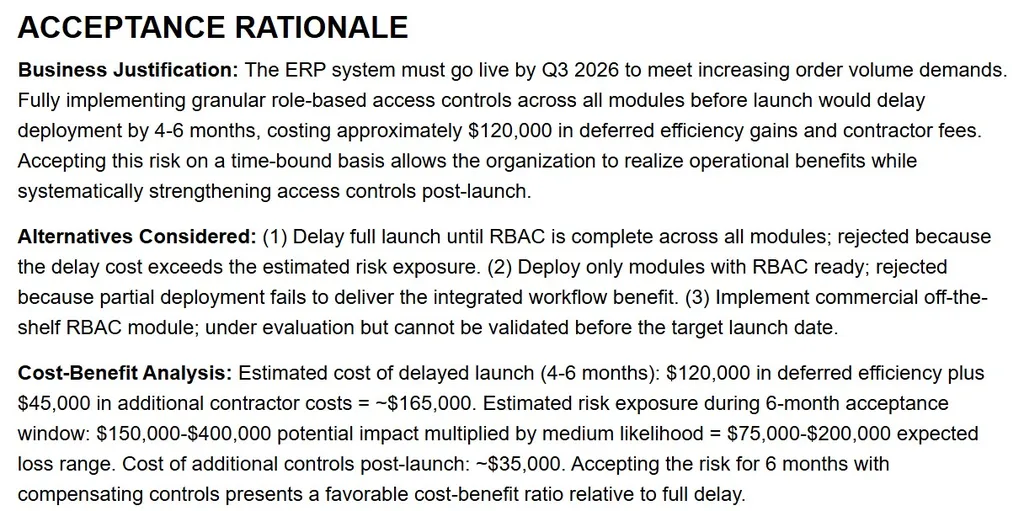
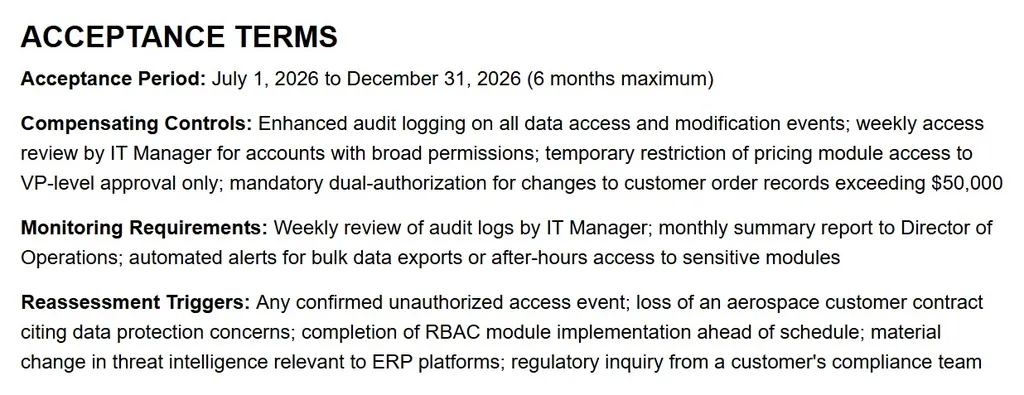
To see how this works in practice, let’s examine a filled-out form based on a fictional company, Precision Components. This manufacturer is implementing a new ERP system but faces a deadline that prevents full implementation of role-based access controls (RBAC). Here is how the framework captures that situation.
First, the Risk Details section establishes the basics.
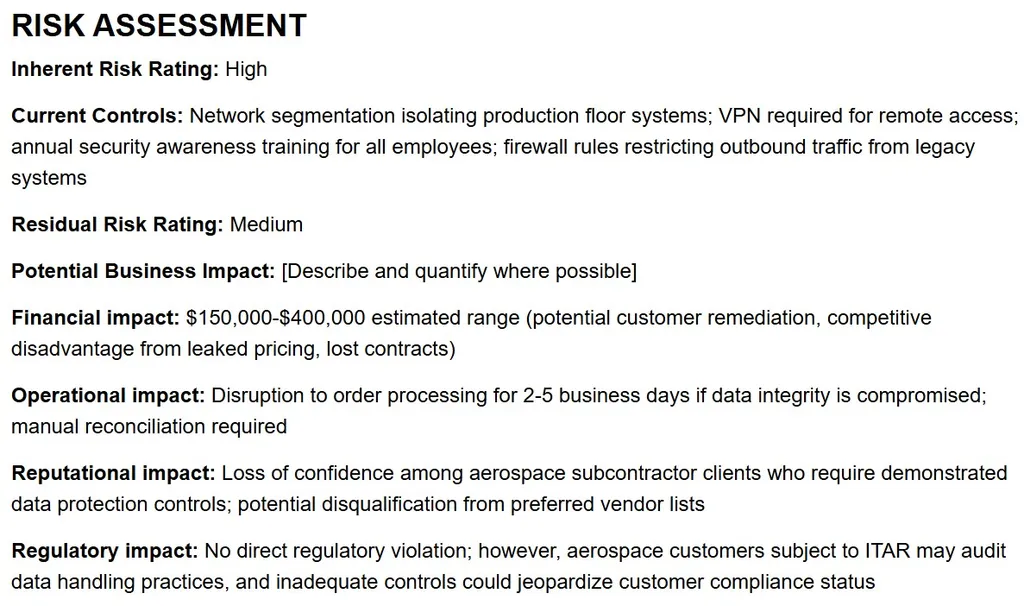
Next, the Risk Assessment quantifies the threat before and after current protections.
The Acceptance Rationale explains why the organization is willing to accept the risk.
The Acceptance Terms set the boundaries for this decision.
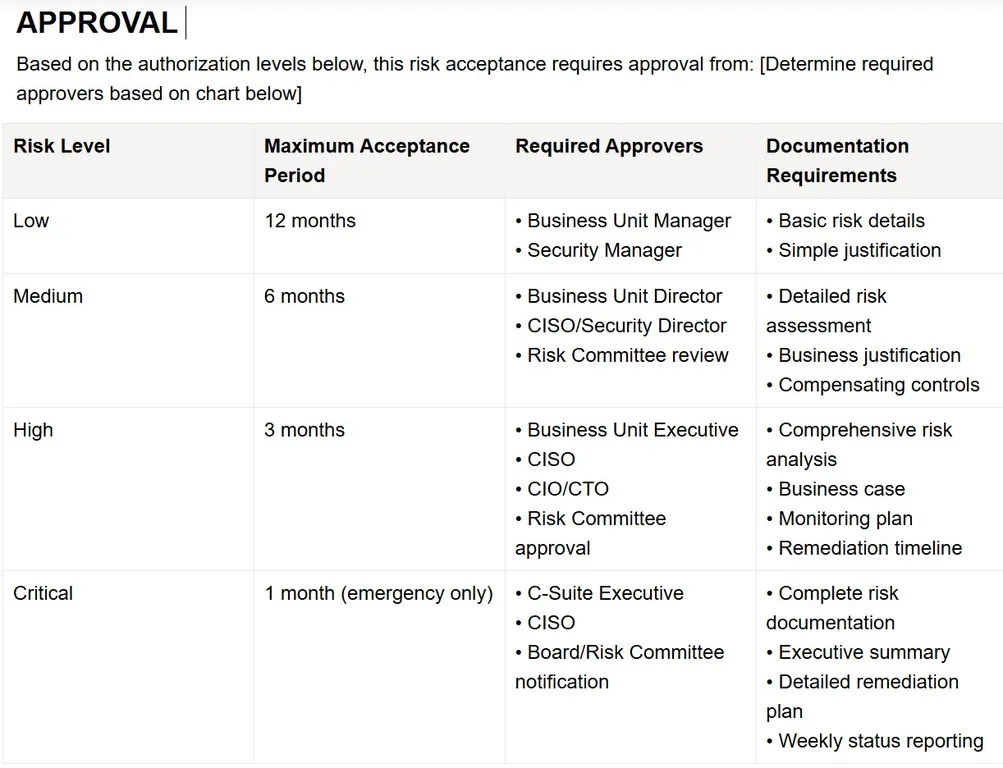
Finally, the Approval section ties it to governance.
Questions About the Risk Acceptance Decision Framework
What is the difference between inherent and residual risk ratings?
Inherent risk represents the raw threat level before any controls are applied, showing the worst-case scenario. Residual risk is the remaining exposure after current controls and compensating measures are taken into account. The framework uses both to determine whether a risk is manageable enough to accept with just compensating controls.
Can I accept a risk permanently without an expiration date?
That’s generally not a good thing, so the framework prohibits permanent risk acceptance. Every decision must have a specific end date, typically ranging from one month for critical risks to twelve months for low risks. This ensures conditions are re-evaluated regularly so no risk remains open indefinitely without review.
Who has the authority to approve a high-risk acceptance?
For a high residual risk, approval typically requires sign-off from a Business Unit Executive, the CISO, and the CIO or CTO, plus approval from the Risk Committee. The specific hierarchy depends on the organization’s predefined authorization table, which matches risk severity to the appropriate level of executive oversight.
What happens if a reassessment trigger occurs before the expiration date?
If a trigger event happens, such as a new vulnerability discovery or a change in business context, the acceptance period ends immediately. The risk must be re-evaluated and a new decision made, whether that means closing it with full remediation, renewing the acceptance with updated controls, or escalating the issue to higher leadership.
What happens if a risk acceptance period expires without a new decision?
Once the expiration date passes, the approval is void and the risk is no longer formally accepted. The organization must either remediate the vulnerability to bring residual risk down to an acceptable level, or submit a new risk acceptance request with updated context and controls. Operating beyond the deadline without a valid signature leaves the company exposed to liability as if the risk were never approved in the first place.
Can a business unit override the security team’s recommendation on risk acceptance?
Yes, but only if they follow the formal escalation path defined in the authorization table. A business leader can accept a risk that the security team advises against, provided they document the business justification, acknowledge the exposure, and obtain the required signatures from their own leadership chain and the CISO. This ensures the decision is conscious, and that the business owner, not the security team, bears the consequence of the trade-off.
Attribution
This resource and the accompanying training are derived from the work of Kayne McGladrey, author of Cyber Risk is a Myth (published 2026). The fictional company scenarios used in the examples are for illustrative purposes only and do not represent real organizations.