Stop Wasting Money on Reports Nobody Reads – The Business Impact Translation Matrix
Rather watch this than read this? Neat.
Security reports die in inboxes every single day. You write them, send them, and they vanish into the digital void until a breach forces everyone to pay attention. The problem isn’t your technical work; it’s your language. You speak in CVSS scores and CVE IDs while leadership speaks in quarterly targets and revenue streams. When these two worlds collide, nothing happens because nobody understands the connection between a server vulnerability and the company bank account.
The Business Impact Translation Matrix exists to fix that disconnect. It’s a simple worksheet that forces you to map technical flaws directly to business outcomes, turning abstract risks into concrete financial decisions. Without it, your warnings become noise. With it, your voice becomes leverage.
Template
Get the template as Markdown or Microsoft Word or Proton Docs. Yes, it’s free and not some marketing thing! Still have a burning desire to give me your email address? Subscribe to my newsletter for more resources like this.
When Should You Use This Business Impact Translation Matrix?
You need this tool whenever you stand in front of a decision-maker who doesn’t care about the technical details of a flaw. If you’re preparing a budget request for security tools, this is your starting point. Leaders won’t sign off on “better encryption,” but they might approve funding to stop a projected loss of half a million dollars. Use the matrix right before you present any finding that requires immediate action or resource allocation. Don’t just dump a scan result on their desk; instead, use the tool to build the bridge between what the scanner found and what that finding means for their KPIs.
Consider a scenario where an internal audit reveals a critical gap in customer authentication. You could send a standard alert saying “CVE-2025-XXXX detected,” but that message is going to be ignored. Or you could open the matrix and fill out the row. You identify that the affected system handles online orders, calculate that a breach would stop sales for three days, and note that a major contract renewal is due next month. Suddenly, the risk isn’t just a software bug, it is a direct threat to revenue and reputation. This is where the completed matrix will help you figure out what to communicate – you wouldn’t send them the completed matrix, but your email or slide deck should be based on it.
Use it during strategy sessions too. If the board is discussing expansion plans or new market entries, use the matrix to help determine how current vulnerabilities might block those specific goals. It works best when timing’s tight because if there is a compliance audit coming up or a product launch on the calendar, the matrix helps prioritize which holes to plug first. It stops the debate about whether a bug is “really bad” by quantifying exactly how bad it is in terms the rest of the leadership team cares about.
Don’t use it for routine maintenance updates or when talking to other engineers and analysts who already know the lingo. If your audience is technical, they don’t need the translation layer. Save the matrix for the people who hold the checkbook. It also helps when you have multiple vulnerabilities competing for attention because you can rank them side-by-side based on their business impact rather than just their technical severity score. This prevents the common mistake of fixing low-risk technical issues while ignoring high-risk business threats.
Why Does This Matrix Matter for Security Professionals?
Most security teams fail because they assume urgency transfers automatically from tech specs to business leaders. It doesn’t. A business leader looks at a list of fifty vulnerabilities and sees noise. They see a problem for IT to solve, not a problem for the company to fund. The matrix matters because it breaks that assumption. It forces you to do the hard work of translation before you ever walk into the meeting. That means asking yourself: “If this goes wrong, what actually breaks?” You have to:
- Find the dollar amount
- Tie it to the strategic plan
- Connect it to the consequences leadership already tracks
Connecting Technical Findings to Business Outcomes
This approach aligns with the core argument in Cyber Risk is a Myth. Security risk often feels abstract or incomprehensible to executives because the communication is broken, not because the threat isn’t real. The book argues that we need to stop treating risk as a purely technical metric and start looking at business outcomes. The matrix operationalizes that theory by providing a structured way to apply the concepts from Chapter 2 without requiring you to become a financial expert. It keeps the technical accuracy intact, while adding the necessary business context.
Without this tool, you’re relying on guesswork or hoping your manager reads between the lines. Hope isn’t a strategy, and guesswork leads to inconsistent reporting that makes you look unprepared. The matrix creates a standard format that builds trust over time. When leaders see that your communications come with clear numbers and actionable timelines, they start listening because they realize you understand their world, not just yours. That shifts the dynamic from “security police” to “business partner.”
Saving Time and Reducing Friction
It also saves time in the long run. You might think writing a detailed business case takes longer than sending a raw report. But if you have to then spend three months chasing approval for a fix that was urgent last quarter, you’ve wasted far more time. Getting the decision upfront means you can focus on solving the problem instead of fighting for resources, and it reduces the back-and-forth emails asking for “more context.” The matrix gives you the framework to provide that context once, clearly, and completely.
In a world where data breaches cost millions, being able to articulate value is just as important as fixing the code. You aren’t just reporting bugs. You’re protecting the organization’s future. The matrix ensures your internal planning produces messages that land when they matter most, turning your technical expertise into business influence.
A Look at the Completed Example
It’d be a lot easier if you were looking at the template right now. Markdown | Word | Proton Docs
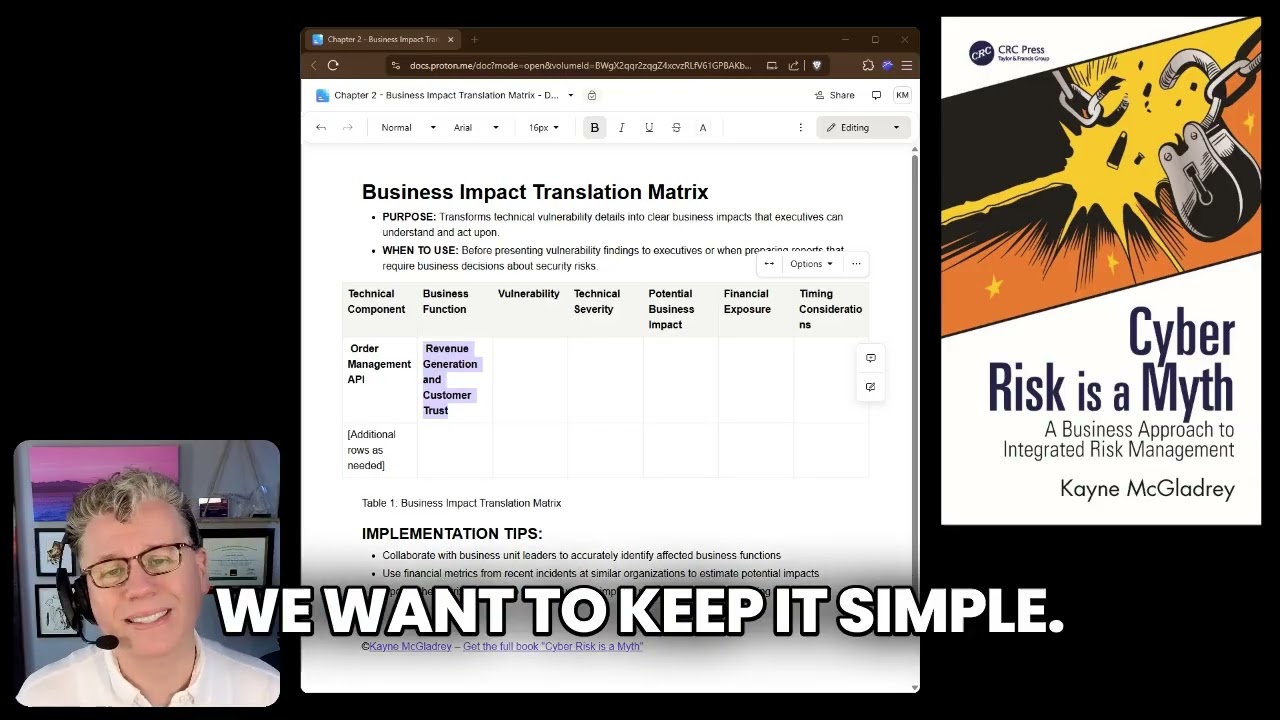
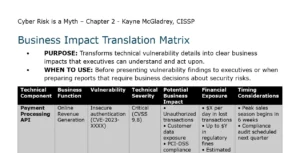
Let’s walk through exactly what a finished row looks like using a fictional case study. Imagine a firm like Precision Components, LLC. They make custom metal parts and rely heavily on an online order system, and their security team finds a flaw in the API that manages these orders. Here is how the matrix captures that insight to shape your internal planning before you speak to leadership.
First, you identify the specific technical component. In this case, it is the Order Management API. Next, you link it to the business function. For Precision Components, that function is Revenue Generation and Customer Trust. You don’t just say “IT System.” You say “Revenue.” Then you describe the vulnerability simply. Insecure Authentication (CVE-2025-XXXX) replaces the jargon-filled explanation.
The potential business impact section is where the magic happens. Instead of saying “Data leak,” you list the actual consequences. Unauthorized access to customer orders, theft of proprietary manufacturing specs, and violation of aerospace subcontractor SLAs. These are things the CEO cares about, and that you’d have to clean up if your message didn’t get through the first time.
Finally, you add the financial exposure and timing. This locks in the urgency.
| Technical Component | Business Function | Vulnerability | Technical Severity | Potential Business Impact | Financial Exposure | Timing Considerations |
|---|---|---|---|---|---|---|
| Order Management API | Revenue Generation & Customer Trust | Insecure Authentication (CVE-2025-XXXX) | Critical (CVSS 9.8) | • Unauthorized access to customer orders • Theft of proprietary manufacturing specs • Violation of aerospace subcontractor SLAs | • $150,000 potential revenue loss during downtime • Estimated $250,000 in breach remediation costs • Risk of contract termination ($2M annual value) | • Major aerospace bid proposal due in 3 weeks • Quarterly audit scheduled for next month |
When you show to a leader, the message is instant. They see that fixing this isn’t optional. It protects $2 million in contracts and avoids a $250,000 hit to the budget. The deadline in the timing column pushes it to the top of their queue. This is what effective communication looks like. It isn’t complex. It’s just clear. Remember, you use this data to build your slide deck or email, but the matrix itself remains your internal guide.
Common Questions (Q&A)
How much data do I need to estimate the financial exposure?
You don’t need perfect numbers. An educated estimate based on similar past incidents or industry averages works fine. Leaders prefer a rough number over no number at all, so use conservative figures if you aren’t sure. Try to provide a range that shows the scale of the risk.
Can I use this for small businesses with limited resources?
Yes, particularly for smaller firms where one breach could be fatal. The matrix helps them prioritize the fixes that matter most when they can’t afford to fix everything. Even a rough estimate of lost revenue is better than ignoring the risk entirely.
What if my executive team doesn’t care about the financial numbers?
That usually means they don’t trust the source yet. Start small and use the matrix for one or two major findings to show results. Over time, consistent linking of risk to money builds credibility. If they still ignore it, the problem is organizational culture, not your tool.
Does this replace technical reports for the engineering team?
No. The matrix sits on top of the technical report. Engineers still get the full depth of the vulnerability data. The matrix is a summary layer designed specifically for decision-makers who need the “so what?” answer immediately.
How often should I update the matrix for ongoing projects?
Update it whenever a significant new finding occurs or when business priorities shift. If a project moves to a new phase or a regulatory deadline changes, refresh the timeline and exposure columns. It’s a living document, not a one-time form.
Is this template suitable for cloud infrastructure risks?
Absolutely. Cloud risks often have massive business implications if left unaddressed. Map the cloud service to the business process it supports, then calculate the cost of downtime or data loss. The logic remains the same regardless of where the servers live.
Should I share the raw matrix file with my executives?
Not really. Keep the matrix as an internal planning tool. Use the data you’ve gathered in it to build your presentation, email, or slide deck. Your final message to leadership should reflect those insights without forcing them to parse a worksheet they didn’t ask for.
Attribution
This resource and the accompanying training are derived from the work of Kayne McGladrey, author of Cyber Risk is a Myth (published 2026). The fictional company scenarios used in the examples, such as Precision Components, LLC, are for illustrative purposes only and do not represent real organizations. For the full theoretical framework, refer to chapter two, “Lost in Translation: Why Technical Vulnerabilities Don’t Resonate”.