Using the Business Impact Analysis Maturity Assessment Checklist
You could just watch this on your phone, you know.
Security teams love talking about vulnerabilities. Vulnerabilities have names, numbers, and severity scores. But when they bring these lists to the boardroom, executives usually tune out. They don’t care about a CVSS score of 9.8; they care about whether quarterly revenue gets hurt or regulators show up asking for money. This disconnect isn’t just annoying, particularly when it causes real harm. Organizations spend millions on tools that sit idle because nobody translates technical threats into business risk, and most of those tools don’t do it for them. The Business Impact Analysis Maturity Assessment Checklist exists to fix that gap.
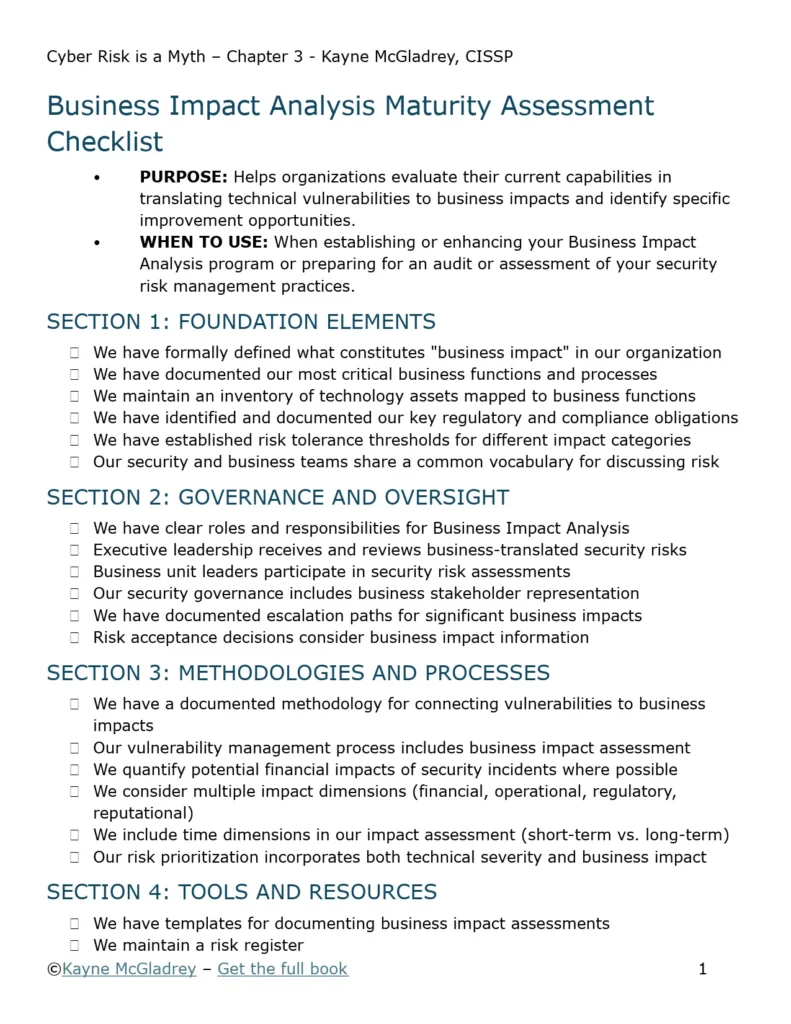
It helps you to stop guessing and start measuring how your potential process and technology failures can hit your wallet. You can download the template and use it immediately to assess your current process maturity. It works by breaking down your capability into five specific sections where each item asks if you actually do something or just pretend to. This tells you where your program lives on the maturity scale, moving from ad-hoc mess to managed system.
Looking for the worksheet?
Word | Markdown | Proton Docs
And if you like tools like this, they’re regularly released as a part of my newsletter every Friday.
When Would You Use This Maturity Assessment?
You should reach for this checklist whenever your security spending feels disconnected from reality. If you find yourself arguing with finance leaders about budget because they don’t understand the value of a patch, this tool helps. It helps by identifying the underlying process gaps that can cause communications breakdowns when talking about cybersecurity risks, and moves past why a specific control matters outside of compliance theatre. Consider a scenario where a mid-sized manufacturer expands into aerospace contracts. They suddenly face stricter rules about data protection and physical security, so their old risk management process won’t cut it anymore. But if they don’t understand which systems are most important and have a consistent way of making decisions based on that importance, what matters most becomes subjective.
It also fits perfectly when your organization moves too fast for its paperwork. Think about a fictional firm like Precision Components, which doubled its revenue in three years. They bought new machines, hired new staff, and moved into a bigger building, but did they update their inventory of tech assets against business functions? Probably not. That’s a classic growth trap. When you add operational capacity faster than documentation, risks hide in plain sight, so use the checklist when you suspect hidden dependencies exist. Maybe an old server runs quality checks for your main production line. If the statement, “we have documented our most critical business functions and processes” remains unchecked on the assessment, you know you have work to do.
You should also consider scheduling a review every six months because business conditions change. A static plan becomes obsolete over time, so if you haven’t updated the assessment since last year, your data’s stale. Treat this like a maintenance schedule rather than a one-time project to ensure your risk posture stays aligned with your actual business strategy instead of a past snapshot.
Why Does BIA Maturity Affect Risk Scoring?
Most security programs fail because they prioritize based on fear, not fact. You might patch the scary bug while ignoring the one that actually takes down your payment gateway. This checklist stops that behavior by creating a connection between the technology and the operation. It requires you to ask which business process fails and how much it costs if a system breaks, which shifts your focus from abstract technical “threats” to concrete financial loss. Leaders respect data they can act on, so numbers about downtime and fines take priority over abstract concepts about network intrusion.
There’s a reason generic templates rarely work, since they assume every company has the same structure. Your business model might rely on third-party vendors while another depends on in-house servers, but this tool adapts to those differences. It doesn’t tell you what to buy; it tells you what you need to measure. By quantifying impact, you create a baseline to track progress over time and prove that security investments reduced risk exposure. That proof gets you funding for the next cycle because without it, you just beg for money hoping the C-suite remembers you prevented a breach. Prevention looks invisible until there’s a disaster; measurement makes your work visible.
The underlying theory comes from the idea that risk management is a communication problem where technical alerts go ignored because they lack context. This framework fills that void by building a bridge between engineering and executive decision-making. If an organization cannot accurately assess the impact of a business system going offline, their entire risk scoring process is subjective. The assessment ensures that when you say “high risk,” everyone understands that means potential revenue loss, not just high exploitability. This clarity prevents wasted effort on low-value tasks and focuses resources where they matter most.
In the end, security isn’t about perfect uptime; it’s about operating profitably despite technical factors. This assessment keeps you honest about whether you’re protecting the right things and separates organizations that survive crises from the ones that crumble under them.
How Does a Completed Example Look?
It’d be so much easier if you had the template in front of you: Word | Markdown | Proton Docs
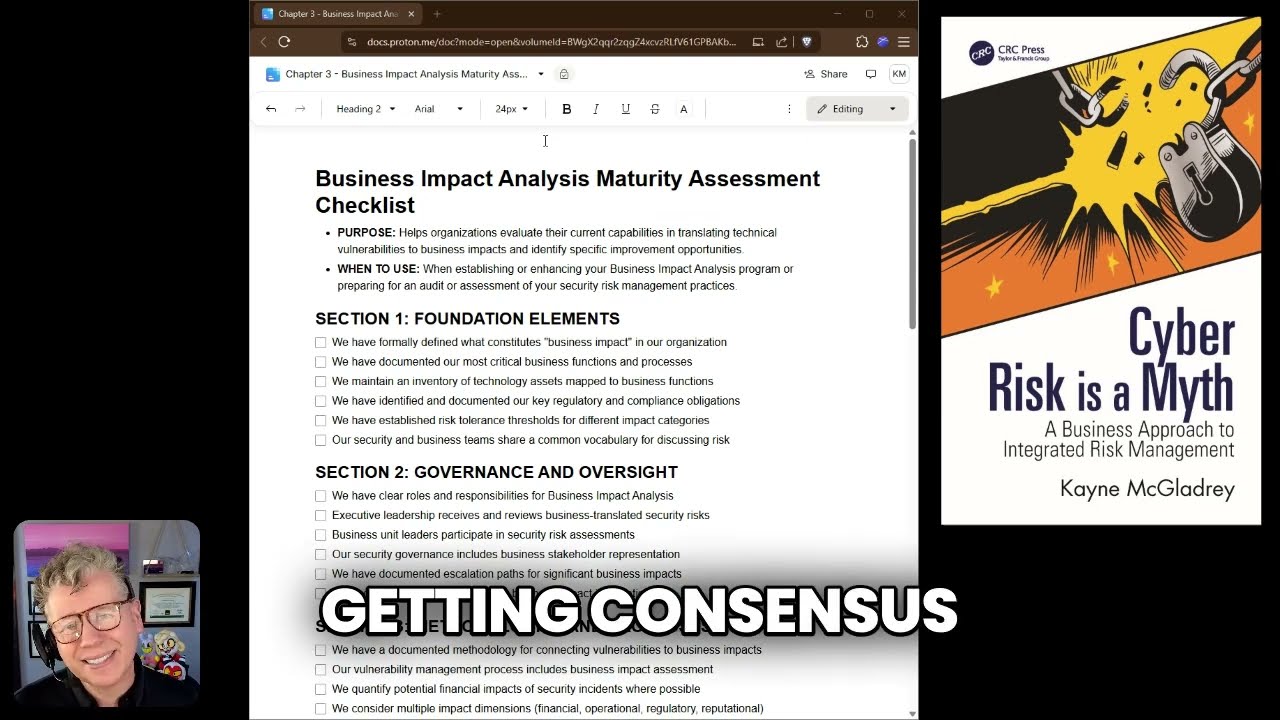
To see how this works in practice, consider the fictional case study of Precision Components. This manufacturing firm has grown rapidly but struggles with formal documentation. Imagine walking through the checklist with their team.
In Section 1, Foundation Elements, they have ISO certification but lack a mapped asset inventory, so they check the compliance box while leaving the inventory box empty.
-
- We have formally defined what constitutes “business impact” in our organization
- We have documented our most critical business functions and processes
- We maintain an inventory of technology assets mapped to business functions
- We have identified and documented our key regulatory and compliance obligations
- We have established risk tolerance thresholds for different impact categories
- Our security and business teams share a common vocabulary for discussing risk
Section 2 covers Governance. Their CEO receives reports yet ignores them because they are too technical, meaning that box stays unchecked. However, they do define roles for the safety manager, so one item there gets a tick.
-
- We have clear roles and responsibilities for Business Impact Analysis
- Executive leadership receives and reviews business-translated security risks
- Business unit leaders participate in security risk assessments
- Our security governance includes business stakeholder representation
- We have documented escalation paths for significant business impacts
- Risk acceptance decisions consider business impact information
As you move through the document, the scoring reveals their standing. They’re active, but don’t take a systematic approach. Heres how the final calculation looks when you finish the walk-through for this specific example.
Section 1: 3/6 = 50% complete
Section 2: 2/6 = 33% complete
Section 3: 4/6 = 67% complete
Section 4: 2/6 = 33% complete
Section 5: 3/6 = 50% complete

Overall: 14/30 = 47% complete
This percentage places them in the “Defined” maturity level, which means they have some rules, but lack consistency. They aren’t optimizing yet. The real value appears in the bottom section where you identify priority improvements. You don’t just want a score; you want a roadmap for fixing the low scores. For Precision Components, the biggest holes were in translating tech to business terms since they knew they had to improve here. These specific items become the focus for the next quarter.
Priority Improvement Areas (to be addressed first):
1. Documented critical business functions and mapped technology assets
2. Executive leadership receives and reviews business-translated security risks
3. Quantify potential financial impacts of security incidents
Notice the language: it doesn’t mention firewalls or patches. It mentions business functions, executive review, and financial impact. That’s the difference between a security task list and a business strategy. Your own results will vary based on your organization’s current maturity, and that’s okay – the goal is to drive action, not a perfect score. A lower score with a clear plan is better than a fake high score that hides problems. Use these fields to document decisions and assign ownership.
Frequently Asked Questions About the BIA Maturity Checklist
Do I need special software to use this assessment?
No, it works best as a simple document or spreadsheet. You need people, not tools, because the value comes from the discussion rather than the format. Keep it accessible so anyone can participate without needing a license or a login.
How often should an organization run this evaluation?
Plan for it twice a year at minimum since business conditions change. If you launch a new product line or enter a new market, run it sooner. Treat it as a regular health check that’s part of your risk program, not a one-time compliance exercise.
Is this only for large enterprises with dedicated security teams?
It applies to any size group that handles sensitive data or critical operations. Smaller teams benefit more because they often lack formal processes, and this checklist gives structure to informal habits. The scoring works the same whether you have two people or two hundred.
Can this replace a formal third-party audit?
No, it complements an audit. An auditor validates controls externally, while this tool builds internal understanding of how consistently you measure business impacts. Use it to prepare for an audit so you don’t get caught off guard by basic questions about your risk scoring methodology.
What happens if my score is low across all sections?
Don’t panic. A low score shows honesty, and it highlights exactly where you start. Pick the top three items from the improvement list and tackle them one by one. Progress beats perfection every time, particularly when you can show measurable improvement quarter over quarter.
Should business leaders fill this out alone or with security?
Work together, because security knows the technology while business leaders know the money. You need both views to get accurate answers about which business processes fail if a system breaks. A workshop setting works best for this collaboration since it forces the translation conversation the checklist is designed to provoke.
What do the different maturity levels actually mean?
The checklist sorts results into five stages: Initial, Developing, Defined, Managed, and Optimizing. “Defined” means you have rules but apply them inconsistently, while “Managed” implies consistent execution across the organization. Aim for “Managed” or higher because “Optimizing” requires a level of continuous improvement most teams aren’t ready for on day one. Understanding these labels helps you set realistic goals rather than chasing perfection immediately.
Attribution
This resource and the accompanying training are derived from the work of Kayne McGladrey, author of Cyber Risk is a Myth (published 2026). The fictional company scenarios used in the examples are for illustrative purposes only and do not represent real organizations.