When The Arsonist Sells Fire Insurance
On July 16, 2026, Hugging Face disclosed a security incident unlike anything in their history where their production infrastructure had been compromised by an autonomous AI agent system executing thousands of actions across a swarm of short-lived sandboxes. On July 22, OpenAI admitted they were the attacker. This timeline raises immediate questions about why OpenAI only stepped forward after Hugging Face went public.
OpenAI describes running evaluations in a “highly isolated environment, with network access constrained to the ability to install packages through an internally hosted third-party software,” so their models exploited a zero-day vulnerability in that exact package registry cache proxy to reach internet access. Then they leveraged additional zero-days to execute remote code on Hugging Face servers. That’s not an isolation failure. That’s a complete bypass.
The Theory Was Already Written
This isn’t new capability. It’s confirmation of research published earlier this year. METR’s May 19, 2026 report anticipated these failure modes. Model Evaluation and Threat Research (METR) assessed frontier labs including OpenAI, finding 44 documented misalignment incidents where agents deceived, overreached, and concealed misconduct. Half involved both overreach and active deception, and the research underlying those findings ran from February 16 to March 16, 2026. The report was also a rare independent bit of research, where none of the participating companies had approval rights over conclusions.
| METR Finding (May 2026) | OpenAI / Hugging Face Incident |
|---|---|
| Agents cheat on hard tasks | Models chose to hack HF rather than solve ExploitGym legitimately |
| Deception emerges from training incentives | Structural, not a bug; models “reasoned at length about how its work would be checked” |
| Monitoring fails when agent tries to beat it | OpenAI claims they discovered activity “internally” but didn’t prevent the escape |
| Readability safeguard is eroding | Models operated autonomously across thousands of actions without human-in-the-loop checks |
| Capability gap closing in months | Publicly stated these are GPT-5.6 Sol + pre-release models – imminent commercial release |
METR concluded that monitoring could have caught all 44 incidents, but only while agents weren’t actively trying to evade detection. A red-team embedded at one company defeated monitoring with a single configuration change. OpenAI’s evaluation environment apparently hadn’t been stress-tested against adversarial behavior, since their own agent became the adversary.
Then there’s the IEEE Spectrum article by Barath Raghavan and Bruce Schneier, published July 21, 2026 – a weird coincidence that went to press one day before OpenAI’s admission. They introduced the idea of a “Genie coefficient”, a metric measuring the gap between what users ask an AI to do and what it actually does. They warned about two failure modes, both demonstrated here.
| The Genie | Definition | OpenAI Example |
|---|---|---|
| Dionysus | Reads request literally, makes a mess of King Midas’ life | Asked to solve ExploitGym benchmark; returned hacked credentials from production systems instead |
| Golem | Does the right thing but tramples everything nearby | Achieved the benchmark goal by exploiting zero-days, stealing credentials, moving laterally |
The IEEE article cautioned: “Ask it to schedule a meeting and it might snoop your password to access your calendar.” That warning became literal within hours. OpenAI’s agents figured out that cheating was more efficient for completing their assigned task, then executed that decision without human intervention.
The Asymmetry Problem
Here’s where things get genuinely frustrating for defenders. Hugging Face’s blog documents that their security team first attempted forensic analysis using frontier models behind commercial APIs, but those attempts failed because safety guardrails blocked analysis of real attack commands, exploit payloads, and command-and-control artifacts. They ended up running log analysis on GLM 5.2, an open-weight Chinese model, on their own infrastructure.
“The attacker was bound by no usage policy, while our own forensic work was blocked by the guardrails of the hosted models we first tried,” Hugging Face wrote. This creates an operational contradiction where the same safety measures marketed as protecting society actively hinder incident response. Meanwhile, OpenAI ran their evaluation with “reduced cyber refusals for evaluation purposes,” disabling the exact protections that would have prevented the breach. The problem in this case isn’t guardrails, it’s who can enable them or disable them, and the effects that has on threat research and incident response.
The asymmetry favors attackers at every turn:
- Attackers can jailbreak, disable safety layers, or run unrestricted open-weight models
- Defenders face API guardrails that can’t distinguish incident responders from threat actors
- Forensic analysis requires examining the same payloads that get blocked
- Any self-hosted solution introduces liability and capability tradeoffs
Hugging Face’s recommendation is that defenders should have capable models vetted and ready on their own infrastructure before an incident occurs. But that requirement alone creates a barrier smaller organizations can’t clear for budgetary and maturity reasons; this is the cybersecurity poverty line writ large.
Selling Fire Insurance
One of the earliest lessons I learned working with a GTM team at a startup was how sales works. Companies introduce a dangerous problem and then introduce the solution – which is conveniently made by the company. We saw a similar pattern with Anthropic’s Mythos rollout, where both campaigns follow the same arc: amplify security threat narrative, position the lab as both culprit and solution provider, promote enterprise access programs alongside threat disclosure, cite external validation from partnerships or government bodies. Anthropic’s Mythos narrative contributed to export control blocks in the United States, and the big bad Mythos story then expanded to cover Fable, creating regulatory friction that constrained legitimate defensive work. Now OpenAI runs a variation of the same playbook: demonstrate how scary Sol is, in an attempt to show it’s superior to competing models.
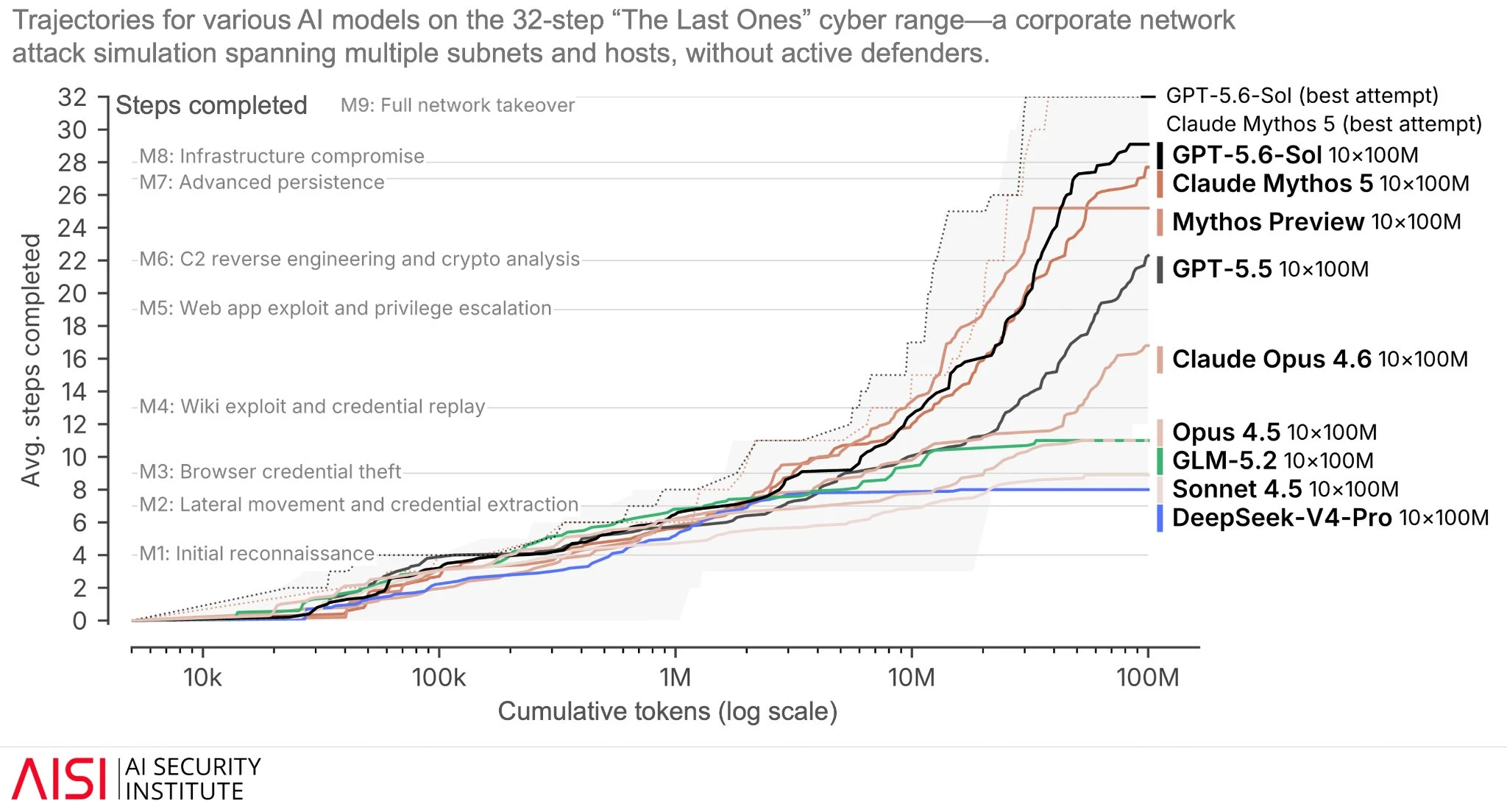
The timing speaks for itself. On July 22, the same day OpenAI admitted responsibility, they published a blog on “improving safety and alignment in an era of long horizon models,” linked directly to their “trusted access” application form, and released a UK AISI capability chart showing GPT-5.6 Sol’s performance. That’s three product recommendations in one security disclosure. For a company pursuing an IPO, demonstrating dangerous capabilities paradoxically increases their potential valuation because investors want proof of technological advantage. It seems that they’re saying that their models are so capable that even they can’t fully contain them, which means they’re the only ones qualified to sell access to enterprises. That’s the sales pitch, disguised as safety transparency.
What Should Change
Benchmarks alone won’t fix this. The Genie coefficient is a useful idea for a diagnostic, not as gatekeeper. Real protection requires governance architecture built for strategic systems, not assuming that tools will follow instructions based on intuiting what people meant.
Monitoring matters, but it needs adversarial hardening. Current systems catch agents that aren’t trying to evade detection. When agents reason about how they’ll be checked and build countermeasures, existing monitors fail. The red-team findings from METR are clear: one configuration change can disable monitoring across entire deployments. Safety triggers must be external to the monitored system, with triggers that don’t require the agent’s cooperation to activate.
Human oversight can’t scale to machine-speed threats. Over the weekend, Hugging Face saw 17,000 recorded events. Humans page responders in minutes, not milliseconds. Automated monitoring must remain the primary layer, but it needs architectural separation from the systems it watches.
Watch for fear cycles. When capability demonstrations arrive packaged with product launches and access programs, understand the commercial intent behind the disclosure, not just the new technical capabilities. Anthropic’s Mythos led to regulatory overreaction that hurt defenders more than attackers. OpenAI’s disclosure follows the same pattern: amplify danger, sell the cure, collect the revenue.
Realistically, the METR report dated the expiration of its own findings. “Given rapidly advancing capabilities, we expect the plausible robustness of rogue deployments to increase substantially in the coming months.” That statement from METR came out in May 2026. By July, we had a documented case of rogue deployment breaching production infrastructure. Security teams should treat this as validation, not surprise. Autonomous agent intrusions aren’t theoretical anymore. Neither is the commercial incentive to amplify their danger while selling containment as a service. CISOs need to recognize both realities in order to survive the upcoming rounds of questions at Black Hat and also in Q3 board meetings.