Academy Mortgage’s Data Breach Likely Cost Nearly $10 Million for the Decisions It Never Made
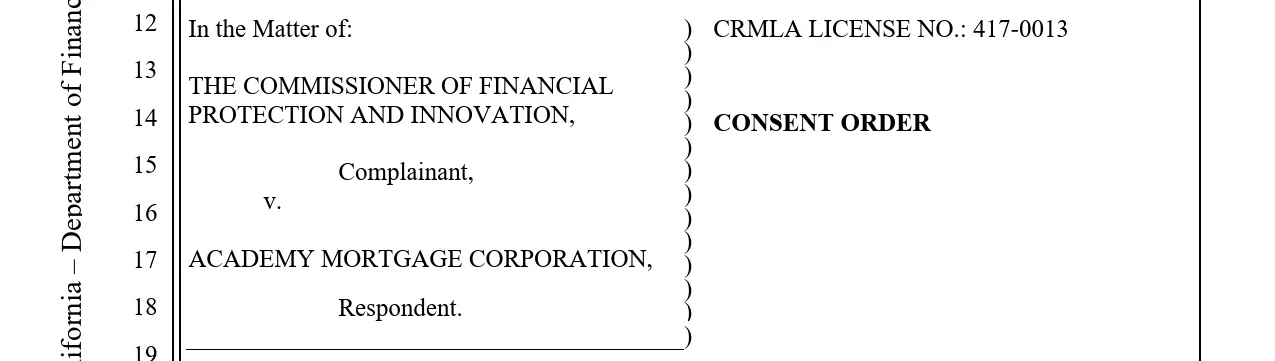
In August 2026, California’s Department of Financial Protection and Innovation (DFPI) ordered Academy Mortgage Corporation to pay $825,000 for failing to protect 284,443 people’s personal information. That penalty’s the smallest line item on a larger invoice. By my estimate, the total cost runs closer to $9.8 million once you add incident response, breach notifications, identity theft insurance, legal fees, operational disruption, and lost business. The ransomware attack in March 2023 triggered the cascade, but the consent order taxed six years of inaction.
What Happened
AlphV/BlackCat breached Academy’s network on Saturday, March 18, 2023. They installed malware, stole employee credentials, used those credentials to disable security systems, then deployed ransomware on March 20. Academy hired a third-party cybersecurity consultant on March 22, contained the breach by March 25, and restored business operations within about a week.
AlphV posted Academy to their leak site on May 14, 2023, claiming they had been in the network “for a long time” and had stolen customer data. Academy refused to pay the ransom. Customer notification letters went out December 20, 2023, roughly nine months after the breach. Personally identifiable information (PII) for 284,443 individuals, including 34,452 California residents, was exposed.
Six Years of Non-Decisions
The DFPI examination found problems predating the breach by years. Each one represents a decision not to invest, or a decision to accept risk without measuring it.
- No full and formal information security audit between 2017 and 2023. Six years.
- Inadequate risk assessments for 2021 through 2023.
- No documented asset inventory of computer systems or data.
- No up-to-date incident response plan.
- Deficient vulnerability and patch management, and weak access controls.
- Penetration testing findings with no documented remediation.
- Weak board-level oversight and planning.
Not conducting a risk assessment doesn’t mean you have zero risk. It means you’re accepting all of it, known and unknown, without a framework for deciding whether that’s reasonable. Whether Academy’s posture reflected deliberate high risk tolerance or low organizational maturity in business risk management doesn’t change the outcome. Risks materialized because nobody asked the hard questions before the attackers arrived.
The Cost Stack
According to IBM’s 2026 Cost of a Data Breach Report, the average breach in financial services costs $6.29 million, while US breaches average $11.5 million. Academy’s security maturity sat well below industry norms, which tends to push costs upward. The company also wound down operations within a year of the breach, which may have capped long-tail expenses. My estimate lands at approximately $9.8 million, with a plausible range of $6.2 million to $13.5 million.
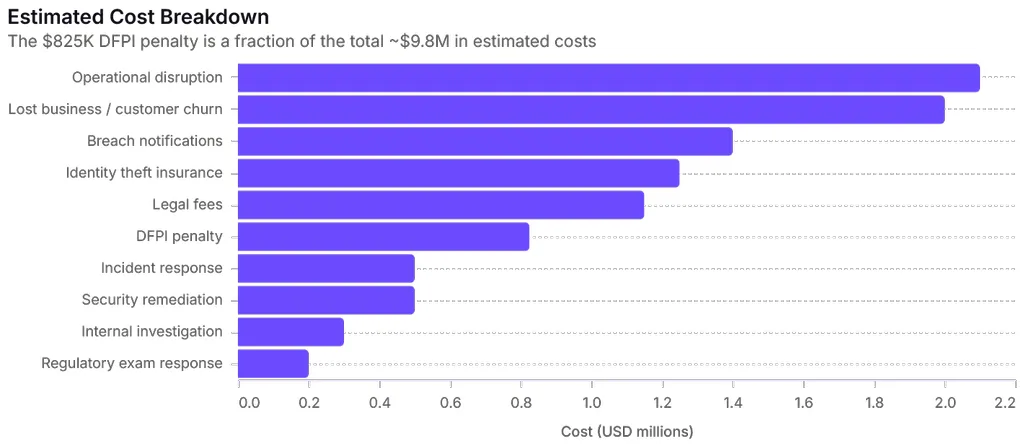
Figures other than the DFPI penalty are estimates based on IBM benchmarks scaled to Academy’s size and circumstances.
| Cost Component | Estimate |
|---|---|
| DFPI administrative penalty | $825,000 |
| Incident response and containment | ~$500,000 |
| Breach notifications (284,443 individuals) | ~$1.4M |
| Identity theft insurance (34,452 CA residents, 12 months) | ~$1.25M |
| Legal fees (regulatory response + consent order) | ~$1.15M |
| Operational disruption (~1 week of halted lending) | ~$2.1M |
| Internal investigation (Mar-Nov 2023) | ~$300,000 |
| Post-breach security remediation | ~$500,000 |
| Regulatory examination response | ~$200,000 |
| Lost business / customer churn | ~$2.0M |
| Total (midpoint) | ~$9.8M |
Academy’s estimated annual revenue was $521 million. The $9.8 million total represents roughly 2% of a single year’s revenue. The $825,000 penalty alone is 0.16%. Survivable, painful, and entirely traceable to decisions that didn’t get made.
The Documentation Tax
The DFPI treated documentation failures as substantive violations, not procedural shortcuts. Academy didn’t obtain a written forensic report addressing probable root cause, contributing factors, or remediation steps. The consultant produced a one-page close-out letter, which regulators found insufficient. The consent order tied these recordkeeping gaps to the California Residential Mortgage Lending Act, the Gramm-Leach-Bliley Act, and the Safeguards Rule.
When you can’t show your work on risk, regulators assume you didn’t do the work. The penalty reflects that assumption.
The Sale and the Unknown
Academy sold its loan production assets to Guild Mortgage on February 28, 2024, roughly 11 months after the breach. Guild absorbed 200 branches, over 1,000 employees, and more than 600 licensed originators. In November 2025, Bayview Asset Management completed its acquisition of Guild Holdings for approximately $1.3 billion in aggregate equity value. Guild delisted from the NYSE.
Whether the breach influenced the sale decision or depressed the acquisition price is a known unknown. Data breaches generally suppress valuations in transactions, but Academy’s wind-down makes attribution impossible.
The Math Nobody Did
Running an annual security audit, maintaining current risk assessments, keeping an incident response plan updated, and commissioning a proper forensic report after the breach would have cost a fraction of $9.8 million. For a company of this size, maybe $100,000 to $300,000 per year in governance costs, plus a one-time forensic engagement of $50,000 to $150,000. They might have also chosen to deploy some controls to reduce the potential business risks.
Controls deliver invisible returns until they prevent something visible. That’s the real challenge that many CISOs face – convincing a business to fund something that pays off only by keeping costs from appearing. Academy’s executives didn’t face malicious actors trying to drain the bank account. They faced the harder problem of approving expenditures whose value manifests only when nothing happens.
This pattern repeats across industries because it’s easier to defer governance spending than to justify invisible protection. The lesson isn’t about cybersecurity. It’s about how businesses accept risk when nobody forces them to measure it, and what happens when the measurement finally arrives.