While Gates Wrote an Essay, RAND Showed Their Work
On August 26, 2026, Bill Gates published a 6,000-word essay arguing that AI will either be “the greatest equalizer ever invented, or the worst source of injustice.” The Guardian, CBS News, and other outlets covered it extensively. Coverage focused on jobs, the Human Reserved concept, and Gates’ personal credibility (the Guardian reminded readers about those Epstein meetings).
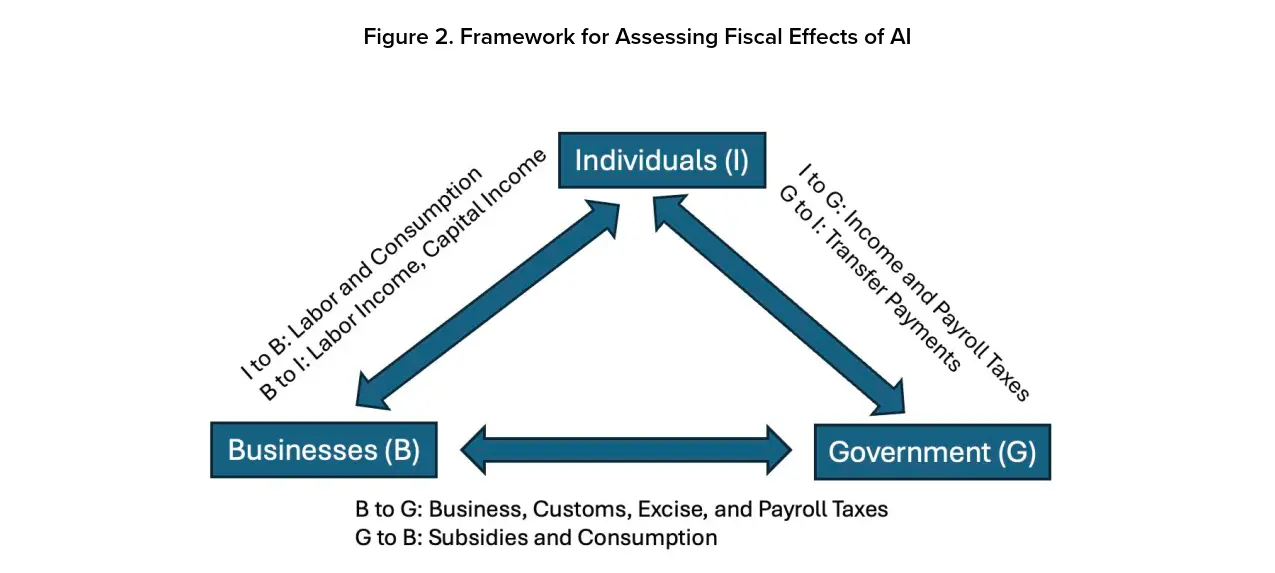
One day earlier, on August 25, RAND Corporation had published a 47-page report examining United States federal tax revenue impacts when AI replaces human labor. Authors Carter C. Price and Akshaya Suresh developed the analysis starting in August 2025, when it first appeared as a working paper. A year of calibration, review, and revision followed – and the press basically ignored it.
I’m not affiliated with either, but if you’ve read my prior work, you know I love reports, particularly ones that aren’t affiliated with cybersecurity or AI vendors.
Two Documents, Same Intersection
Gates writes in the register of moral urgency whereas RAND writes in the language of dynamic stochastic general equilibrium (DSGE) modeling. Guess which one gets attention and doesn’t need a math degree to understand. But if you are making decisions about AI’s economic trajectory, the RAND report deserves equal time alongside Gates’ essay.
| Gates Essay | RAND Report | |
|---|---|---|
| Published | Aug 26, 2026 | Aug 25, 2026 (working paper since Aug 2025) |
| Format | 6,000-word personal essay | Peer-reviewed research report |
| Primary audience | Public, lawmakers | Economists, policymakers |
| Tax proposal | Tax AI tokens and robots | Shift from labor taxes; excise taxes; UBI; possible nationalization |
| At-cost AI scenario | Not addressed | Central to analysis |
Both land in the same place, but RAND shows the path isn’t obvious. Even when corporate tax revenue holds or rises, the payroll and income taxes lost when a salaried worker is replaced leaves the government short. AI displaces workers, net revenue falls, and the safety net gets harder to fund. Gates frames this as a moral crisis. RAND quantifies it as a fiscal one.
The At-Cost Problem Nobody’s Talking About
Gates proposes taxing AI tokens and robots with straightforward logic. Employers pay payroll taxes on human workers but can write off robot purchases as business expenses. Fix the incentive to slow displacement and fund retraining. He’s been making this argument for years.
RAND’s modeling complicates the view. Their report constructs four scenarios along two axes: whether displaced workers find new jobs, and whether AI is priced monopolistically or at cost. The at-cost scenarios are where things get bad.
If AI systems are widely accessible at or near the cost of inference (think open-weight models like Meta’s Llama series or Alibaba’s Qwen), firms providing AI-enabled services cannot extract monopoly profits. There’s nothing to tax. RAND’s simulation, projecting outcomes to 2035 under a 10% workforce displacement shock, shows the damage:
| Scenario | New Jobs? | AI Pricing | Nominal GDP 2035 ($T) | Corp Tax Rev 2035 ($T) |
|---|---|---|---|---|
| Baseline | – | – | 43.9 | 0.80 |
| Business as Usual | Yes | Monopolistic | 43.0 | 1.05 |
| Hyperconcentration | No | Monopolistic | 48.3 | 0.86 |
| Price Shocks | Yes | At Cost | 32.4 | 0.57 |
| System Breaks | No | At Cost | 33.2 | 0.21 |
In the worst case, corporate tax revenue collapses from $0.80 trillion to $0.21 trillion. Nominal GDP falls to $33 trillion against a $43.9 trillion baseline. Deflation eats the tax base from the inside. A robot tax on hardware inputs might capture 2% of federal revenue. Taxing compute time could supplement revenue during transition. If AI genuinely commoditizes cognition, the profit pool everyone assumes will exist to tax might not be there. The monopolistic scenarios look almost benign on GDP – Hyperconcentration even runs hot at $48.3T – but that headline hides the revenue mix problem. Gates doesn’t address this; RAND spends 47 pages on it
The Corporate Tax Offset Doesn’t Close
Gates notes the tax system nudges employers toward replacing people with machines, though he doesn’t quantify what closing that gap requires. RAND finds corporate tax rates would need to roughly double to reach parity with current labor tax revenue. In 2024, 84% of federal revenue came from individual income and payroll taxes. When you swap a salaried worker for an AI system, you lose the income and payroll taxes on that salary. The AI owner pays corporate tax on whatever profit remains, but at 21%, the revenue does not come close to replacing what walked out the door.
High-income amplification makes this worse. RAND notes that in 2022, the top 10% of earners contributed 72% of federal revenue from individual taxes. If AI targets high-paid knowledge work first, the revenue shock is outsized relative to headcount. Even if displaced workers find new jobs at similar pay, the fiscal hit resembles a recession. If they do not, and AI is cheap, it is a structural collapse.
Different Jobs, Same Building
Gates compares the needed government reorganization to post-9/11, except bigger. He wants new domestic institutions, an international body modeled on nuclear inspections, and United States-China cooperation. His staff is reportedly working on a November meeting with President Xi Jinping.
RAND does not address diplomatic architecture, assuming instead a closed United States economy and flagging that as a limitation. If foreign firms own the AI models displacing United States workers, the capital income that might partially offset labor losses flows overseas. No offset at all.
What This Means For Public Policy
If you are betting on AI economics, understand what you are betting on. Three scenarios deserve tracking:
- Monopoly rents hold. A handful of AI firms capture the value. Tax them heavily enough and you might close the gap. Gates’ robot tax works here. RAND’s numbers say you would need to roughly double corporate rates.
- AI commoditizes. Open-weight models drive prices to marginal cost. There is no profit to tax. Nominal GDP contracts. The tax base shrinks faster than in the monopoly case, and nobody has a clean answer for this one.
- The transition is uneven. Some sectors see monopoly dynamics, others see commoditization. The fiscal outcome depends on the mix, and it will vary by market and task.
Gates is building political will while RAND built the analytical foundation for policy. The public conversation stopped at the alarm, but the measurements sit right there.