Picking the Security Certification That Actually Unsticks Your Deals
A prospect sends over their vendor security questionnaire, and buried between “MFA policy” and “vendor management” sit three checkboxes sales can’t explain. SOC 2, ISO 27001, and the Cybersecurity Maturity Model Certification (CMMC). Are they the same thing? Interchangeable? A scam? None of the above. All three show up in questionnaires because procurement teams keep copying the last questionnaire they saw, and the copy chain rarely distinguishes between a market gate, an attestation, and a management system standard. The seller’s job is simpler than the questionnaire makes it look. Figure out which badge your actual buyers want, earn that one first, and let the rest wait.
What Each One Actually Is
SOC 2
The American Institute of Certified Public Accountants released SOC 2 in 2010 as an attestation framework for service organizations, and it has since become the default handshake for B2B SaaS. An accredited CPA firm examines your controls against the Trust Services Criteria, where Security is mandatory and the rest are optional add-ons.
- Security (always required)
- Availability
- Confidentiality
- Processing Integrity
- Privacy
Two report types exist. Type 1 checks your controls at a point in time, which makes it the placeholder buyers tolerate rather than respect. Type 2 tests that the controls actually operated over a period, typically a year, and a Type 2 report is what enterprise buyers mean when they say “send us your SOC 2.” There’s no certificate. You get a report shared under NDA, refreshed annually, because buyers treat a stale report the way banks treat old income statements.
ISO 27001
ISO 27001 is the international standard for an information security management system (ISMS), and it takes a different philosophical position than SOC 2 on nearly everything. Rather than tailoring criteria per customer, you build an ISMS against clauses 4 through 10, select applicable controls from the 93 in Annex A (four themes covering organizational, people, physical, and technological controls), document your selections in a Statement of Applicability, and submit to a certification body for an initial audit plus annual surveillance audits across a three-year cycle. What you walk away with is a certificate you can publicly assert. That explains its popularity across Europe, the Middle East, and the Asia-Pacific region, where buyers want proof they can verify rather than a private report behind an NDA wall.
CMMC
The Department of War (DoW) built the Cybersecurity Maturity Model Certification for one reason: protecting Federal Contract Information (FCI) and Controlled Unclassified Information (CUI) on contractor systems. FCI is unmarked information generated under a government contract; CUI is the more sensitive tier, covering technical drawings, test data, and personnel information. The program escalates through three levels.
- Level 1 covers FCI with the 15 basic safeguarding requirements in FAR 52.204-21, which map to 17 NIST SP 800-171 requirements since one clause splits into three, verified through annual self-assessment.
- Level 2 covers CUI with all 110 practices drawn from NIST Special Publication 800-171 Revision 2, historically with a third-party assessment.
- Level 3 adds 24 more practices from NIST Special Publication 800-172 and a government-led assessment.
If you don’t sell to the DoW or its primes, none of this applies to you.
The Cheat Sheet
| Question | SOC 2 | ISO 27001 | CMMC |
|---|---|---|---|
| What it answers | Can customers trust your controls? | Do you run a real management system? | Will DoW let you near CUI? |
| Who demands it | US enterprise buyers, SaaS-heavy | Europe, APAC, multinationals | Defense primes and DoW contracting officers |
| What you get | Attestation report, no certificate | Certificate, publicly assertable | Level certification in SPRS or eMASS |
| Validity | Refresh annually | 3-year cycle, annual surveillance | Annual self-affirmations, multi-year assessments |
| Applicability | Voluntary, market-driven | Voluntary, market-driven | Mandatory if you handle FCI or CUI |
SOC 2 answers whether a customer can trust you. ISO 27001 answers whether you can trust yourself. CMMC answers whether the DoW will let you bid.
How Hard, and How Expensive
Every credible estimate stacks the three in the same order. SOC 2 sits at the bottom, fast and comparatively cheap because the criteria flex to your environment. ISO 27001 is a step up on paperwork and duration, since the ISMS demands formal risk methodology, internal audits, and management review before an auditor schedules stage one. CMMC Level 2 plays a different sport entirely.
Industry estimates put both SOC 2 and ISO 27001 in the $15,000-$60,000 range all-in, with ISO implementations running roughly six to twelve months. The DoW’s own regulatory impact analysis for the CMMC Program Rule puts a small entity’s Level 2 certification costs at $104,670 over three years, and that figure covers assessment, reporting, and affirmations while excluding the implementation work required to pass. The Small Business Administration’s July 2026 analysis went further, putting total compliance costs at roughly $593,800 for small firms needing third-party assessment and $388,600 for those eligible to self-assess. Year-one Level 2 spending commonly lands between $50,000 and $250,000 depending on how mature the starting posture was.
The structure amplifies the pain, too. ISO 27001 lets you declare controls out of scope through your risk assessment, while CMMC Level 2 requires all 110 practices with no opt-outs and system security plans that routinely run past 400 pages with evidence artifacts attached per control.
The Overlap Trap
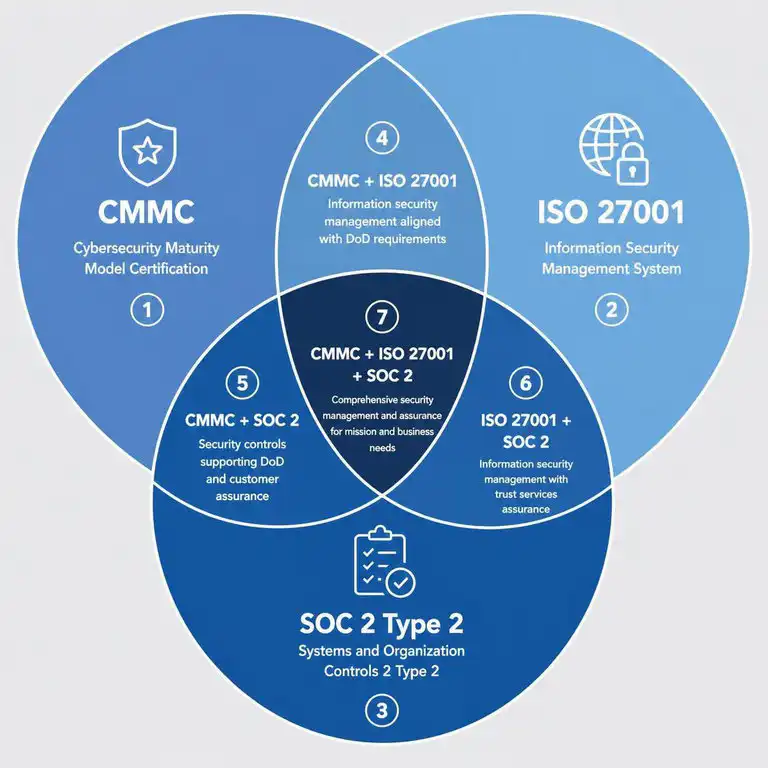
Consultancies love the mapping story, mostly because mapping software is what they sell. Estimates of control overlap between ISO 27001 and CMMC Levels 1 and 2 range from about two-thirds to 90 percent, and the overlap itself is real. Access control, incident response, logging, configuration management, and training overlap heavily across all three frameworks.
What the mapping demos skip is where CMMC’s excess burden actually lives, which is documentation granularity, evidence production, and raw prescriptiveness rather than unique control domains your SOC 2 program somehow missed. A SOC 2 Type 2 or ISO 27001 investment is a genuine head start on CMMC work. But it’s not a substitute for it, no matter how many integrations a compliance platform claims.
Where CMMC Stands
The July Suspension
The CMMC Program Rule (32 CFR Part 170) took effect December 16, 2024. Phase 1, which folded self-assessment requirements into contracts, began November 10, 2025, and Phase 2 was scheduled to start November 10, 2026, at which point third-party certification would become a condition of award on DoW contracts involving CUI. Except on July 13, 2026, the DoW suspended Phase 2 pending a program review. The decision held Phases 3 and 4 indefinitely and stood up a Reform Task Force. That same day the SBA applauded the move, noting that more than 120,000 small businesses would have been funneled toward roughly 100 approved assessment organizations. Whatever you call 120,000 firms queued against 100 assessors, the math was never going to go well by November.
The Review Machinery
The request for information drew more than 1,100 comments, and DoW CIO Kirsten Davies said in September that a majority of them supported the suspension. A March 2026 GAO report had already found the program’s planning addressed six of seven elements of a sound strategy, with the missing piece being any documented accounting of external factors that could derail rollout. That warning was still standing when the July suspension arrived.
This is the second major pause in CMMC’s history. The first, during the Biden administration, produced the 2.0 restructure, so structural reform is possible. Whether the second pause produces reform or just a new deadline is the open question hanging over the program.
The CMMC Pause Isn’t a Compliance Holiday
For contractors, the critical detail is what July 13 did not suspend.
- DFARS 252.204-7012 still governs your contracts
- SPRS scores and senior-officer affirmations still gate eligibility for award
- The Defense Industrial Base Cybersecurity Assessment Center (DIBCAC) can still show up and audit
- The NIST 800-171 baseline never moved an inch
Under Class Deviation 2026-O0025 Revision 3, clause modifications land at the next option exercise or administrative modification. The version you signed keeps binding you until your amendment arrives. The suspension removed the government’s exam schedule, not your homework.
Enforcement got more assertive at the exact moment the certification requirement relaxed. LOGZONE, a veteran-owned small business in Huntsville, self-reported a perfect 110 in SPRS in October 2021. A DIBCAC Medium Assessment in February 2024 scored the firm at -170. The June 2026 settlement cost $507,144, half of it restitution, against roughly $682,000 in Navy billings, with criminal liability and debarment left open. The Department of Justice tied the case to its fraud enforcement task forces, per a DOJ settlement announcement. A 280-point gap between self-report and reality used to be a compliance footnote. Now it carries a six-figure price tag with the False Claims Act attached.
So Which One Should You Pursue
The right answer follows your revenue mix, not a vendor’s roadmap.
- Selling into US enterprises as a service organization? Get the SOC 2 Type 2 and skip the Type 1 detour unless a specific deal demands a point-in-time placeholder. Roughly 90 percent of enterprise buyers in the SaaS market expect it, so it’s table stakes rather than differentiation.
- Selling into Europe, the Middle East, or APAC, or chasing multinationals? ISO 27001 is the passport those buyers recognize, and its public certificate skips the NDA dance entirely.
- Holding or chasing DoW contracts with CUI? Keep the 800-171 remediation moving regardless of the pause, because SPRS obligations and DIBCAC audits are live right now. Delay the certification spend until the Task Force picture clears, but check with your primes first, since they can demand C3PAO certification contractually with or without the government’s schedule.
- None of the above? CMMC doesn’t apply to you, and no questionnaire copy-paste should convince you otherwise.
The frameworks differ in scope, mechanics, cost, and philosophy, and they agree on one thing: hope isn’t an access control. The seller who knows which checkbox the buyer actually needs hands the questionnaire back faster, and spends the rest of the sales cycle selling instead of chasing evidence.