Business-Focused Vulnerability Translator
©Kayne McGladrey – Get the full book “Cyber Risk is a Myth”
- PURPOSE: This tool helps security professionals translate technical vulnerabilities into business language that executives can understand and act upon, while creating a structured briefing format ready for decision-makers.
- WHEN TO USE:
- When preparing to communicate security vulnerabilities to executive audiences
- When requesting resources or decisions about security risks
- When prioritizing vulnerabilities based on business impact
PART 1: TRANSLATION WORKSHEET (Internal Use)
SYSTEM/ASSET CONTEXT
System/Asset Name: OEM telematics integration layer (factory telematics across the rental fleet, with vendor portals for machine location, hour meters, health codes, geofence alerts, and remote engine disable)
Business Function Supported: Theft recovery and late-return enforcement for the rental fleet; utilization and maintenance scheduling; delivery coordination between branches
Business Value: The rental business is the company’s largest revenue stream at roughly 44% of annual revenue, about $60M-$65M per year, consistent with total revenue in the upper half of the company’s $100-150M band. Spread across the calendar, rental bills an average of about $170K per day ($170K x 365 is roughly $62M a year). Telematics is what keeps that fleet controllable. Since geofence alerts were introduced, the chronic late-return and fuel-drain losses that used to be absorbed as a cost of doing business have largely stopped. The same platform also underpins two planned revenue initiatives: a rental-monitoring subscription service and eventual participation in OEM autonomous-equipment pilots. Both depend on customers trusting us with fleet data.
Key Stakeholders: Rental customers, including regional general contractors, municipal public works departments, and specialty trades who rely on machines arriving and staying available; OEM telematics platform providers; branch operations managers across nine locations; field service technicians whose tablets authenticate against this layer
VULNERABILITY ASSESSMENT
Vulnerability Description (in plain language): The credentials we use to protect the fleet are the same credentials that operate it. Someone who compromises our telematics integration layer could remotely disable roughly 80% of our connected units at once, bricking them on customer jobsites, voiding service contracts, and holding our rental operation hostage. The same access exposes a year of GPS trails showing exactly where our customers work and when, which is a privacy problem for the municipal accounts in particular. The remote-stop capability we market for theft recovery could be turned against us by whoever holds the same access.
Technical Details: No CVE is attributed to this engagement; the failure mode has been demonstrated publicly and is documented as a class. Precedent: CVE-2022-2107 (CVSS 9.8), a hard-coded credential on a telematics control server that allowed an unauthenticated remote attacker to take over fleet trackers, cut fuel, and disable alarms, disclosed by CISA in advisory ICSA-22-200-01 alongside CVE-2022-2141, CVE-2022-2199, CVE-2022-34150, and CVE-2022-33944. The relevant weakness families are improper authentication, authorization bypass through user-controlled keys, and hard-coded credentials (CWE-287, CWE-639, CWE-798). Separately, at least one major compact-equipment OEM now ships a commercial remote engine disable feature manageable from a web portal with a few clicks, confirming the capability exists in production hardware across our fleet classes today.
Detection Method: Identified through an external attack surface and API authorization review of the telematics integration layer, commissioned through our managed service provider and completed in August 2026. The review tested for shared credentials across OEM portals, direct object reference on device endpoints, and weak MFA fallbacks. It corroborated a related finding: technician tablets authenticate against the DMS with SMS-based fallback, so a SIM swap of a technician’s phone currently opens an account-takeover path into rental contracts.
Exploitation Status:
- Actively being exploited in the wild
- Exploit code is publicly available
- Exploitation requires specialized knowledge (selected)
- Exploitation is theoretical at this point
Selected because attacking our environment requires working knowledge of the OEM portal APIs plus valid credentials, and no exploit code exists that targets our integration layer. We treat this rating as unstable: the published precedent shows that flaws of this class can be weaponized quickly once understood, so the rating is re-evaluated quarterly. There is no evidence anyone is probing our integration layer, but we also have no portal log monitoring today that would tell us if they were.
BUSINESS IMPACT MAPPING
Potential Business Consequences:
- Data breach/unauthorized data access (GPS trails showing customer jobsite locations and work patterns)
- Service/system downtime (mass remote disable of connected units)
- Data corruption/integrity issues (considered and ruled out; a disable command halts machines but does not corrupt records)
- Regulatory compliance violations (considered and ruled out; exposure here is contractual and negligence-based, covered under Compliance Exposure below)
- Reputational damage
- Other: extortion scenario, voided service contracts, stranded customers mid-job
Revenue Impact: Rental generates about $170K per calendar day on average. A mass disable that takes roughly 80% of the connected fleet out of service halts most of that billing for the duration of recovery; the 80% figure is a round planning assumption reflecting that roughly 85-90% of the fleet is telematics-enabled and a bulk command would hit most connected units simultaneously. The $1.4M to $2.0M loss estimate is top-line billing; by contrast, the 2024 DMS outage figure of roughly $1.5M included margin and overtime, so the comparison basis differs. Beyond the immediate stoppage, the two planned telematics-dependent revenue initiatives (the rental-monitoring subscription and autonomous-equipment pilots) would be difficult to launch with customers who had watched machines go dark on their jobsites.
Cost Implications: Recovery and emergency response scale from our 2024 precedent, when a nine-day outage to our core dealer management platform cost roughly $1.5M in lost margin and overtime, and the initial backup restore failed. A telematics event adds trucking and re-enable labor for stranded machines, customer credits and contractual penalties for downed rented units, and forensic investigation of the jobsite location data held in the portals. We have deliberately excluded any extortion demand from the quantified range: the decision to pay rests with the board, and no pre-event estimate would be defensible. For order of magnitude, demands in comparable availability-driven extortion cases typically fall in the low seven figures, which is inside the range already carried.
Compliance Exposure: Our credit-application workflow pulls Social Security numbers and full financial statements into systems lacking lender-grade controls, so mishandling creates negligence exposure rather than regulatory penalties. The telematics data itself carries privacy and contract-dispute liability, particularly with municipal customers whose jobsite location history, if leaked or mishandled under subpoena, becomes a disclosure problem we have no governed process for. For benchmarking, the industrial sector averages roughly $5.0M in total costs per data breach per IBM’s 2025 Cost of a Data Breach Report; the resemblance to the top of our range is coincidental, since our range is built bottom-up from internal inputs. For lifecycle timing, IBM’s 2024 industrial-sector analysis reports roughly 199 days to identify and 73 days to contain, against a 194/64 global norm; we cite that edition because it is the one that breaks out industrial-sector timing.
Reputation Risk: The customers most damaged by a mass disable are the ones with the least slack: contractors on schedule and municipalities on public projects. News of machines shut down mid-job would circulate quickly among regional contractors and municipal buyers. Our competitive pitch leans on dependability and honest advice about renting versus buying, and a fleet that shuts down remotely from a single compromised login undercuts that story with the customers who anchor our recurring revenue.
Strategic Impact: The near-term expansion into two adjacent metro markets extends the same integration layer and network footprint to new branches. Longer term, both growth initiatives described above (the telematics subscription product and autonomous-equipment pilots) assume customers will let us hold fleet-control credentials and location data. A headline incident in this layer would likely end the subscription product before launch and make OEM partners reluctant to include us in autonomy programs.
Quantified Financial Exposure: Estimated $2.8M to $5.0M, central estimate $3.9M (the midpoint of the range and the sum of the component midpoints). Build: lost billable rental revenue of roughly $1.4M to $2.0M assuming roughly 80% of connected units disabled for a 10-to-14-day recovery (deliberately somewhat worse than our 2024 nine-day precedent, since vendor-mediated re-enable across nine branches will not be instant); $0.6M to $0.9M in emergency response, overtime, and trucking to stranded units; $0.3M to $0.9M in customer credits, penalties, and churn; $0.5M to $1.2M contingent forensic and legal costs tied to jobsite location data exposure.
RESPONSE OPTIONS
Option 1: Full Remediation (in-house credential vault with per-OEM scoped accounts)
Actions: Stand up a dedicated credential vault for all telematics vendor portal and integration accounts; replace shared logins with per-OEM, per-function scoped service accounts; issue hardware security keys to all privileged administrators; decouple fleet-control credentials from general IT identity (and therefore from the MSP’s domain-level access); run documented quarterly access reviews and break-glass drills.
Resources Required: $150K-$220K in year one (vault licensing, hardware keys for the privileged administrator population of roughly 40-60, and implementation services across three OEM portals), $50K-$70K annually thereafter for licensing and administration; 6-9 month timeline including vendor coordination.
Business Benefits: No single compromised account can reach the whole fleet; the SIM-swap path into rental contracts closes; the foundation supports the telematics subscription product with defensible privacy governance; board sees a closed item in the modernization program.
Drawbacks: Two of our three OEM portals support scoped service accounts today; the third will not commit to scoped access before its contract renewal in spring 2027. Implementation competes for the same internal bandwidth as the secondary DMS environment, which is already queued behind the hosting vendor’s schedule.
Residual Risk: Roughly 85-95% reduction once fully implemented. The spread reflects the third OEM portal, which covers roughly a quarter of connected units and retains a shared-account configuration until the spring 2027 renewal; that interim exposure is why the floor of the range sits at 85%. Remaining exposure sits at the OEM side: portal-side compromise or a zero-day in the platform itself, which we cannot remediate and can only detect faster. All reduction percentages in this worksheet are consultant estimates based on which documented attack paths each option eliminates, not output from a scored model.
Option 2: Partial Remediation (phishing-resistant MFA and account hygiene)
Actions: Enforce hardware-token or app-based MFA for all telematics vendor portal, DMS, and bank treasury administrator accounts; eliminate SMS fallback for administrators; restrict and rotate shared service accounts; quarterly access reviews.
Resources Required: $35K-$50K one-time (tokens, licensing, professional services working within each OEM portal’s capabilities), modest ongoing admin time; executable within 60-90 days.
Business Benefits: Closes the documented technician SIM-swap takeover path and the credential-theft vector behind the published precedents; fastest route to a materially better posture.
Drawbacks: Leaves shared and broadly scoped accounts in place; a compromise of a single remaining shared credential still reaches all connected units. Requires follow-on work to converge with Option 1.
Residual Risk: Roughly 55-65% reduction, consultant estimate.
Option 3: Compensating Controls (monitoring, contracts, and fallback drills)
Actions: Ingest available OEM portal logs into the SIEM with alerting on bulk enable/disable commands, privileged logins from unfamiliar networks, and MFA fallback spikes; add contractual security requirements and breach-notification timelines to portal vendor and MSP agreements; run a semiannual tabletop of the paper-based dispatch fallback.
Resources Required: $15K-$30K, mostly consultant and MSP time plus a small SIEM use-case build.
Business Benefits: Cuts detection-to-response time from weeks toward days at minimal cost; strengthens legal position; keeps the manual dispatch muscle exercised before the veterans who know it retire.
Drawbacks: Nothing structurally prevents a mass disable command. A related constraint: none of our OEM portal contracts currently guarantees log delivery, so the monitoring this option depends on is best-effort until renewals.
Residual Risk: Roughly 35-40% reduction, consultant estimate.
Recommended Option: Option 1, with Option 2 executed immediately as phase one. MFA hardening fits inside the already-approved IT modernization budget and can start within 30 days of approval, while the credential-vault procurement runs its course. The economics favor acting now: a $150K-$220K investment defends against a $3.9M central exposure. The unresolved piece to watch is the third OEM’s scoped-account roadmap, which realistically cannot move before the spring 2027 contract renewal; until then that portal retains a shared-account configuration under enhanced monitoring as an accepted, board-visible risk.
PART 2: EXECUTIVE BRIEFING (For Decision-Makers)
SITUATION SUMMARY (2-3 sentences)
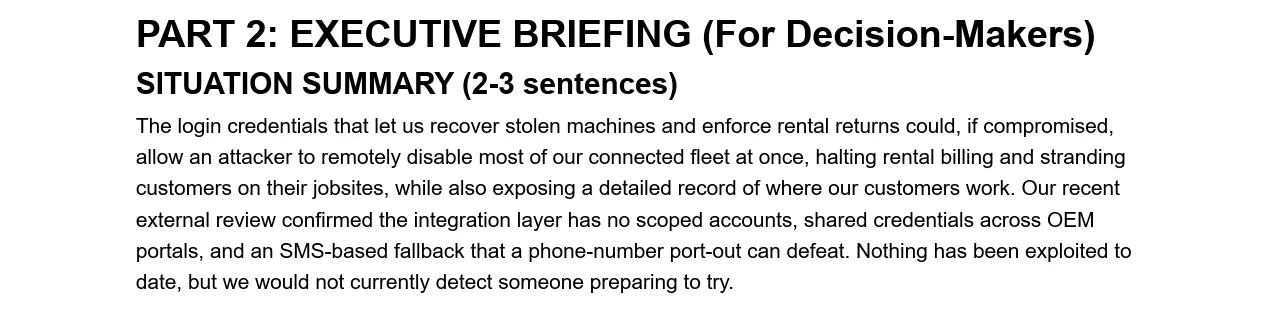
The login credentials that let us recover stolen machines and enforce rental returns could, if compromised, allow an attacker to remotely disable most of our connected fleet at once, halting rental billing and stranding customers on their jobsites, while also exposing a detailed record of where our customers work. Our recent external review confirmed the integration layer has no scoped accounts, shared credentials across OEM portals, and an SMS-based fallback that a phone-number port-out can defeat. Nothing has been exploited to date, but we would not currently detect someone preparing to try.
BUSINESS IMPACT
If Not Addressed:
- Revenue: Rental generates about $170K per calendar day and roughly 44% of total revenue; a mass-disable event halts roughly 80% of that billing for an estimated 10-14 day recovery and jeopardizes the planned telematics subscription product and autonomy pilots that depend on customer trust in our data handling.
- Compliance: Exposure runs through negligence and contract disputes; no fine regime applies. Municipal customer jobsite location history and credit application files (Social Security numbers, financial statements) handled without lender-grade controls are the main legal exposure.
- Operations: Remote re-enable across nine branches requires OEM-mediated credential revocation, trucking to stranded machines, and overtime at scale comparable to the 2024 outage, which cost roughly $1.5M over nine days.
- Reputation: Regional contractors and municipal buyers choose us for dependability; machines bricked mid-job would be visible to exactly the customers who anchor our recurring revenue, and word of such an incident would spread quickly in this market.
- Financial Exposure: Estimated $2.8M to $5.0M, central estimate $3.9M, excluding any extortion demand.
- Timeline Considerations: The FY2027 budget cycle closes in December 2026, so funding decided now avoids a full-year delay; the third OEM portal’s contract renews in spring 2027 and is the lever for scoped-account support; our proven paper-fallback playbook depends on veteran staff whose attrition quietly erodes it each year.
OPTIONS AND RECOMMENDATION
Option 1: Full Remediation (in-house credential vault, per-OEM scoped accounts)
What’s Involved: Dedicated vault for all fleet-control credentials, scoped per-OEM service accounts so no single compromise can reach the whole fleet, hardware keys for administrators, and decoupling fleet control from general IT identity.
Benefits: Eliminates the fleet-wide blast radius of any single credential theft; closes the technician SIM-swap path; lays the governance foundation for the telematics subscription business.
Investment Required: $150K-$220K in year one, $50K-$70K annually thereafter, 6-9 months to full deployment with phase-one MFA live within 30 days of approval.
Residual Risk: Roughly 85-95% risk reduction (consultant estimate), with remaining exposure concentrated in the third OEM portal until its spring 2027 renewal and on the OEM platform side, where only faster detection is possible.
Option 2: Partial Remediation (phishing-resistant MFA and account hygiene)
What’s Involved: Hardware-token or app-based MFA on all vendor portal, DMS, and treasury administrator accounts; SMS fallback eliminated; shared accounts restricted and rotated.
Benefits: Fastest material improvement; closes the documented takeover path; no procurement cycle beyond tokens.
Investment Required: $35K-$50K one-time, within 60-90 days.
Residual Risk: Roughly 55-65% risk reduction (consultant estimate), because a shared account compromise can still reach every connected unit.
Option 3: Compensating Controls (monitoring, contracts, and fallback drills)
What’s Involved: SIEM alerting on bulk engine-disable commands and unusual portal logins; contractual security requirements and breach-notification timelines with portal vendors and the MSP; semiannual dispatch-fallback tabletops.
Benefits: Lowest cost; cuts detection-to-response time materially and strengthens legal posture.
Investment Required: $15K-$30K.
Residual Risk: Roughly 35-40% risk reduction (consultant estimate), and dependent on vendor log availability that current contracts do not guarantee.
Recommendation: Option 1, with Option 2 launched as its first phase within 30 days. The MFA work fits the approved modernization budget and removes the most credible attack path immediately, while the vault build removes the fleet-wide blast radius permanently. The third OEM portal cannot support scoped accounts until its spring 2027 renewal, so we recommend accepting that shared-account configuration under enhanced monitoring in the interim and revisiting at renewal. A $150K-$220K program against a $3.9M central exposure, in a business where one nine-day outage already cost $1.5M, is the right allocation of next year’s security budget.
DECISION REQUESTED
Approval of the Option 1 program at $150K-$220K year-one spend (with $50K-$70K recurring from FY2028) drawn against the approved IT modernization budget, with phase-one MFA hardening initiated within 30 days of approval and the credential vault in production by Q3 2027. Decision requested by December 1, 2026 to align with the FY2027 budget cycle.