Exercise: Develop Your Challenge Mitigation Strategy
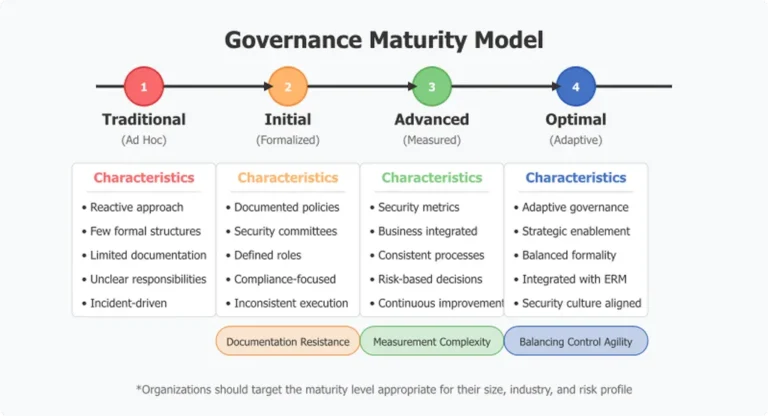
This worksheet has been completed for a mid-market creative and digital media agency (approximately 70-80 staff, $15-20M in annual revenue) serving roughly 30 active clients, administering approximately 475 client platform credentials, and managing $20-25M in annual client media spend on their behalf. The organization’s current security-business integration maturity is Initial: a virtual CISO has been engaged, IT and selected security services are delivered by a managed services provider, and formal access-governance commitments exist on paper, but integration of security into daily business operations remains partial.
1. Challenge Identification
Challenge A: Informal client credential and access governance
Category: Resource constraints
Ways this challenge manifests in the organization:
- Roughly 160 of the ~475 client platform credentials (ad platforms, CMS logins, analytics, CRM admin) are managed outside the centralized vault, in shared spreadsheets, browser password stores, and chat threads.
- Full MFA coverage exists only for newer client onboardings; estimated coverage across the full credential estate is near 50%. Vault coverage is approximately 66% (roughly 315 credentials), meaning some vaulted accounts still lack MFA.
- Years of ad-platform and social-platform authorizations persist with no inventory of what is still live; dormant OAuth grants from long-ended engagements linger as standing access.
- Historically loose access revocation when staff depart or client relationships end has accumulated orphaned permissions that are only now being audited.
- A prior agency-side session hijack on a client’s social and ad accounts resulted in an estimated $200K+ of fraudulent ad spend and a client-trust crisis; passkeys, a password vault, and session monitoring were deployed afterward, but the legacy estate remains partially unmanaged.
Likelihood: High Potential impact: High
Challenge B: Security trust and compliance as a precondition for winning business
Category: Organizational/cultural
Ways this challenge manifests in the organization:
- Enterprise and healthcare prospects increasingly require SOC 2-aligned controls in RFPs; the agency’s current evidence consists mainly of post-incident tooling improvements rather than independently examined controls.
- Recurring impersonation scams targeting clients have eroded trust in inbound agency requests, so routine credential resets and payment changes now require out-of-band verbal confirmation that slows operations.
- Leadership judges initiatives by visible results; without early wins, the integration program risks losing executive attention to competing revenue priorities.
Likelihood: High Potential impact: Medium
Challenge C: Extended-enterprise exposure through contractors, partners, and shared channels
Category: Technical
Ways this challenge manifests in the organization:
- Approximately 25 active freelancers access unreleased campaign assets and shared drives from personal devices.
- Partner vendors (influencer networks, print vendors, photo studios) are onboarded on referral and trust with no security evaluation, extending the agency’s exposure without visibility.
- Clients hold direct messaging channels into the agency workspace, and those threads occasionally contain credentials and sensitive launch details shared carelessly.
- Product launches and campaign concepts circulate to staff and contractors months before public release; a leak would damage both the agency’s reputation and clients’ competitive positions.
Likelihood: Medium Potential impact: High
2. Impact and Likelihood Matrix
| Potential impact | Likelihood: Low | Likelihood: Medium | Likelihood: High |
|---|---|---|---|
| High | — | Challenge C | Challenge A |
| Medium | — | — | Challenge B |
| Low | — | — | — |
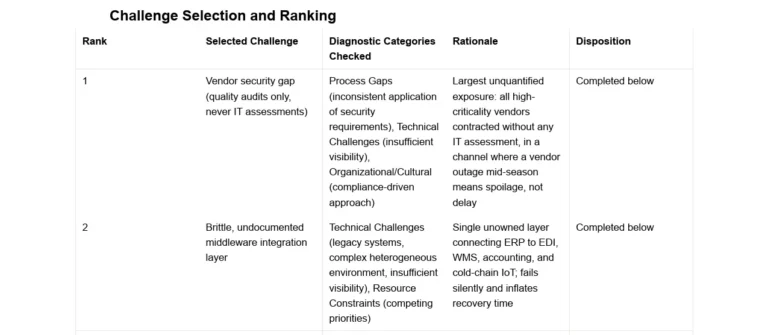
Mitigation planning focuses on Challenge A first (high likelihood, high impact), followed by Challenge C (high impact, medium likelihood), then Challenge B (high likelihood, medium impact). Challenge B builds on A’s early milestones and runs in partial overlap with A’s longer-duration controls.
3. Mitigation Strategy Development
Challenge A: Informal client credential and access governance
Potential mitigation approaches:
- Deploy a centralized enterprise password manager with mandatory credential rotation for all client-related platform accounts, eliminating the shared spreadsheets of logins.
- Move from admin-role grants to scoped permissions and OAuth-based delegation across client ad platforms and CRMs under a formal least-privilege model.
- Institute a quarterly access-review process that inventories every active OAuth grant and removes client credentials dormant longer than 12 months.
Preventive measures (reduce likelihood of occurrence):
- Extend passkey and MFA enrollment from the newest client onboardings across the entire credential estate.
- Require scoped, delegable access at client onboarding so no new engagement starts with standing admin rights.
- Embed an access-revocation checklist in HR offboarding and client-exit workflows so orphaned permissions stop accumulating.
- Retain the post-incident session-monitoring capability and route its alerts to the managed services provider’s review queue.
Contingency plans (if the challenge materializes):
- Revoke sessions and tokens agency-wide within 24 hours of suspected compromise and rotate affected client credentials.
- Execute a client-notification playbook coordinated through client services leads, using pre-approved messaging that acknowledges the agency’s trustee role over client environments.
- Invoke cyber liability coverage that includes third-party liability for administered client environments (contingent upon binding coverage at renewal), preserving evidence for forensics and any professional-liability defense given that master service agreements cap liability at fees paid.
Warning signs that the challenge is emerging:
- Any credential discovered outside the vault (spreadsheets, chat threads, browser stores).
- MFA challenges originating from unfamiliar geographies or sessions persisting overnight.
- A dormant OAuth grant observed to be active, or an ended engagement still showing live platform permissions.
- A departure or client exit closed without a matching access-revocation record.
Challenge B: Security trust and compliance as a precondition for winning business
Potential mitigation approaches:
- Undertake SOC 2 Type I readiness built directly on the access-governance controls delivered under Challenge A, rather than as a separate compliance program.
- Follow with SOC 2 Type II once a body of operating evidence exists.
- Produce a plain-language client-facing trust summary and a standardized security-response module for RFP submissions.
Preventive measures:
- Collect control evidence continuously (review records, revocation logs, vault coverage reporting) instead of reconstructing it at audit time.
- Train account teams to present security posture in business terms: client data stewardship, launch timing protection, paid-media continuity.
Contingency plans:
- If a prospect demands Type II evidence sooner than the observation window allows, choose between an accelerated external readiness engagement or a contractual attestation plus a remediation roadmap as a bridge.
- If trust in inbound communications degrades further, pre-register a verification protocol (a known callback number and challenge phrase) with each client contact.
Warning signs:
- Lost-pitch feedback citing security or compliance.
- Security exhibits newly added to client renewal negotiations.
- Prospects requesting independent attestations or penetration-test results.
Challenge C: Extended-enterprise exposure through contractors, partners, and shared channels
Potential mitigation approaches:
- Provide NDA-backed secure workspaces for freelancer access to unreleased campaign work.
- Introduce a lightweight security questionnaire and annual re-attestation for partner vendors, prioritized by criticality and data access.
- Adopt a shared-channel hygiene policy prohibiting credentials and sensitive launch details in client messaging threads.
- Deploy data-loss-prevention tooling on shared drives holding unreleased work.
Preventive measures:
- Onboard contractors through scoped, delegable access instead of credential sharing; no personal-device access to raw credential stores.
- Maintain a central register of partner vendors with criticality and data access noted, reviewed at least annually.
Contingency plans:
- Maintain a pre-drafted takedown, legal, and client-notification playbook for a leak or contractor-device compromise affecting unreleased material.
Warning signs:
- Credential requests arriving through messaging tools.
- Unreleased assets surfacing outside approved workspaces.
- Active freelance engagements with expired NDAs.
Deferred and unresolved items:
- SOC 2 Type II timing: Type I report issues at Month 9; the observation window begins at Month 15, allowing six months of post-Type-I operating evidence before Type II examination. This timing is driven by audit-scheduling availability and provides a maturity buffer beyond the minimum six-month threshold.
- Hardware stipends to remove freelancer personal-device dependency are deferred pending first-year budget results.
- Cyber liability coverage with adequate third-party limits for administered client environments remains under negotiation at renewal; the contract cap exposure persists until bound.
- MSP capacity may push the first full OAuth inventory from Month 6 to Month 9.
4. Action Planning
| # | Action | Responsibility | Timeline | Effectiveness measure |
|---|---|---|---|---|
| A1 | Deploy enterprise password manager; migrate ~160 unmanaged legacy credentials (Q1: 45, Q2: 55, Q3: 40, Q4: 20; totaling 160) | vCISO, with MSP IT Lead | Months 1-12 | Share of client credentials in the vault rises from ~66% to 100% |
| A2 | Extend MFA/passkeys across the full credential estate at ~20 accounts per month | MSP IT Lead | Months 1-12 | MFA coverage rises from an estimated 50% to >95% by Month 12 |
| A3 | Migrate top-tier client ad and CRM admin roles to scoped permissions and delegated OAuth | Director of Paid Media and Director of Client Services, supported by vCISO | Months 3-9 | Count of client platforms on scoped roles vs. admin grants |
| A4 | Quarterly access reviews; retire credentials dormant >12 months; first full OAuth inventory (at risk of slipping from Month 6 to Month 9) | vCISO, with MSP IT Lead | Quarterly, beginning Q1 | Baseline established by Q3, then trend toward zero unknown-access items |
| A5 | Embed access-revocation checklist in HR and client-exit workflows | Head of Talent, with Director of Client Services | Live by Month 3 | 100% of departures and client exits closed with revocation within 5 business days |
| B1 | SOC 2 Type I readiness assessment and gap remediation on access-governance controls | COO (sponsor); vCISO (execution) | Months 1-6 | Gap list closed; control evidence assembled |
| B2 | SOC 2 Type I examination | COO | Month 9 | Type I report issued |
| B3 | Client-facing trust summary and standardized RFP security module | Director of Client Services | Months 4-6 | RFP security section pass rate, plus RFP outcomes where security was decisive, tracked per quarter |
| B4 | Begin Type II observation window | vCISO | Month 15 onward (Type II report target: Month 21) | Unremediated findings count trending to zero |
| C1 | Roll out NDA-backed secure freelancer workspaces | Production Director | Months 2-5 | Share of active freelancers working in approved workspaces |
| C2 | Partner vendor security questionnaire and central register | Head of Talent, with vCISO | Months 3-6 | 100% of Tier-1 partners assessed |
| C3 | Adopt shared-channel hygiene policy | Director of Client Services | Month 2 | Policy exceptions logged and reviewed monthly |
| C4 | Deploy data-loss prevention on drives holding unreleased work | Production Director, with MSP IT Lead | Months 6-9 (budget-dependent) | Unauthorized external shares blocked; alert volume reviewed monthly |
Note on MSP capacity: The MSP IT Lead owns actions A1, A2, A4, and C4 concurrently. Load planning shows these tasks are staggered where possible, but the OAuth inventory (A4) and DLP deployment (C4) may compete during Months 6-9. Contingency: if capacity slips, delay C4 to Month 10 or reduce DLP scope to initial high-risk drives first.
Progress is tracked on a monthly basis for the process metrics above, with quarterly reviews of outcome and perception measures, reflecting the agency leadership’s expectation of visible, results-oriented reporting. An annual reassessment of this plan is scheduled.
©Kayne McGladrey – Get the full book “Cyber Risk is a Myth”