Security Integration Challenge Resolution Toolkit
- PURPOSE: Helps security and business leaders identify, assess, and overcome common challenges in integrating security risk management with business operations.
- WHEN TO USE: When facing resistance to integration efforts, encountering obstacles in implementation, or proactively planning to address potential challenges.
PART 1: CHALLENGE DIAGNOSTIC
Organizational/Cultural Challenges:
[X] Security viewed as a barrier rather than enabler
- Security team lacks business understanding
[X] Business leaders lack security awareness
- Misaligned incentives between security and business teams
- Resistance to changing established processes
- Siloed organizational structure
- “Not my responsibility” mentality toward security
[X] Compliance-driven rather than risk-driven security approach
Resource Constraints:
[X] Limited budget for security initiatives
- Insufficient skilled personnel
[X] Competing priorities for limited resources
- Lack of executive sponsorship
[X] Insufficient time allocated for security activities
- Limited access to necessary tools or technologies
[X] Unclear ROI for security investments
Technical Challenges:
[X] Legacy systems with limited security capabilities
[X] Complex, heterogeneous IT environment
- Data fragmentation across multiple systems
- Lack of integrated security and business tools
[X] Insufficient visibility across environment
- Cloud/hybrid environment complexity
- Rapid technological change outpacing security
Process Gaps:
- Undefined or immature risk assessment processes
- Security brought in too late in business initiatives
- Unclear escalation paths for security issues
- Inadequate metrics for measuring security effectiveness
- Ineffective security governance
[X] Inconsistent application of security requirements
- Poor knowledge transfer and documentation
PART 2: CHALLENGE ANALYSIS WORKSHEET
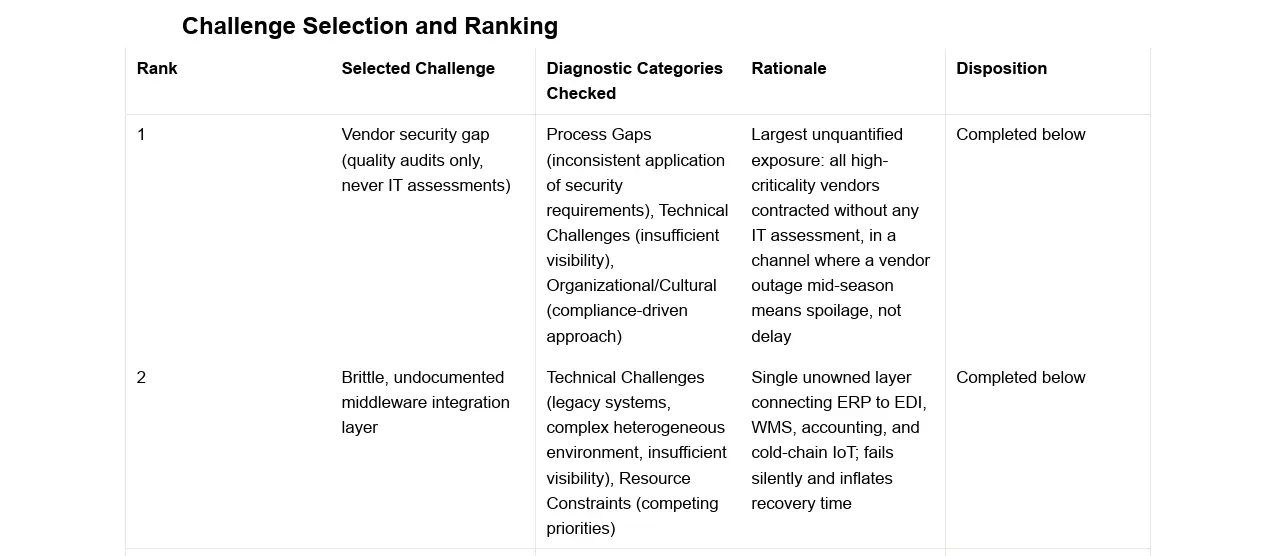
Note: A full engagement would analyze the top three challenges. For this cycle, two challenges have been completed deliberately. Challenges were ranked against three criteria drawn from the diagnostic above:
(a) potential business impact given the company’s hours-level downtime tolerance for perishable goods,
(b) the share of the exposure that is currently unquantified and unmanaged, and
(c) the feasibility of meaningful mitigation within the planning year.
The vendor security gap ranked first because every high-criticality third-party dependency sits behind unaudited quality-only contracting; the middleware fragility ranked second because a single unowned layer backs ordering, inventory, accounting, and cold-chain visibility. The third-ranked challenge, OT network segmentation, scored lower on feasibility because a segmentation review is already funded and scheduled under the short-term remediation plan; its full worksheet entry is deferred to the next quarterly cycle (see Appendix).
Challenge Selection and Ranking
| Rank | Selected Challenge | Diagnostic Categories Checked | Rationale | Disposition |
|---|---|---|---|---|
| 1 | Vendor security gap (quality audits only, never IT assessments) | Process Gaps (inconsistent application of security requirements), Technical Challenges (insufficient visibility), Organizational/Cultural (compliance-driven approach) | Largest unquantified exposure: all high-criticality vendors contracted without any IT assessment, in a channel where a vendor outage mid-season means spoilage, not delay | Completed below |
| 2 | Brittle, undocumented middleware integration layer | Technical Challenges (legacy systems, complex heterogeneous environment, insufficient visibility), Resource Constraints (competing priorities) | Single unowned layer connecting ERP to EDI, WMS, accounting, and cold-chain IoT; fails silently and inflates recovery time | Completed below |
| 3 | Plant-floor OT network segmentation | Technical Challenges (complex environment, insufficient visibility), Process Gaps (inconsistent security requirements) | Real but lower near-term urgency: a one-time segmentation review is already committed and scheduled in the short-term remediation plan, so a full strategy entry adds little until that review lands | Deferred; see Appendix |
Challenge 1:
Undocumented third-party security requirements; quality audits cover food safety but never IT assessments
Root Causes:
Third-party relationships were built and governed exclusively through food-safety frameworks. Overflow co-packers receive full specification packages but have never been subjected to an IT assessment; their internal cybersecurity maturity is unknown. Recall and traceability demands flow through brokerage, retailer portals, and distribution partners whose record accuracy cannot be directly audited. The 2025 ransomware event at an industry peer, which halted shipments, was the first time leadership treated vendor cyber posture as a business continuity issue rather than a hypothetical.
Stakeholders Impacted:
Supply Chain Director (owns co-packer and ingredient supplier contracts), Sales Director (retailer relationships and broker agencies), VP of Operations (overflow production for seasonal SKUs), IT/MSP (would perform or receive any assessments), and Finance (contract renegotiation leverage). Downstream, the 100 to 150 employees depend on overflow capacity that a vendor outage or ransomware event could interrupt mid-season.
Business Impact:
A vendor-side ransomware or outage event during peak season would hit the same hours-level downtime tolerance the company already measures for perishability: spoilage losses rather than merely delayed revenue. Formula documentation and competitive launch plans shared with a flavor consultant lab and two overseas co-packers represent erodable competitive moat. Leakage of pricing, promotional allowances, and volume commitments moving through managed EDI channels would weaken every retailer renewal negotiation. Retailer security addenda (increasingly common in 100+ store banners) could disqualify the company from shelf placement if supplier security cannot be evidenced.
Current Mitigation Attempts:
Quality-only vendor audits (no IT component); a third-party supplier-security assessment commissioned in 2025 after the peer ransomware event, which has produced an interim one-page findings summary and a verbal debrief, though the final report is still outstanding; contractual protections rather than technical controls, which deepen with every private-label expansion.
Success Blockers:
No internal security function exists to conduct or interpret assessments; the assessment vendor’s final report has not yet been delivered, so actions extending beyond the two highest-criticality co-packers and the ERP hoster are contingent on its arrival; negotiating IT clauses into existing co-packer agreements gives leverage away at renewal time, and peak-season co-packer capacity is scarce, so the company risks overplaying its hand; vendor assessment effort competes for the same limited budget as the MFA and segmentation work already committed.
Challenge 2: Brittle, undocumented middleware integration layer connecting ERP to EDI, WMS, and accounting
Root Causes:
The 2022 ERP migration was executed as a delivery project, not an integration-architecture program. Third-party middleware connections to EDI, WMS, and accounting were configured by implementers and never documented in-house; institutional knowledge left with the implementation team. The regional MSP administers the hosted ERP but has no contractual visibility into the middleware layer. IoT sensor feeds across the reefer trailer fleet and two warehouses joined this environment in 2023, adding an external attack surface with tampered-readings risk that could silently destroy refrigerated inventory before alarms sound.
Stakeholders Impacted:
IT/MSP (unsupported configuration it did not build), VP of Operations (production planning and inventory accuracy), Controller (accounting integration integrity), Sales Director and brokers (order volumes, ASN accuracy, chargeback data), and the executive team (unquantified concentration risk in a single unowned layer).
Business Impact:
Undocumented integrations fail silently and expensively: a misconfigured EDI feed produces chargebacks and missed ASNs with grocery banners; a failed ERP-to-WMS sync misstates inventory and triggers spoilage decisions on bad data. Incident response is slowed because nobody knows what talks to what, and recovery time after an outage or ransomware event is inflated accordingly. This layer is also the weakest link behind the recipe and formula IP that lives in the hosted ERP.
Current Mitigation Attempts:
Backup management via the MSP (not yet immutable or air-gapped); positive-pay cash controls at the bank protecting payments; informal dependence on a single contractor relationship for troubleshooting.
Success Blockers:
No documentation exists to remediate from, so discovery effort is unbudgeted; middleware is owned by a third party the MSP has no contract with, so accountability is unclear; the legacy MFT file-share still carries retailer spec-sheet traffic and must be retired in parallel; freeze windows around peak production season constrain when integration changes can be tested.
PART 3: RESOLUTION STRATEGY FRAMEWORK
Note: As with Part 2, resolution strategies have been developed for two challenges this cycle. Ownership is assigned to roles, since titles map to the actual org structure. Budget figures are planning bands for FY2027, not approved amounts.
Challenge: Undocumented third-party security requirements; quality audits cover food safety but never IT assessments
| Strategy Element | Details | Owner | Timeline |
|---|---|---|---|
| Short-term Actions | |||
| Quick wins to demonstrate value | Add an IT security questionnaire (compact, 20-item maximum) to the 2027 renewal packet for the two highest-criticality co-packers and the ERP hoster; pair it with the interim one-page findings summary from the 2025 supplier-security assessment to show leadership the exposure is being triaged, not just discovered. This activity is internal and no-cost: questionnaire drafting, briefing preparation, and renewal-packet assembly use existing staff time only. | Supply Chain Director, supported by vCISO | Weeks 1 to 6 |
| Temporary workarounds | Until assessments complete, restrict specification packages sent to unrated co-packers to the minimum needed for current SKUs, and route formula-level documents through the governed collaboration portal (replacing the legacy MFT file-share) with access logging as a compensating control. The package restrictions are internal and no-cost; portal rollout proceeds under the already-committed short-term remediation plan. | Supply Chain Director with IT/MSP | Weeks 1 to 10 |
| Immediate communication needs | Brief the executive team that vendor cyber posture is the company’s largest unquantified exposure: on the ranking criteria in Part 2, it scores highest because every high-criticality dependency is unaudited, the impact ceiling is spoilage and lost shelf placement rather than mere delay, and no current control bounds the exposure. The interim findings summary supports this briefing; confirm the go/no-go on including IT clauses in peak-season renewals despite capacity pressure. | vCISO | Week 1 |
| Stakeholder Engagement | |||
| Key stakeholders to involve | Supply Chain Director, Sales Director, VP of Operations, Controller, and the four regional brokerage agencies; retailers’ supplier-security contacts, who are a forcing function and a source of acceptable-clause language. | vCISO | Weeks 2 to 12 |
| Resistance management approach | Frame assessments in risk-based prioritization rather than security ideals, meaning the highest-criticality vendors get full assessments while lower-criticality vendors get questionnaires only. Expansion beyond the initial two co-packers and the ERP hoster, and any questionnaire tooling rollout, waits on final-report delivery and budget approval. Lead with the peer ransomware precedent; sales leaders respond to shelf-placement risk, operations to spoilage math. | vCISO | Weeks 2 to 6 |
| Communication strategy | One-page risk summary per vendor category for the executive team; standing vendor-risk agenda item at the monthly operations review; shared metrics matter to both sides, so report vendor incidents and shelf-placement exposure together. | vCISO | Ongoing from Week 4 |
| Resource Requirements | |||
| Budget needs | $75,000 to $125,000 for FY2027: assessment vendor fees for 4 to 6 high-criticality vendors plus questionnaire tooling. Not yet approved; competing against the immutable backup project. Weeks 1 to 6 activities require none of this funding; all external assessment spend is gated on budget approval and final-report delivery. | Controller with vCISO | FY2027 budget cycle |
| Personnel/skills needed | Assessment vendor (external); Supply Chain Director at roughly 4 hours per week; vCISO at roughly 6 hours per week. No headcount added. | vCISO | Week 1 onward |
| Tools/technology requirements | Governed collaboration portal replacing the legacy MFT file-share (funded under the already-committed short-term plan); vendor risk register maintained in the existing project tracker rather than a new tool purchase. | IT/MSP | Weeks 4 to 10 |
| Process Changes | |||
| Process modifications needed | Amend the vendor onboarding process so every new IT-connected supplier receives an IT assessment tiered by criticality; quality audits and IT assessments run as parallel checkpoints, neither substituting for the other. | Supply Chain Director with vCISO | Weeks 8 to 16 |
| Documentation updates | Vendor risk register with criticality ratings; revised contract template with IT security addendum; update the recall traceability procedure to name which third-party records are trusted and which require verification. | Supply Chain Director | Weeks 8 to 18 |
| Training requirements | 90-minute session for procurement and supply chain staff on tiered vendor assessment and questionnaire interpretation. | vCISO | Week 12 |
| Success Measurement | |||
| Success indicators | Leading indicators carry the measurement program: percentage of high-criticality vendors with completed IT assessments (primary); percentage of IT-connected suppliers with security clauses at renewal; rate of closure of exceptions raised by the assessment vendor, weighted by severity; and evidence-quality score on returned questionnaires. Vendor-originated incident count is tracked as a secondary, lagging indicator only, with the caveat that under-detection can mimic success; its reading is always interpreted alongside assessment completion and exception trends. Baseline: zero confirmed vendor-originated incidents internally; the 2025 industry peer event is context, not a baseline. | vCISO | Quarterly |
| Measurement approach | Quarterly review of the vendor risk register against process and outcome metrics; outcome lag means the leading indicators above carry the first two quarters. | vCISO | Quarterly, starting Week 16 |
| Review timeline | Full re-review at the Q2 FY2027 operations retrospective; outstanding item carried forward if the assessment vendor’s final report slips past Week 10, at which point any actions contingent on it are re-planned rather than assumed complete. | Executive team | Q2 FY2027 |
Challenge: Brittle, undocumented middleware integration layer connecting ERP to EDI, WMS, and accounting
| Strategy Element | Details | Owner | Timeline |
|---|---|---|---|
| Short-term Actions | |||
| Quick wins to demonstrate value | Commission a one-time integration discovery and mapping engagement so the middleware layer is documented; deliver a simple data-flow diagram to the executive team showing which business processes depend on an unowned layer. | IT/MSP with vCISO | Weeks 2 to 10 |
| Temporary workarounds | Compensating controls that shrink detection lag while the gap persists: enhanced monitoring on EDI feed errors and chargeback spikes, weekly reconciliation between ERP and WMS inventory counts, and immutable, air-gapped backup of the ERP and recipe repositories. These controls do not remediate the brittleness itself; they compress the window in which a silent failure goes unnoticed from days to hours, and weekly reconciliation catches inventory divergence before it compounds into spoilage decisions. Immutable backup makes recovery of core data and the ERP platform independent of integration integrity, though full business-process restoration still depends on knowing how the integrations fit together, which is what discovery delivers in parallel. Residual risk until discovery and monitoring complete: failure modes nobody has mapped, including tampered cold-chain readings feeding bad data into decision systems. | IT/MSP | Weeks 4 to 20 |
| Immediate communication needs | Notify the executive team that a middleware failure today would be detected late and recovered slowly, and that the immutable backup project (already committed in the mid-term plan) is being accelerated as the primary mitigation. | vCISO | Week 2 |
| Stakeholder Engagement | |||
| Key stakeholders to involve | IT/MSP (contract owner for discovery), the middleware vendor (accountability, previously unengaged), Controller, VP of Operations, and the ERP hoster. | vCISO | Weeks 2 to 14 |
| Resistance management approach | Position discovery as insurance on the 2022 migration investment, not a critique of it; involve the implementer relationship where possible to convert defensiveness into documentation support. Decision deferred this cycle: whether to renegotiate the MSP contract to explicitly cover the middleware layer, since that has cost implications the Controller wants bundled with the FY2027 budget rather than handled piecemeal. | Controller with vCISO | Deferred to FY2027 budget cycle |
| Communication strategy | Weekly written status during discovery (Weeks 2 to 10), then monthly reporting of integration incident counts and reconciliation results in the operations review. | vCISO | Ongoing |
| Resource Requirements | |||
| Budget needs | $50,000 to $90,000 for discovery, monitoring, and the immutable/air-gapped backup acceleration; within the same FY2027 envelope as Challenge 1, bringing the combined security budget ask to $125,000 to $215,000, with backup prioritized if the envelope is cut. | Controller with vCISO | FY2027 budget cycle |
| Personnel/skills needed | External integration architect for discovery (roughly 15 to 20 days); IT/MSP for monitoring implementation; vCISO for governance oversight. | vCISO | Week 2 onward |
| Tools/technology requirements | Immutable air-gapped backup for ERP and recipe IP repositories with tested ransomware recovery procedures; integration monitoring and alerting; the governed collaboration portal replacing the legacy MFT file-share is delivered under Challenge 1 (Weeks 4 to 10) and touches the same data flows this challenge governs. | IT/MSP | Weeks 4 to 20 |
| Process Changes | |||
| Process modifications needed | Require that all future ERP, EDI, WMS, and IoT integrations be documented and ownership-assigned before go-live; add integration change control to the existing change-management procedure. | IT/MSP with vCISO | Weeks 12 to 24 |
| Documentation updates | Integration architecture map; middleware runbook with failure modes and detection points; cold-chain sensor firmware update process and SBOM requirement formalized. The SBOM and firmware-update requirement stems from the company’s own mid-term roadmap commitment: the IT/MSP is tasked with negotiating formal SBOM documentation and a controlled firmware update channel from the cold-chain IoT platform vendor, with terms to be settled by Week 24 so the documentation is not aspirational. | IT/MSP | Weeks 10 to 24 |
| Training requirements | Half-day tabletop ransomware recovery exercise for IT/MSP, Controller, and VP of Operations, exercising the immutable backups and the newly documented data flows together. | vCISO | Week 24 |
| Success Measurement | |||
| Success indicators | Documented and owned integration count (target: 100 percent of ERP-connected interfaces); EDI error and chargeback trend; restoration time from the Week 24 tabletop, reported explicitly as an exercise-based estimate rather than a measured capability, paired with a tested technical recovery objective of restoring the ERP platform from immutable backup within 24 hours, validated in the same exercise; firmware currency of cold-chain sensors. | vCISO | Monthly (process), Quarterly (outcome) |
| Measurement approach | Process metrics tracked monthly to catch drift early; outcome metrics reviewed quarterly alongside the Challenge 1 vendor metrics so both challenges report in one integrated view. | vCISO | Monthly and Quarterly |
| Review timeline | Discovery results reviewed Week 10; middleware contract accountability decision revisited at the FY2027 budget cycle; comprehensive re-review at Q3 FY2027. | Executive team | Q3 FY2027 |
PART 4: COMMON RESOLUTION STRATEGIES
For Organizational/Cultural Challenges:
- Identify and engage executive sponsors
- Create cross-functional working groups
- Develop shared metrics that matter to both security and business
- Implement recognition programs for collaborative security efforts
- Share success stories of security enabling business outcomes
- Provide business context training for security personnel
- Offer security awareness training tailored to business roles
For Resource Constraints:
- Focus on high-impact/low-resource initiatives first
- Leverage existing projects to incorporate security improvements
- Develop phased implementation approaches
- Build business cases showing ROI or cost avoidance
- Explore automation opportunities to maximize existing resources
- Consider managed services for specialized capabilities
- Prioritize based on business risk rather than security ideals
For Process Gaps:
- Define clear security touchpoints in existing business processes
- Create security champions within business units
- Develop simple, standardized risk assessment templates
- Establish regular cross-functional security reviews
- Implement escalation paths with clear criteria
- Create shared knowledge repositories
- Develop metrics that connect security activities to business outcomes
IMPLEMENTATION TIPS:
- Involve both security and business stakeholders in completing this toolkit to ensure balanced perspectives
- Focus on understanding root causes rather than symptoms when analyzing challenges
- Develop resolution strategies that address both immediate pain points and long-term integration goals
APPENDIX: DEFERRED THIRD CHALLENGE
The third-ranked diagnostic finding, separation of plant-floor OT systems from corporate IT, was intentionally deferred rather than omitted. A one-time network segmentation review is already funded and scheduled under the company’s committed short-term remediation plan, so completing a full resolution strategy before that review lands would duplicate work and produce recommendations the review itself will supersede. The segmentation review covers the scoping and architecture questions; what remains for the next quarterly cycle is the worksheet analysis of root causes (historical growth of the OT estate alongside IT without a governing boundary policy) and the resolution strategy for remediation follow-through, including owner assignment and success measurement. That entry will be completed when the review’s findings are in hand.
(c)Kayne McGladrey – Get the full book “Cyber Risk is a Myth”