Risk-to-Value Mapping Framework
©Kayne McGladrey – Get the full book “Cyber Risk is a Myth”
STEP 1: Identify key business value drivers
Completed for the engagement (pending formal validation with leadership at the next board meeting):
- Customer trust and loyalty. The company sells privacy-first analytics to regional hospital systems whose procurement processes are risk-averse; retention of roughly a dozen provider clients depends on the demonstrable protection of protected health information (PHI).
- Regulatory compliance. HIPAA obligations as a business associate, SOC 2 Type II certification already attained, and a planned pursuit of HITRUST certification required by the largest prospective hospital-network customers.
- Operational reliability. Analytics delivery to every client depends on a single cloud provider and a single cloud data warehouse; a regional outage halts service to all clients simultaneously.
- Data-driven decision making. The product itself: readmission-risk models and clinical analytics that hospital clients use for operational decisions, which means data integrity failures carry patient-safety adjacency, not just reporting errors.
- Innovation and growth capabilities. Expansion depends on tightened control over clinical-note processing, a maturing vendor risk program, and eligibility to bid on clinical-trial analytics work requiring additional regulatory due diligence.
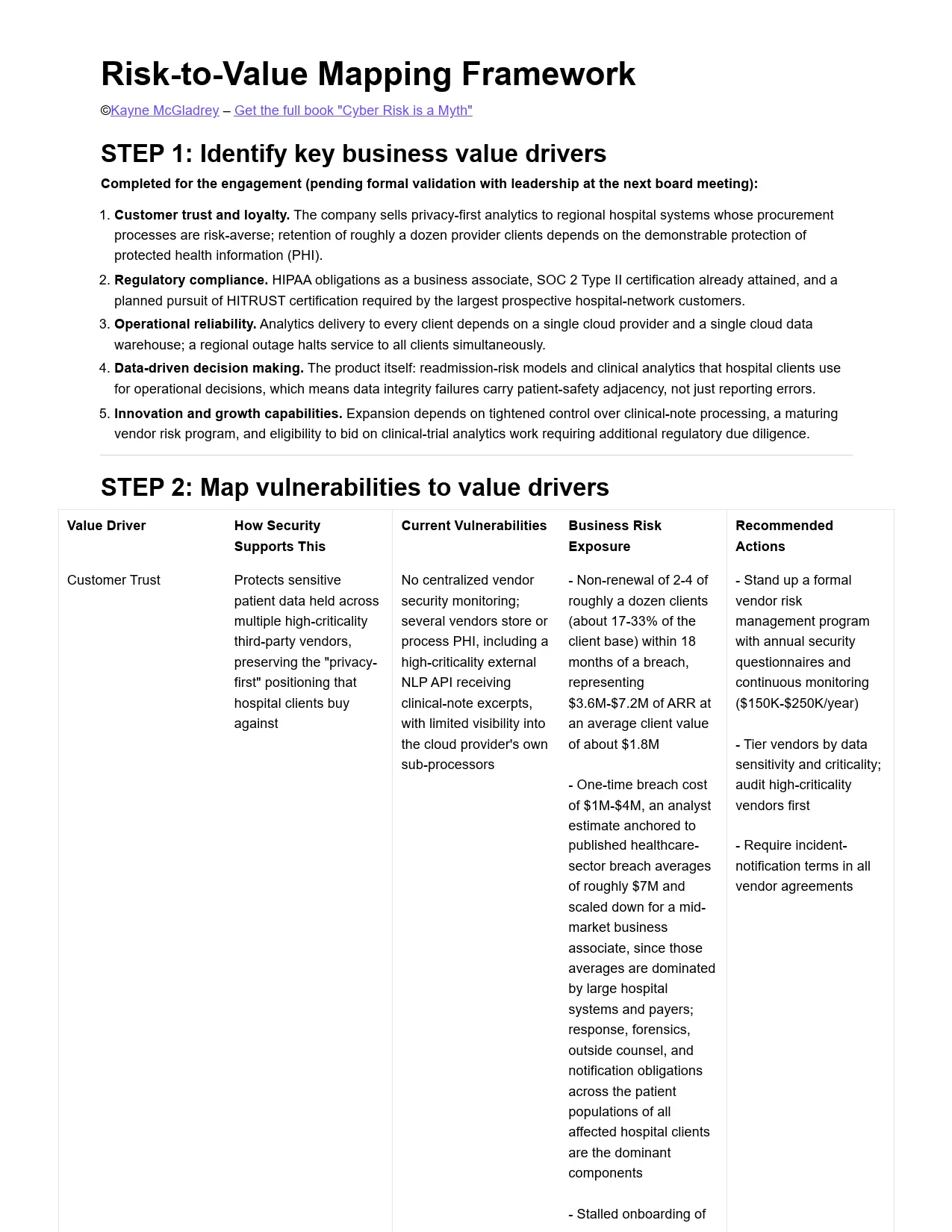
STEP 2: Map vulnerabilities to value drivers
| Value Driver | How Security Supports This | Current Vulnerabilities | Business Risk Exposure | Recommended Actions |
|---|---|---|---|---|
| Customer Trust | Protects sensitive patient data held across multiple high-criticality third-party vendors, preserving the “privacy-first” positioning that hospital clients buy against | No centralized vendor security monitoring; several vendors store or process PHI, including a high-criticality external NLP API receiving clinical-note excerpts, with limited visibility into the cloud provider’s own sub-processors | – Non-renewal of 2-4 of roughly a dozen clients (about 17-33% of the client base) within 18 months of a breach, representing $3.6M-$7.2M of ARR at an average client value of about $1.8M – One-time breach cost of $1M-$4M, an analyst estimate anchored to published healthcare-sector breach averages of roughly $7M and scaled down for a mid-market business associate, since those averages are dominated by large hospital systems and payers; response, forensics, outside counsel, and notification obligations across the patient populations of all affected hospital clients are the dominant components – Stalled onboarding of out-of-state health systems that can select competitors already holding HITRUST certification | – Stand up a formal vendor risk management program with annual security questionnaires and continuous monitoring ($150K-$250K/year) – Tier vendors by data sensitivity and criticality; audit high-criticality vendors first – Require incident-notification terms in all vendor agreements |
| Regulatory Compliance | Maintains HIPAA business-associate status, SOC 2 Type II attestation, and the compliance posture needed to pursue HITRUST certification | Lapsed or unrenewed Business Associate Agreements with EHR-vendor partners; contracts not tracked centrally; eight-plus third-party API integrations relying on keys and tokens that are not centrally managed, scoped, or rotated | – OCR civil monetary penalties of $250K-$2M under the four-tier culpability schedule, with per-violation exposure accruing for each month a BAA lapse persists – Unmanaged credentials create a plausible breach vector that would compound notification obligations with a “failure to manage risk” finding – A lapsed BAA discovered during a client audit could trigger termination rights | – Adopt a centralized secrets-management platform for all third-party credentials ($100K-$250K first year, $50K-$100K/year thereafter) – Assign contract lifecycle management to a named owner with quarterly BAA/DPA renewal reviews – Defer HITRUST certification funding decision to next budget cycle; certification is a growth enabler, not a loss-prevention control, and should not displace the credential and vendor programs |
| Operational Reliability | Ensures analytics delivery remains available to all clients concurrently, supporting the revenue stream that funds every other initiative | Heavy dependence on a single cloud provider and a single cloud data warehouse with no tested secondary region or provider | – A 4-8 hour regional outage affecting all clients simultaneously, dropping monthly uptime to roughly 98.9-99.4% and, if standard 10-30% monthly-fee credit tiers apply, creating an illustrative exposure of $180K-$540K on roughly $1.8M in monthly recurring revenue; actual credit terms await confirmation with finance – Recovery and response costs of $50K-$150K per incident – Renewal-confidence erosion among hospital clients ahead of enterprise contract negotiations, which cannot be reliably monetized but weighs materially on deals in flight | – Define and validate actual SLA credit terms with finance, which remain unverified – Stage multi-cloud readiness as a long-term roadmap item rather than a current-year spend – Improve monitoring and tested failover runbooks within the current provider first, at materially lower cost |
| Data-Driven Decision Making | Preserves the integrity and availability of the clinical datasets feeding readmission-risk models and client-facing dashboards | Token sprawl across eight-plus integrations means a single compromised key could expose clinical datasets or silently corrupt pipeline outputs; limited alerting on anomalous data-flow patterns | – A credential-driven PHI breach sharing the same $1M-$4M one-time cost band as a vendor breach, since both routes converge on the same notification, forensic, and enforcement exposure – Silent data-integrity failures in readmission-risk models undermining the analytical conclusions hospital clients act on | – Prioritize credential centralization ahead of all other remediations; it delivers the greatest expected-loss reduction per dollar spent (50-70% reduction of the credential-compromise vector) – Implement automated monitoring on data-pipeline integrity – Rotate and scope all existing keys upon platform adoption |
| Innovation and Growth | Enables the expansion strategy into new health systems, in-house clinical-note processing, and clinical-trial analytics requiring additional vendor due diligence | Dependence on a high-criticality external NLP API for clinical-note summarization extends PHI exposure beyond direct control and constrains the compliance story told to enterprise prospects | – Continued dependence adds a standing breach vector that is difficult to assure in client security reviews – Competitors with HITRUST certification win enterprise deals the company is not yet eligible to bid – Deferred decision: in-house NLP build at $750K-$1.5M over 12-18 months remains unfunded; interim exposure is accepted | – Scope the in-house NLP migration as a mid-term investment with a board decision gate after the vendor risk program matures – Sequence HITRUST pursuit after the credential and vendor programs to avoid spreading an already-constrained security budget across three simultaneous initiatives – Accept residual exposure on the NLP dependency for the current year, documented as a risk-acceptance decision with a scheduled reassessment |
Table 1: Mapping vulnerabilities to value drivers
STEP 3: Prioritize based on value protection
Which vulnerabilities threaten multiple value drivers?
Vendor and sub-processor PHI exposure threatens all five value drivers: it destroys trust, triggers regulatory exposure, disrupts operations during response, corrupts the analytical promise, and stalls growth simultaneously. Credential sprawl threatens four of five, converging on the same breach exposure if a key compromise succeeds. Single-cloud concentration and contract drift each threaten two to three drivers.
Which vulnerabilities threaten your most important value drivers?
Leadership has not yet formally ratified the value drivers, but the company’s mission statement places privacy-first trust and compliance first. Provisionally, and pending board ratification, the vendor PHI exposure and credential sprawl dominate those drivers. Qualitatively, renewal-confidence erosion from a service outage compounds the trust damage of either route, and this factor is carried forward as an unquantified weight in this ranking rather than dropped.
Which mitigations protect the most value for the least resource investment?
Total impact of a breach
Measured on a common 24-month post-breach window, any PHI breach route carries:
- One-time response cost: $1M-$4M
- Lost ARR from client non-renewal: $3.6M-$7.2M
- Total impact: $4.6M-$11.2M
Expected loss by route
Applying three-year breach likelihoods without new controls:
| Entry Route | Likelihood | Expected Loss Pool |
|---|---|---|
| Credential compromise | ~30% | $1.4M-$3.4M |
| Vendor/sub-processor breach | ~40% | $1.8M-$4.5M |
Program comparison (three-year total cost of ownership)
| Program | Three-Year Cost | Loss Removed | Return per Dollar |
|---|---|---|---|
| Secrets-management platform | $200K-$450K (first-year build + recurring operations) | $0.7M-$2.4M (50-70% of the credential pool) | ~1.5x-12x |
| Vendor risk program | $450K-$750K | $0.5M-$2.2M (25-50% of the vendor pool) | ~0.7x-5x |
Note that the two controls address different entry routes to a shared loss pool, so their loss reductions overlap and cannot be summed.
Ranking and caveats
- Secrets-management platform first on value protected per dollar
- Vendor risk program second, yet still essential: it is the only control addressing the exposure that spans all five value drivers
- Returns are an order-of-magnitude indication, not a forecast, and are sensitive to the likelihood and reduction estimates above
- Both programs are already reflected in the company’s short-term roadmap, which the executive team has previously endorsed in principle
Deferred or unfunded: the multi-cloud build and in-house NLP migration are deferred, and HITRUST certification is unfunded pending next budget cycle.
All rankings are provisional pending board ratification of the value drivers.
ADDITIONAL NOTES:
- Value drivers are drafted and awaiting formal validation with business leadership at the next board meeting; all prioritization and rankings in Step 3 are provisional until that ratification and should be revised if leadership ranks revenue growth or certification eligibility above trust and compliance.
- Business impact figures are measured on a 24-month post-breach window and compared against three-year cumulative likelihoods and three-year program costs; the one-time breach-cost band is an analyst estimate anchored to published healthcare-sector averages of roughly $7M and scaled down for a mid-market business associate; service-credit exposure is illustrative, assuming standard 10-30% monthly-fee credit tiers triggered when monthly uptime falls below roughly 99.5%, pending confirmation of actual SLA terms with finance; likelihood, reduction, and churn estimates are analyst judgment and should be replaced with actuals as they become available.
- Update this map quarterly as vendor relationships, contract status, and the growth strategy evolve, with the first refresh due immediately after the board validates the value drivers.