Security Communication Playbook: Making Security Reports That People Actually Read
So many words! Would you rather just watch this on YouTube?
Security professionals have a communication problem they’ve earned because they produce detailed technical reports packed with vulnerability counts, patching rates, and system logs that executives ignore. Budget requests get denied, then everyone acts surprised when a breach happens and nobody approved the controls that would have prevented it. The Security Communication Playbook from Chapter 6 of Cyber Risk is a Myth exists to fix this disconnect. It gives security professionals ready-to-use templates that translate technical data into business language the people holding the budget actually understand.
The Playbook isn’t theory. It’s a working document with five parts: an audience analysis tool, message framing templates for different audiences, an effectiveness checklist, a storytelling framework, and a guide to common communication mistakes. You fill it in and hand it to the right people, then you get decisions instead of blank stares.
Looking for the playbook?
Download it here: Word | Markdown | Proton Docs
And if you like, I write a weekly newsletter where I drop resources like this without advertising.
When Should You Use the Security Communication Playbook?
Pull this Playbook out when you’re preparing any security communication aimed at a business audience. That means board presentations, executive briefings, CFO investment justifications, incident updates, or regular security reporting to leadership. If you’re about to send a technical report full of CVE references to someone with “Chief” in their title, stop and use this instead.
It’s especially useful when you’re asking for money because security budget requests fail most often when they’re framed as technical needs rather than business investments. A CFO doesn’t care that you need a new SIEM platform. They care what it costs, what it saves, and what happens if they say no. The CFO Security Investment Brief template in Part B of the Playbook forces you to answer those questions before you walk into the meeting.
Consider a scenario where a small manufacturer is pursuing aerospace contracts and needs to pass a security audit, or a mid-size company rolling out an ERP system that connects production floors to cloud services for the first time, or a healthcare provider facing new compliance requirements with no documented security program. Each of these situations requires security communication that connects to business outcomes, and each one needs a different template from this Playbook.
Can the Playbook Handle Incident Communication?
The Playbook also works when you’re communicating bad news because security incidents demand clear, calm communication that tells executives what happened, what it means for the business, and what decisions they need to make right now. The incident communication template in Part B handles this without the fear-based rhetoric that makes leaders tune out.
Why Does Security Communication Matter for Budget Decisions?
Back in 2024 when I sat down to write the book, I cited the 2024 Security Budget Benchmark Summary Report from IANS Research and Artico Search. It found sixty-seven percent of CISOs rely on “budget as percentage of IT spend” as their primary budget metric. Fifty-two percent use “budget as percentage of annual revenue.” These are blunt instruments because they tell you nothing about whether security spending is actually reducing business risk or enabling business growth. This also hasn’t changed much in the years since.
When security teams can’t connect their work to business outcomes, they lose. Budgets get cut, security gets positioned as a compliance function instead of a strategic partner, and the people who could have prevented the next breach spend their time explaining why they didn’t have the resources to do so. The Playbook fixes this by doing something simple. It makes you answer the question every executive is actually asking: “What does this mean for our business?” Not “How many vulnerabilities did you patch?” Not “What’s your MFA implementation percentage?” Those are activity metrics. Executives don’t care about activities. They care about revenue protection, cost avoidance, competitive advantage, and operational resilience.
The templates in this Playbook help facilitate that translation. When you fill out the Executive Briefing template, you can’t just list technical achievements. You have to tie each one to a business outcome with a dollar figure attached. When you complete the CFO Investment Brief, you have to show ROI, compare alternatives, and present a “do nothing” scenario with quantified risk. When you refer to the Storytelling Framework, you see how to build a narrative that starts with business context and ends with a specific decision.
This approach works because it speaks the language of the people making decisions. A CFO understands ROI calculations. A CEO understands revenue at risk. A board member understands governance gaps. The Playbook gives you the structure to deliver security information in those terms without dumbing it down or hiding the technical details in an appendix where nobody reads them.
A Look at the Completed Example
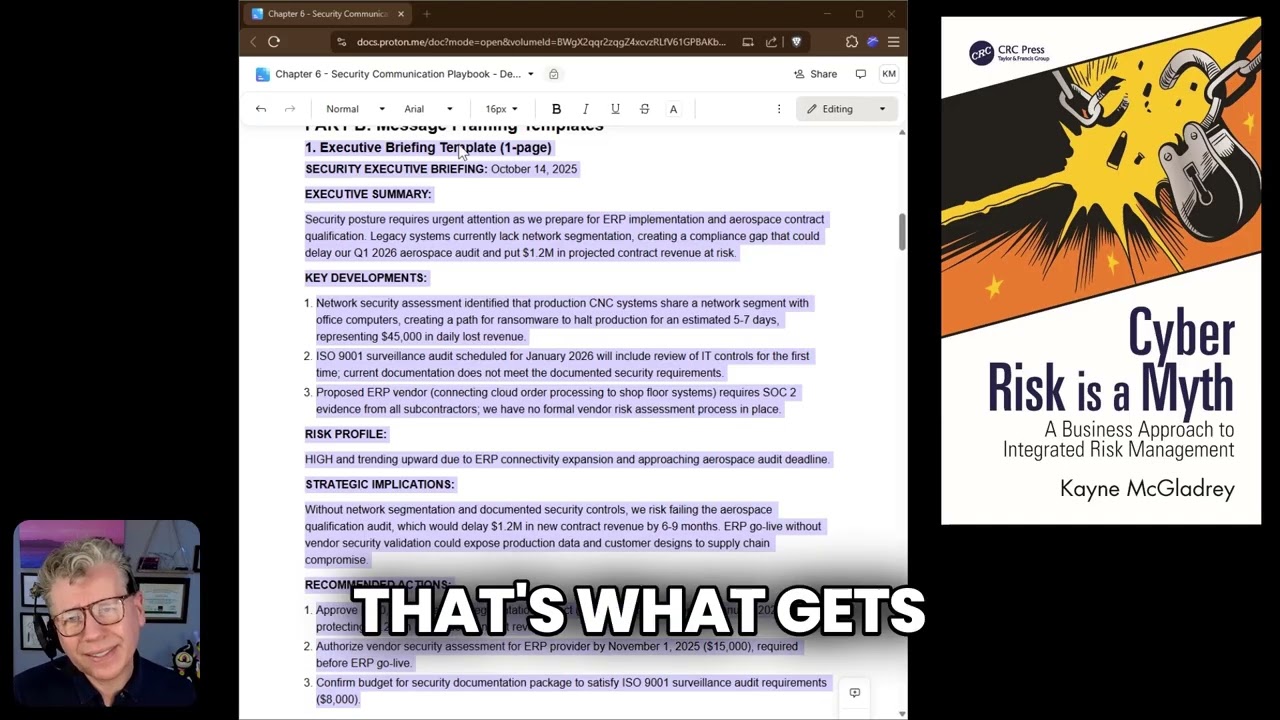
If you don’t have the Playbook yet, get a copy here: Word | Markdown | Proton Docs
To see how this works in practice, imagine a fictional company called Precision Components, LLC. They’re a small CNC machining shop in Plano, Texas with forty-two employees and eight and a half million in annual revenue. They’re pursuing aerospace contracts worth one point two million dollars, implementing an ERP system, and preparing for an ISO 9001 surveillance audit that will review IT controls for the first time.
Their security professional fills out the Executive Briefing template from Part B of the Playbook. Here’s what that looks like:
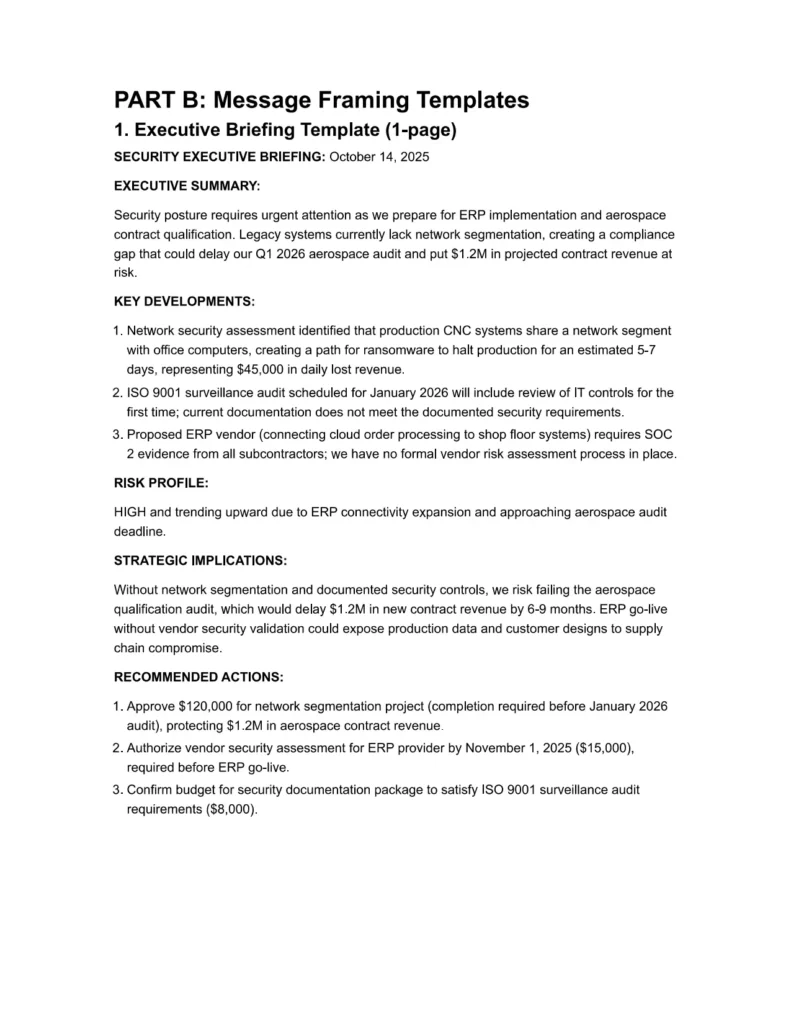
Notice what’s not in that briefing. No VLAN references. No firewall rule counts. No SIEM dashboards. Just contracts, revenue, deadlines, and dollar amounts. That’s what gets a CEO to look up from their phone.
For the CFO, the same security professional fills out the Investment Brief template. This is where the numbers do the talking:
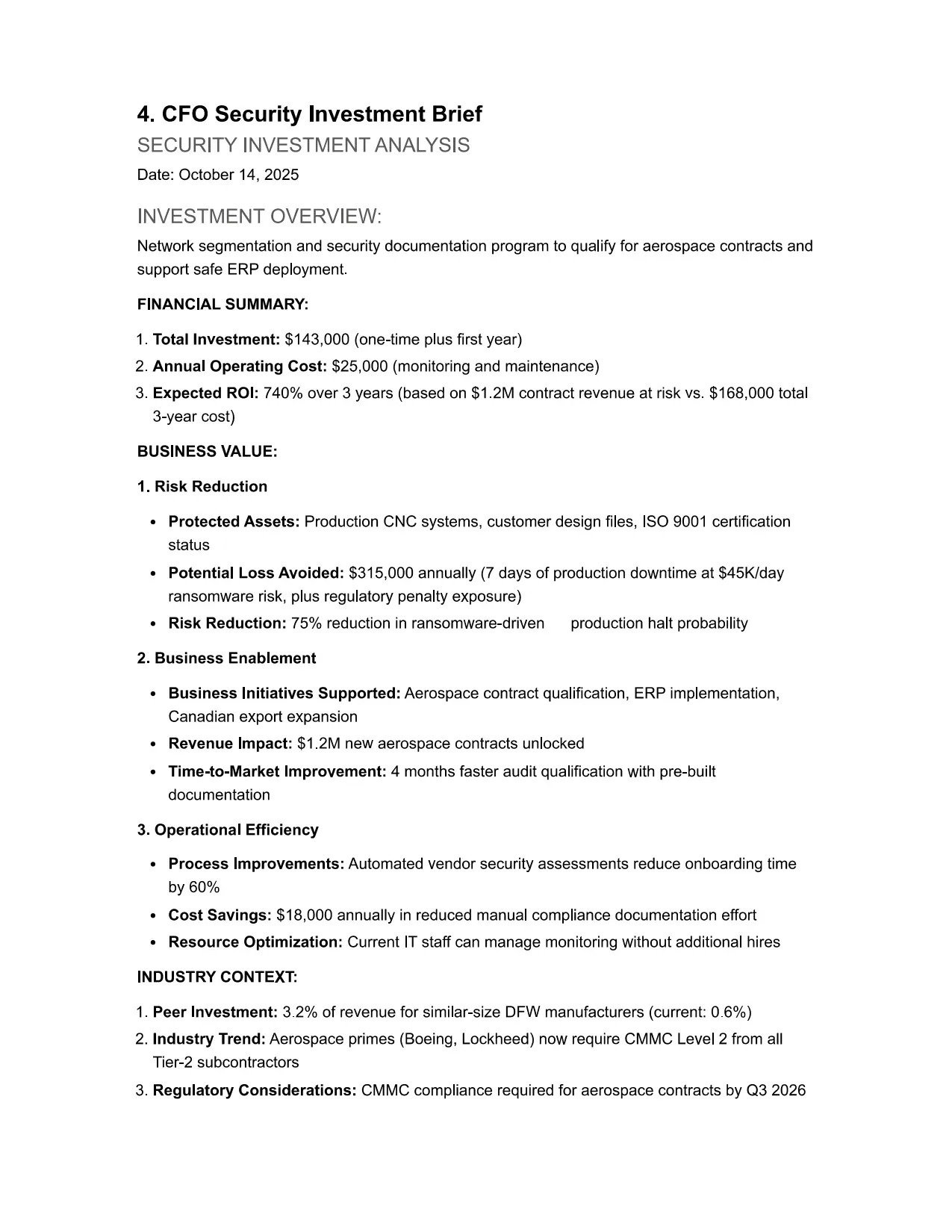
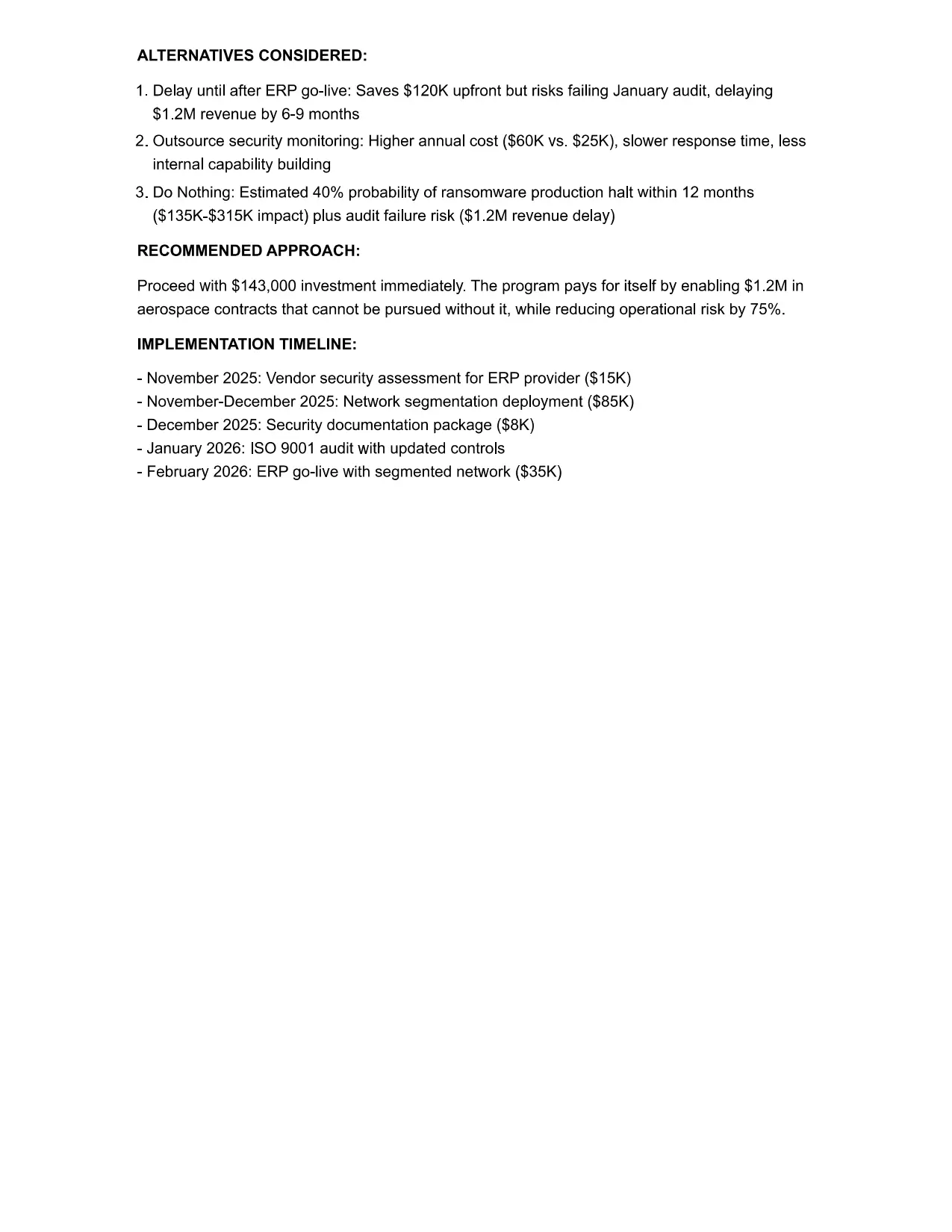
Seven hundred forty percent ROI. Three alternatives with honest tradeoffs. A “do nothing” scenario that shows what inaction actually costs. That’s how you get budget approved without begging for it.
Frequently Asked Questions
Who should use the Security Communication Playbook?
Any security professional who needs to communicate with business audiences should use this Playbook. That includes CISOs, security managers, IT directors, and consultants preparing reports for client leadership. If you’ve ever watched an executive’s eyes glaze over during a security presentation, this tool is for you.
Do I need to customize the templates for each audience?
Yes, because the whole point is that one-size-fits-all reporting doesn’t work. The Playbook’s “audience analysis” tool helps you map who you’re talking to, what they care about, and what decisions they can make. You then select the matching template from Part B and tailor the content to that specific person’s concerns.
What if I don’t have hard financial numbers for my security metrics?
Start with estimates, because the Playbook’s approach works even with rough calculations. The structure itself demonstrates business thinking. Industry benchmarks, peer data, and reasonable assumptions based on known costs all provide better context than raw technical metrics with no business framing at all. Precision Components in the example uses industry averages and internal cost data to build its case.
How is this different from a generic security report template?
Generic templates give you a format, but the Playbook gives you a method. It forces you through audience analysis before you write and requires business impact quantification in every section. It also includes a quality control checklist to catch common mistakes. You’re not just filling in blanks; you’re changing how you think about what security information means to the person reading it.
Can the Playbook handle incident communication or just regular reporting?
Both. Part B includes a dedicated Security Incident Communication Template that covers incident summary, business impact, response status, decisions needed, and communication plans. It’s designed for active incidents where executives need clear, calm information and specific decision points, not fear-driven alerts.
What’s the most common mistake the Playbook helps avoid?
Technical overload, because security professionals tend to lead with technical details since that’s what they know best. The Playbook’s Part E shows before-and-after examples of messages transformed from jargon-heavy to business-focused. The pattern is always the same: lead with business impact, provide technical details only as supporting evidence, and end with a clear ask.
Does this work for small companies or just large enterprises?
It works for any size, and the Precision Components example proves it by using a forty-two-person manufacturer. The templates scale because the communication principles don’t change with company size. A CFO at a ten-person startup cares about ROI just as much as a CFO at a Fortune 500. The numbers change, but the approach stays the same.
Attribution
This resource and the accompanying training are derived from the work of Kayne McGladrey, author of Cyber Risk is a Myth (published 2026). The book is available at wherever you buy books and also from your local library. The fictional company scenarios used in the examples are for illustrative purposes only and do not represent real organizations.