Opportunity Cost Analysis: The Security Tool Your CFO Actually Wants to See
So many words, wouldn’t you rather just watch this?
Every security leader knows the feeling. You build a thoughtful proposal for controls you genuinely need, walk into the budget meeting, and watch the CFO’s eyes glaze over the moment you say “ransomware.” The problem isn’t your proposal; it’s that you’re speaking security when the room speaks dollars.
The Opportunity Cost Analysis exercise from Chapter 5 of Cyber Risk is a Myth fixes this translation gap. It forces you to evaluate your security spend against every competing use of the same money, including the option of doing nothing. It produces a single document that answers the biggest cybersecurity question executives care about: is this the best place to put our capital right now?
Looking for the template?
Templates are neat. This one’s available in Word | Markdown | Proton Docs
And if you like neat things, maybe subscribe to my newsletter, where you’ll find more resources like this? Yes, you have to hand over your email address, and in turn you’ll get a different cat photo weekly in addition to the templates. No, not kidding about the cats, either.
How Do You Know When to Use This Framework?
Pull this framework out when you’re preparing for a budget cycle and you know your request will compete against revenue-generating projects. If your CFO has ever asked “what’s the ROI on security?” and you didn’t have a number ready, that’s your trigger signal. This isn’t a tool for day-to-day ticket triage or vendor selection; it’s a pre-budget weapon designed for high-stakes conversations that happen annually.
Specifically, use it in these four situations:
- Your organization is expanding with new systems, people, or locations that increase cyber exposure
- Leadership needs to understand how unfunded security creates drag on their own growth initiatives
- Your company pursues contracts with compliance requirements like CMMC, HIPAA, or GDPR
- Previous fear-based pitches involving breach statistics and industry horror stories didn’t work (pro tip: and they never will)
Consider pulling this out whenever you think your own proposal might not survive scrutiny. Maybe you’re asking for a tool because a vendor gave a compelling demo rather than calculating actual risk reduction. Running this analysis on your own idea before submitting it forces intellectual honesty. If the numbers don’t hold up, revise the scope before someone else does it for you.
Why Does This Framework Beat Traditional Security Pitches?
Most security budgets fail not because the controls are wrong but because there wasn’t a business case. Security professionals tend to think in terms of risk reduction, threat vectors, and control coverage, while executives think in terms of return, payback period, and opportunity cost. These aren’t the same language, and hoping the translator shows up isn’t a strategy.
The Opportunity Cost Analysis bridges this gap by using financial models that executives already trust. Three tools do the heavy lifting here:
- Annualized Loss Expectancy (ALE) gives you a dollar figure for expected annual loss
- Risk Reduction ROI lets you compare your security spend against the return from a new sales hire or a production machine
- Side-by-side comparison tables give decision-makers the format they’re already comfortable with
Here’s what changes when you use this tool. Instead of “we need $96,000 for security,” your proposal becomes “we can spend $96,000 to reduce annual loss exposure by $170,000, or we can spend $180,000 on a CNC machine that generates $500,000 but perpetuates a $240,000 annual risk.” That’s a conversation an executive can engage with, and it’s an unemotional, maths-based decision.
Security isn’t a cost center; it’s an investment that protects revenue, enables growth, and preserves market access. But those claims ring hollow unless you can back them with numbers. The Opportunity Cost Analysis is how you back them.
What Does a Completed Example Look Like?
This one’s going to be kind of abstract unless you’ve downloaded the template, which is available as Word | Markdown | Proton Docs
To see how this works, consider a fictional company called Precision Components, LLC. Forty-two employees, $8.5 million in annual revenue, CNC machining shop in Plano, Texas. They’re pursuing aerospace contracts, exploring Canadian exports, and planning an ERP rollout. Here’s what the completed Opportunity Cost Analysis looks like for their scenario.
Step 1 captures the proposed security investment. Every dollar, every hour, every disruption gets named.
Direct Costs:
-
- Managed Detection and Response (MDR) subscription: $48,000/year ($4,000/month)
- Network segmentation hardware and installation: $25,000 one-time
- Endpoint protection platform upgrade: $12,000/year
- Security awareness training (annual): $3,500
- External security assessment: $8,000 one-time
- Year 1 total: $96,500; Annual recurring: $63,500
Resources Required:
-
- IT Manager time: ~40 hours over 6 weeks for implementation coordination
- Production floor supervisors: 2 hours each for training sessions (5 supervisors = 10 hours)
- Management attention: Monthly 30-minute security review meetings
- Technical infrastructure: 1 weekend production pause (approximately 8 hours) for network cutover
Business Impacts During Implementation:
-
- One planned 8-hour production pause for network segmentation cutover (Saturday, low-impact window)
- 30 minutes of production floor downtime per employee for awareness training (42 employees = 21 labor hours)
- Potential minor latency during endpoint agent rollout (non-disruptive, staged by workstation group)
Step 2 documents the alternatives. This is where honesty matters. What else could that money buy?
Alternative 1: Sixth CNC Machine
-
- Expected financial return: Estimated $400,000-$600,000 incremental annual revenue based on current aerospace demand and existing 85% utilization of 5-machine fleet
- Cost: Approximately $180,000 (machine, installation, tooling)
- Strategic objectives supported: Short-term growth goal of investing in a sixth CNC machine to increase capacity for aerospace contracts
- Risks created or perpetuated: Continued operation without network segmentation increases blast radius of any intrusion; unprotected CNC controllers could be bricked by ransomware; growing attack surface with each new networked device
Alternative 2: Two Additional Sales Engineers
-
- Expected financial return: Estimated $300,000-$500,000 in new and retained client revenue based on deeper account penetration
- Cost: Approximately $220,000/year (salary, benefits, ramp-up time)
- Strategic objectives supported: Short-term goal of deepening relationships with existing clients
- Risks created or perpetuated: No change to security posture; new hires onboarded without security awareness baseline; no formal access control governance for expanded team
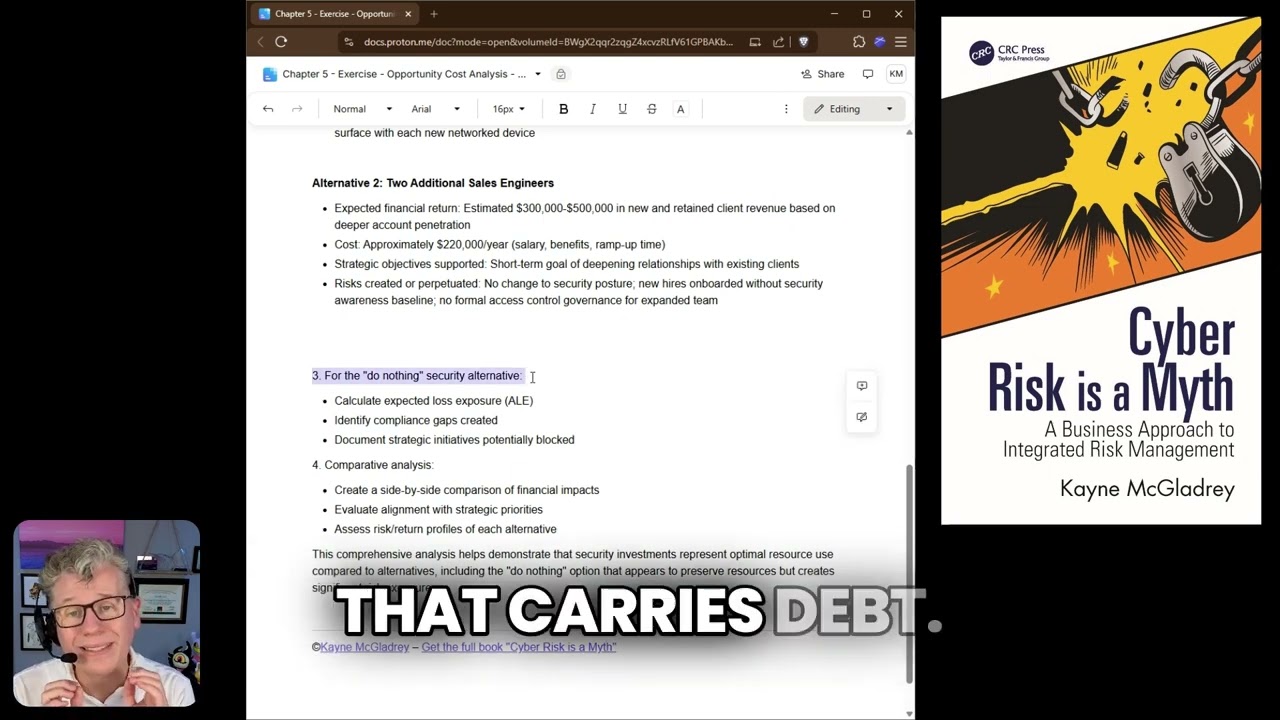
Step 3 is the section most proposals skip entirely. The “do nothing” path has a price tag, and it’s usually higher than people think.
Expected Loss Exposure (ALE Calculations):
Risk Scenario 1: Ransomware affecting production floor
-
- Single Loss Expectancy (SLE): $1,200,000 (estimated 10-day production halt: 42 employees, average loaded labor cost of $55/hr x 8 hrs x 10 days = $184,800; lost revenue from delayed orders: $850,000; emergency IT response and remediation: $165,200)
- Annual Rate of Occurrence (ARO): 0.15 (15% annual probability based on increasing ransomware targeting of small manufacturers)
- ALE: $180,000
Risk Scenario 2: Data breach of customer IP and design files
-
- SLE: $750,000 (notification and credit monitoring for aerospace and automotive clients: $120,000; legal fees: $200,000; lost contracts due to broken trust: $350,000; regulatory fines: $80,000)
- ARO: 0.08 (8% annual probability, reflecting relatively small data footprint but high-value IP)
- ALE: $60,000
Combined ALE: $240,000/year
Compliance Gaps Created:
-
- CMMC Level 1 requirements not met: Blocks eligibility for Department of Defense subcontracting through prime contractors. At least 2 existing aerospace clients have signaled upcoming CMMC flow-down requirements.
- PIPEDA (Personal Information Protection and Electronic Documents Act): Unaddressed for planned Canadian export expansion. Lack of documented data protection controls creates legal exposure for cross-border data handling.
- ISO 9001 surveillance audit risk: Information security controls are increasingly examined during quality management audits; gaps could result in findings that jeopardize certification maintenance.
Strategic Initiatives Potentially Blocked:
-
- Aerospace contract expansion: Prime contractors increasingly require demonstrated cybersecurity controls (CMMC, NIST SP 800-171). Without investment, Precision Components cannot bid on or retain these contracts.
- Canadian export launch: PIPEDA compliance gaps delay or block market entry.
- ERP implementation: Deploying ERP software without foundational security controls (segmentation, access management, endpoint protection) creates systemic risk across all business processes the ERP touches.
Step 4 produces the comparison table. This is the page you hand to your CFO.
| Dimension | Proposed Security Investment ($96,500 Y1) | Alt 1: 6th CNC Machine ($180K) | Alt 2: 2 Sales Engineers ($220K/yr) | “Do Nothing” ($0) |
|---|---|---|---|---|
| Year 1 Financial Impact | -$96,500 net cost; reduces ALE by ~$170,000 | -$180,000 capex; +$400-600K potential revenue | -$220,000 opex; +$300-500K potential revenue | $0 on paper; $240,000 ALE hidden cost |
| Strategic Alignment | Enables aerospace contracts (CMMC), Canadian export (PIPEDA), safe ERP deployment | Supports aerospace capacity goal only | Supports client relationship goal only | Blocks aerospace, export, and ERP initiatives worth approximately $1m |
| Compliance Status | Progresses toward CMMC L1 and PIPEDA readiness | No compliance impact | No compliance impact | Creates CMMC, PIPEDA, and ISO 9001 gaps |
| Risk Profile | Reduces ransomware ALE from $180K to ~$54K; reduces breach ALE from $60K to ~$18K | Perpetuates growing attack surface; CNC controllers unprotected | Adds unmanaged access points; no security baseline | Full exposure maintained; ALE grows with each new system |
| Payback Period | ~6.8 months (based on $170K annual risk reduction vs. $96.5K Y1 cost) | ~4-5 months (revenue-based, ignoring security risk) | ~5-7 months (revenue-based, ignoring security risk) | N/A (no investment made) |
| Long-term Value | Sustains growth by maintaining compliance and protecting operational continuity | Limited; revenue growth constrained by compliance gaps blocking contracts | Limited; client growth constrained if security incidents erode trust | Negative; compounding risk exposure and shrinking addressable market |
The “do nothing” row tells the real story. Zero dollars spent on paper, but $240,000 in annual expected losses, blocked aerospace contracts, stalled Canadian export plans, and an ERP deployment that introduces systemic risk instead of solving operational headaches. That’s not saving money – that’s borrowing against the future at a terrible interest rate.
Frequently Asked Questions
How is opportunity cost different from regular cost-benefit analysis?
Cost-benefit analysis looks at whether a single investment pays for itself. Opportunity cost analysis compares that investment against every other way you could spend the same money, including not spending it at all. It forces you to admit that every yes is also a no to something else. The value isn’t just in justifying security spend; it’s in making trade-offs visible so leaders can make informed choices.
What if I don’t have enough data to calculate ALE?
Start with estimates. Industry breach cost reports from IBM, Verizon, and others provide baseline numbers for SLE, while your insurance broker can share claim data for similar organizations. For ARO, use qualitative ranges if you can’t get precise probabilities. A 10% to 15% annual chance of ransomware incident for a small manufacturer isn’t a wild guess; it’s a defensible estimate based on industry trends. Perfect data isn’t required because directional accuracy beats gut feelings every time.
Should I include compliance costs in the “do nothing” calculation?
Absolutely. Compliance gaps are quantifiable, so treat them like that. If you can’t bid on a $2 million aerospace contract because you lack CMMC certification, that’s a real number worth tracking. If your ISO 9001 surveillance audit produces a finding that puts your certification at risk, the cost of recertification and lost customer confidence is calculable too. Don’t let these costs stay invisible because that’s where the “do nothing” option hides its biggest bills.
How long should this analysis take to complete?
A first pass should take two to four hours if you have access to financial data and a risk register. Vendor quotes cover security investment costs, while budget committee priorities reveal alternative uses. ALE calculations require research but shouldn’t exceed an hour for two or three scenarios. Formatting the comparison table takes the least effort of all. Don’t overthink it; a good-enough analysis submitted on time beats a perfect analysis submitted after the budget deadline.
What if my CFO still rejects the proposal after seeing this analysis?
That’s actually a win. If the CFO sees the numbers, understands trade-offs, and chooses a different path anyway, you’ve done your job. You made the risk visible and documented the decision properly. If the organization experiences a loss event later, the analysis exists as a record that leadership knew the risk, quantified it, and accepted it. Your job isn’t to win every budget battle; it’s to make sure every decision is an informed one.
Can I use this framework for ongoing security spend, not just new investments?
Yes. Run it during annual budget reviews for recurring costs like MDR subscriptions or security awareness training. Alternatives and “do nothing” calculations change over time as your organization grows and the threats your organization faces change. A $48,000 MDR subscription that made sense last year might need rejustification if revenue doubled or compliance obligations expanded. Treat this as a living document rather than a one-time exercise.
Does this work for non-manufacturing companies?
The framework is industry-agnostic; I just have a special place in my heart for manufacturing companies. A professional services firm replaces “production floor downtime” with “billable hours lost,” while a healthcare provider swaps “delayed orders” for “patient care disruption.” The math and logic stay identical across industries. What changes are the specific cost categories and compliance regimes you plug into the template.
Attribution
This resource and the accompanying training are derived from the work of Kayne McGladrey, author of “Cyber Risk is a Myth” (published 2026). The fictional company scenarios used throughout these examples are for illustrative purposes only and don’t represent real organizations. The full book is available from Routledge and other fine book stores.